


Choosing the Right Partner: What Top-Tier Companies That Install Solar Panels Actually Deliver
You've decided to go solar. The motivation is clear: energy independence, reducing your carbon footprint, and significant long-term savings on electricity bills. Your next step is to search for "companies that install solar panels." But here's the reality—that search will return a vast array of options, from local electricians to national franchises. The critical question isn't just about installation; it's about which company provides a holistic, intelligent energy solution that will perform optimally for the next 25+ years. The difference between a basic installer and a true energy partner is profound, impacting your system's efficiency, reliability, and ultimate return on investment.
The Solar Surge: More Than Just Panels on a Roof
Across Europe and the United States, the shift to solar is accelerating. It's no longer a niche trend but a mainstream energy strategy for homeowners and businesses alike. This surge is driven by volatile fossil fuel prices, supportive government policies, and remarkable advancements in photovoltaic (PV) technology. However, this growth has also led to a crowded marketplace. Many companies that install solar panels focus primarily on the quick sale and physical mounting of hardware. But the true value—and the sophistication needed for modern energy needs—lies in a company's ability to design, integrate, and manage a complete energy ecosystem. This is where the industry is heading: from simple solar providers to comprehensive energy solution experts.
The Data Behind a Smart Solar Investment
Let's talk numbers. According to the International Energy Agency (IEA), renewable capacity additions soared by almost 50% in 2023, with solar PV accounting for three-quarters of this growth. In the U.S., the Solar Energy Industries Association (SEIA) reports that the solar market is expected to quadruple in size by 2030. But raw installation capacity only tells part of the story. The real performance data comes from system yield and self-consumption rates. A well-designed system in Southern Europe might produce 1,500 kWh per kWp installed per year. Yet, without a strategy to use that power when the sun isn't shining, a typical household might only directly consume 30-40% of its solar generation, exporting the rest to the grid at lower rates. This is the critical gap that separates basic installers from advanced system providers.

Image Source: Unsplash. A modern solar installation requires precise design and monitoring, not just mounting.
Case Study: A German Mittelstand Company's Success Story
Consider the real-world example of a mid-sized manufacturing company (Mittelstand) in Bavaria, Germany. Facing rising energy costs and ambitious corporate sustainability goals, they engaged a premium energy solutions provider—not just a solar installer. The project involved a 500 kWp rooftop solar array. However, the core of the solution was a seamlessly integrated 240 kWh battery energy storage system (BESS) and an advanced energy management system (EMS).
| Metric | Result | Impact |
|---|---|---|
| Solar Generation | 525,000 kWh | Covered 65% of total site demand |
| Self-Consumption Rate | Increased from 35% to 92% | Dramatically reduced grid reliance |
| Peak Demand Shaving | Reduced by 40% | Lowered capacity charges and grid fees |
| CO2 Emissions Reduction | Over 300 tonnes annually | Significant progress toward sustainability targets |
The key to this success was the provider's deep expertise in integrating storage and smart controls with solar generation. This holistic approach transformed a capital expense into a strategic asset that manages energy flow in real-time, capitalizes on time-of-use tariffs, and provides backup power. This is the benchmark for what leading companies that install solar panels should now offer.
How to Choose the Right Company to Install Your Solar Panels
So, how do you identify a partner that delivers this level of sophistication? Look beyond the per-watt price quote. Evaluate them on these three pillars:
1. Technical Expertise & System Design
A top-tier company doesn't start with a standard package. They begin with a detailed energy audit. They analyze your historical consumption patterns (often using smart meter data), roof orientation, shading, and, crucially, your future energy goals. Do you plan to buy an EV? Expand your facility? Their design software should simulate not just production, but consumption, storage, and economic outcomes over the system's lifetime. Ask them: "How will you optimize my system for maximum self-consumption and resilience, not just maximum production?"
2. Quality of Technology & Components
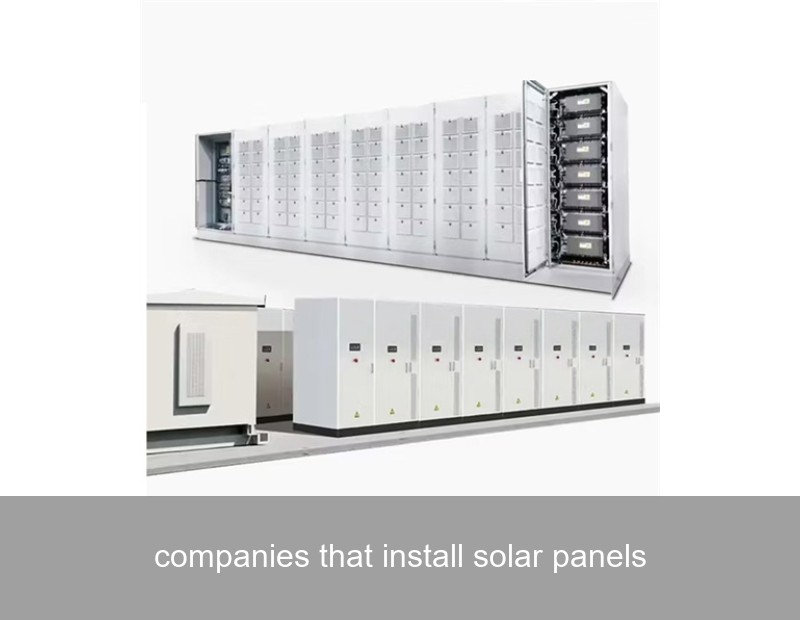
The solar panels themselves are important, but the "brains" and "muscle" of the system are equally critical. This includes the inverters, the battery storage, and the energy management software. This is where a provider like Highjoule distinguishes itself. As a global leader in advanced energy storage since 2005, Highjoule doesn't just source components; it engineers fully integrated, intelligent systems. For instance, Highjoule's IntelliBESS battery storage systems are specifically designed to pair seamlessly with solar PV, featuring high-cycle life, safe lithium iron phosphate (LFP) chemistry, and sophisticated software that learns and adapts to your usage. Partnering with companies that install solar panels who utilize such tier-1, purpose-built storage technology future-proofs your investment.

Image Source: Unsplash. A professional battery storage system, like Highjoule's IntelliBESS, is the cornerstone of a modern solar-plus-storage setup.
3. Comprehensive Service & Smart Energy Management
Installation is day one. What happens for the next 25 years? Leading providers offer long-term performance monitoring, proactive maintenance, and software updates. They provide you with a user-friendly portal or app to track your energy flows in real-time. Highjoule's EnergyOS platform, for example, gives commercial and residential clients full visibility and control. It can automatically decide when to store solar energy, when to use it, when to sell to the grid, and when to draw from it, based on weather forecasts and tariff schedules. When evaluating companies that install solar panels, ask about their ongoing service and the intelligence of their monitoring platform. Are they setting you up with a static system or a dynamic, learning energy asset?
The Future is Integrated: Beyond Simple Solar Installation
The energy landscape is evolving from a one-way grid to a decentralized, interactive network. Your solar installation is a key node in this network. The most forward-thinking companies that install solar panels are already planning for this with solutions that enable participation in virtual power plants (VPPs), grid services, and peer-to-peer energy trading. By choosing a partner with expertise in integrated systems—like Highjoule, which provides solutions for commercial, industrial, residential, and microgrid applications—you're not just buying a solar array. You're investing in a scalable, adaptable energy infrastructure that can grow and generate value in ways we are only beginning to explore.
Ready to move beyond a simple quote and start a conversation about a truly intelligent energy system? What is the first question you will ask your next potential solar provider to see if they are a basic installer or a strategic energy partner?
 Inquiry
 Online Chat