


Understanding Complete Home Solar System Cost: A Smart Investment for Energy Independence
You're considering solar power for your home. It's a fantastic decision for your wallet and the planet. But when you start researching, one question looms large: what is the real, total cost of a complete home solar system? It's more than just panels on the roof. The price tag you see often hides key components or future expenses. Let's demystify the investment together, breaking down the costs, the value, and how modern solutions from companies like Highjoule are making solar-plus-storage smarter and more accessible than ever.
Table of Contents
- Breaking Down the Complete Home Solar System Cost
- The Critical (and Often Overlooked) Storage Factor
- Real-World Insight: A Case Study from California
- How Incentives and Financing Change the Equation
- The Highjoule Approach: Integrated Intelligence for Long-Term Value
- Looking Ahead: Is Your Home Ready for This Upgrade?
Breaking Down the Complete Home Solar System Cost
Think of a home solar system as a sophisticated energy ecosystem. The cost isn't a single item but a sum of interconnected parts, each vital for performance and reliability.
- Solar Panels (Photovoltaic Modules): Typically 25-35% of total cost. Efficiency and warranty matter greatly here.
- Inverters: The "brain" that converts DC solar power to usable AC home power. Crucial for efficiency.
- Racking and Mounting: The secure foundation on your roof. Quality ensures longevity against the elements.
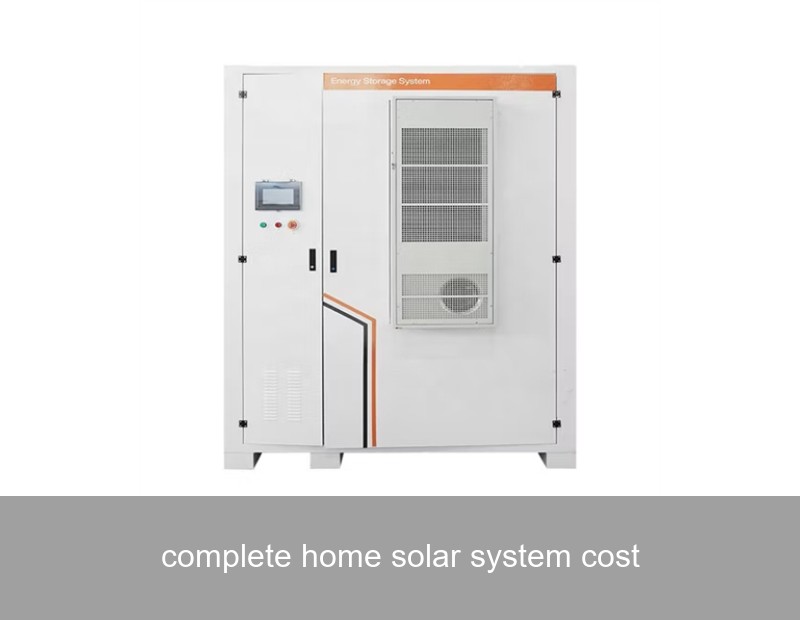
- Energy Storage (Battery System): This is the game-changer. It allows you to use solar power at night and during outages, maximizing self-consumption. It's a significant but increasingly valuable addition.
- Balance of System (BOS): Wiring, switches, monitoring systems, and other electrical components.
- Soft Costs: Permits, inspections, installation labor, and the installer's profit margin. In the U.S. and Europe, these can constitute a substantial portion of the price.
According to the U.S. Department of Energy, a typical residential system can range significantly, but understanding this breakdown helps you compare quotes apples-to-apples.
The Critical (and Often Overlooked) Storage Factor
Here's a key insight: a system without storage is incomplete in today's energy landscape. Why? Without a battery, excess solar energy you produce midday is often sold back to the grid at a low rate, only for you to buy it back at night at a higher price. This dynamic, known as "net metering," is changing in many regions, reducing the financial benefits of solar-only setups.
Adding storage shifts the paradigm. It turns your system from a grid-dependent supplement into a personal power plant. The upfront complete home solar system cost increases, but so does your energy independence and long-term savings, especially in areas with time-of-use rates or unreliable grids.

Image Source: Unsplash. A modern home energy setup integrates generation, storage, and consumption.
Real-World Insight: A Case Study from California
Let's move from theory to data. Consider the Smith family in Southern California (a common profile in our target markets).
- Phenomenon: High electricity rates (~$0.30/kWh), frequent public safety power shutoffs (PSPS), and a desire for sustainability.
- Old System (2020): 8kW solar-only system. Reduced bills but still vulnerable to outages and sold excess power for a low credit.
- Upgrade (2023): Added a 13.5kWh integrated battery storage system to their existing solar.
- Data & Results:
*Slightly longer payback due to battery addition, but value includes guaranteed backup during 10+ annual outage events, priceless for a family with a home office. Data is illustrative based on aggregated, anonymized customer profiles.Metric Before Storage After Storage Grid Import (Night) ~15 kWh/day ~2 kWh/day Self-Consumption of Solar ~40% ~90% Bill Savings ~70% ~95% (plus backup power) Payback Period 7 years Projected 8.5 years*
The case shows that evaluating cost purely on payback period is shortsighted. The value of resilience and total control is a major financial and emotional benefit.
How Incentives and Financing Change the Equation
The sticker price isn't what you'll likely pay. In the U.S., the federal Investment Tax Credit (ITC) currently covers 30% of the total system cost, including storage. Many states and utilities offer additional rebates. In Europe, schemes like VAT reductions on battery storage in Germany or the IEA's listed national incentives dramatically lower the net investment.
Financing options—solar loans, leases, and Power Purchase Agreements (PPAs)—can bring the initial outlay to near zero, turning the complete home solar system cost into a manageable monthly payment that is often less than your previous utility bill.
The Highjoule Approach: Integrated Intelligence for Long-Term Value
This is where Highjoule's expertise transforms the cost-value discussion. Since 2005, we've moved beyond selling components to providing intelligent, integrated energy systems. For homeowners, this means our solutions are designed to optimize every dollar of your investment over 25+ years.
Our Residential Energy Hub combines high-efficiency modules with our proprietary Hybrid Inverter and scalable Li-Ion battery units. The magic is in the software: our AI-driven energy management system constantly learns your usage patterns, weather forecasts, and utility rate schedules. It automatically decides when to store solar energy, power your home, or sell back to the grid for maximum profit.

Image Source: Unsplash. Modern battery storage systems are compact, safe, and intelligent.
By integrating all components from a single provider like Highjoule, you avoid compatibility issues, benefit from a unified warranty, and get a system where the whole is greater than the sum of its parts. This holistic design often results in a lower lifetime cost and higher performance than a pieced-together system, making the initial complete home solar system cost a wiser, more durable investment.
Looking Ahead: Is Your Home Ready for This Upgrade?
The conversation is shifting from "How much do solar panels cost?" to "What is the value of total energy independence?" The complete home solar system cost is an investment in predictable energy bills, increased home resilience, and a direct contribution to a sustainable grid. With evolving technology and supportive policies, the financial and practical case grows stronger every year.
So, we leave you with this question: When you evaluate your next energy bill, what true cost are you paying for dependence—and what could you control instead? The journey to finding your answer starts with a conversation with a trusted expert who can provide a transparent, customized analysis for your home and goals.
 Inquiry
 Online Chat