


How Much Lithium is Powering Our Clean Energy Future?
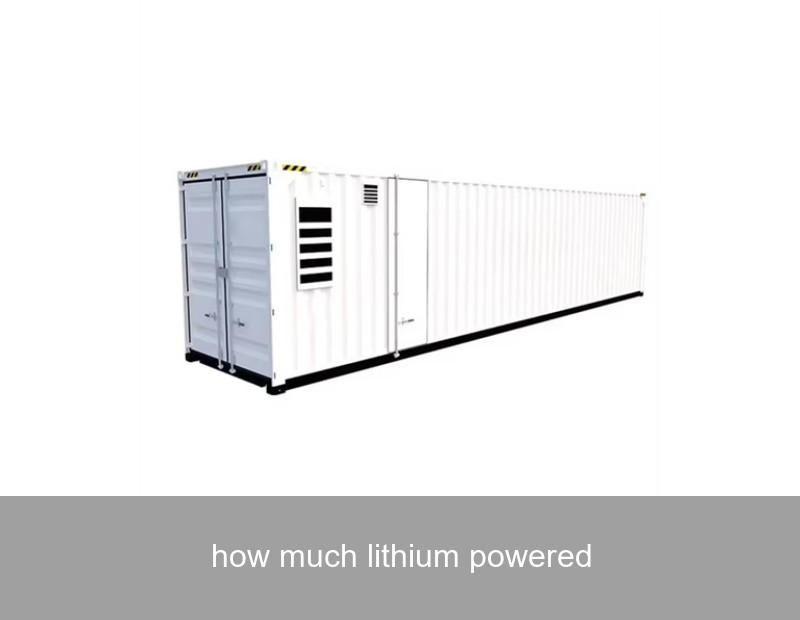
As you charge your phone, drive an electric vehicle, or watch solar panels on a neighbor's roof, you're witnessing the lithium-ion revolution. But have you ever stopped to wonder, how much lithium powered that moment? The transition to renewable energy and electric transportation is fundamentally a story about energy storage, and at the heart of most modern storage lies lithium. Understanding the scale of this critical resource is key to appreciating the challenges and innovations shaping our sustainable future.
Table of Contents
- The Lithium Phenomenon: More Than Just a Battery
- By the Numbers: Quantifying the Lithium Demand Surge
- Case Study: Powering a Bavarian Industrial Park
- Beyond the Battery: Efficiency is King
- The Highjoule Approach: Maximizing Every Milligram of Lithium
- Building a Resilient and Responsible Energy Future
The Lithium Phenomenon: More Than Just a Battery
Lithium-ion batteries have become synonymous with portable power. Their high energy density, rechargeability, and declining cost curve have made them the undisputed champion for everything from consumer electronics to grid-scale storage. But this creates a compelling phenomenon: our collective clean energy ambitions are now intrinsically tied to the supply chain of a single, albeit abundant, element.
The question isn't just "how much lithium is in a battery?" It's "how much lithium is required to power a home for a night, a factory for an afternoon, or stabilize an entire regional grid?" The answer lies at the intersection of chemistry, engineering, and intelligent software.
By the Numbers: Quantifying the Lithium Demand Surge
Let's look at the data. According to the International Energy Agency (IEA), global demand for lithium soared from approximately 50,000 tonnes in 2020 to around 130,000 tonnes in 2022, driven overwhelmingly by the transport and energy sectors. They project demand could reach over 500,000 tonnes by 2030 in their stated policies scenario. To put that in perspective, a typical electric vehicle (EV) battery pack might contain 8 to 12 kilograms of lithium. A commercial-scale battery energy storage system (BESS) for a factory can contain many times that amount.
| Application | Typical Lithium Content (Approx.) | Primary Function |
|---|---|---|
| Electric Vehicle (70 kWh pack) | 8-12 kg | Mobility |
| Residential Storage (10 kWh system) | 1-1.5 kg | Backup, Self-Consumption |
| Commercial & Industrial BESS (1 MWh system) | 100-150 kg | Peak Shaving, Energy Arbitrage |
| Utility-Scale Storage (100 MWh project) | 10-15 tonnes | Grid Frequency, Renewable Integration |
Sources: IEA Global EV Outlook 2023, USGS Mineral Commodity Summaries. Note: Lithium content varies significantly by cathode chemistry (NMC, LFP, etc.).
This data reveals a crucial insight: while EVs grab headlines, the silent workhorse of the energy transition is the stationary battery storage system. These systems are the enablers, allowing intermittent solar and wind power to become reliable, dispatchable energy sources 24/7.
Case Study: Powering a Bavarian Industrial Park with Less Lithium
Let's make this real with a project from southern Germany. A mid-sized automotive component manufacturing plant in Bavaria faced two problems: volatile energy prices and a corporate mandate to reduce its carbon footprint. Their new rooftop solar array produced ample energy at noon, but the factory's peak consumption was in the morning and late afternoon. They needed to shift that solar energy.
The initial proposal was a standard 1 MWh lithium-ion battery system. However, after a detailed audit, Highjoule's energy engineers proposed a smarter solution: a 750 kWh Highjoule H-Ion C&I battery system integrated with our advanced Adaptive Load Manager. How did this reduce the needed capacity? Our AI-driven software didn't just manage the battery; it orchestrated the entire site's energy flow.
- Intelligent Load Shifting: The system identified non-critical loads (like warehouse ventilation and pre-heating) and automatically scheduled them for high solar production periods.
- Predictive Peak Shaving: Using weather and production schedule data, the battery was precisely discharged to shave peak grid demand, avoiding costly capacity charges.
- Thermal Management Synergy: The system even coordinated with the plant's existing thermal storage, using excess electricity for heating when optimal.
The result? The plant achieved its energy independence and cost-saving goals with a 25% smaller battery system than originally specified. This directly translated to using approximately 200-300 kg less lithium for the same operational outcome, while also extending the battery's lifespan through optimized cycling. This is the power of intelligence over sheer size.

Image: Modern industrial facilities are prime candidates for integrated solar and intelligent battery storage solutions. (Photo by American Public Power Association on Unsplash)
Beyond the Battery: Efficiency is King
The Bavarian case highlights a fundamental truth often overlooked in the "how much lithium" discussion: the most sustainable lithium is the lithium you don't need to use. Before adding more raw material, we must maximize the efficiency and utility of every battery cell already in the system. This is where software and system design become as critical as the chemistry itself.
The Highjoule Approach: Maximizing Every Milligram of Lithium
Since 2005, Highjoule has operated on a core principle: intelligent storage unlocks sustainable power. We don't just supply battery racks; we deliver optimized power solutions that extract maximum value from every component, especially the precious lithium inside.
Our product ecosystem is designed for this efficiency:
- H-Ion C&I Series: Our flagship battery systems for commercial and industrial use feature industry-leading round-trip efficiency (over 95%) and are built with modularity in mind. They use advanced lithium iron phosphate (LFP) chemistry where suitable, which, while slightly less energy-dense than some alternatives, offers superior safety, longevity, and reduces reliance on cobalt and nickel.
- Neuron Energy Management Platform: This is the "brain" of the operation. Neuron uses machine learning to predict energy generation and consumption, automating decisions to maximize self-consumption, minimize costs, and ensure battery health. It turns a static battery into a dynamic financial and operational asset.
- GridSync Inverters: High-efficiency, bidirectional inverters that ensure seamless, stable power conversion between DC battery storage, AC building loads, and the grid, with minimal energy loss.
For a hospital needing critical backup, a data center seeking to lower its PUE, or a microgrid in a remote community, Highjoule's solutions are engineered to deliver resilience and ROI while consciously managing the embedded resource footprint.
Building a Resilient and Responsible Energy Future
The path forward isn't just about mining more lithium. It's a multi-faceted strategy:
- Chemistry Diversification: Supporting R&D into alternative chemistries (like sodium-ion) for specific applications.
- Circular Economy: Investing in robust recycling infrastructure to recover lithium and other valuable materials at end-of-life. Highjoule partners with certified recyclers for all our decommissioned systems.
- System Intelligence: As demonstrated, smart software can dramatically reduce the primary storage capacity required for a given task.

Image: The heart of modern storage. Intelligent management systems are crucial to maximize the value and lifespan of each lithium-ion cell. (Photo by Michael Fousert on Unsplash)
Your Energy, Your Questions
So, when you ask "how much lithium powered" your shift to clean energy, the most empowering answer might be: "Less than you think, with the right partner." The conversation is evolving from sheer capacity to smart capacity. What specific energy challenge—be it price volatility, reliability concerns, or a sustainability target—could you address by making the lithium in a storage system work smarter, not just harder?
 Inquiry
 Online Chat