


Understanding the Cost of Solar Panels in Malaysia: A Gateway to Energy Independence
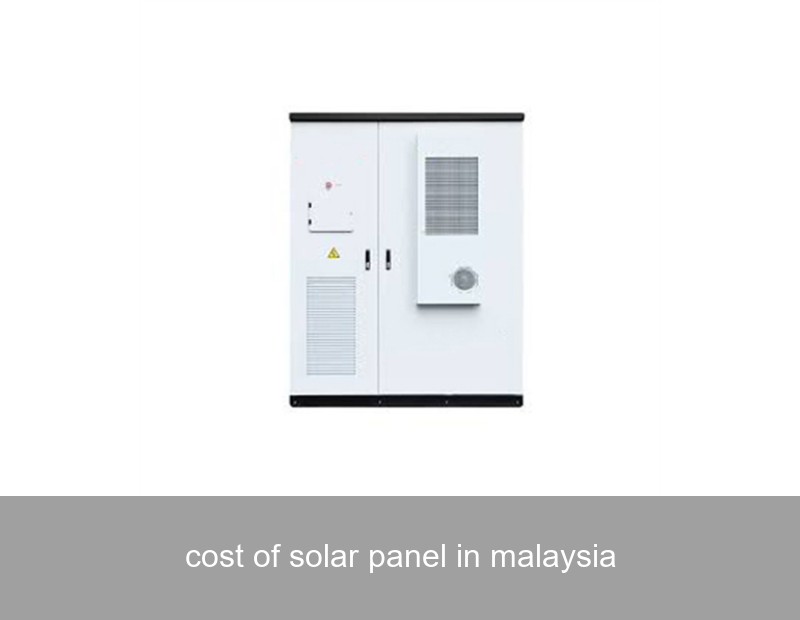
When considering a shift to renewable energy in Southeast Asia, the "cost of solar panels in Malaysia" is often the first and most crucial factor for homeowners and businesses alike. It's a topic that goes beyond a simple price tag, intertwining with government policies, technological advancements, and long-term financial planning. While Malaysia enjoys abundant sunshine, making it an ideal candidate for solar power, the initial investment can seem daunting. But what if we told you that the true cost isn't just about the panels on your roof? It's about the entire ecosystem—including the intelligent battery storage system that unlocks solar power's full potential, day and night. This is where looking at global leaders in energy storage, like Highjoule, provides invaluable insight into maximizing your return on investment, no matter where you are.
Table of Contents
- Breaking Down the Cost: More Than Just Panels
- The Phenomenon & The Data: Malaysia's Solar Surge
- A Real-World Case Study: The Subang Jaya Industrial Story
- The Hidden "Costs": Intermittency and Self-Consumption
- Highjoule's Role: Intelligent Storage as a Cost-Solution
- Your Next Step Towards True Energy Savings
Breaking Down the Cost: More Than Just Panels
The quoted price per watt for solar panels in Malaysia is just the starting point. A realistic budget must account for the complete system:
- Solar Panels (Modules): Typically 25-35% of total cost. Prices vary by efficiency and brand (monocrystalline being premium).
- Inverters: 15-20% of cost. Converts DC solar power to usable AC power. String inverters are common; microinverters are more expensive but offer per-panel optimization.
- Mounting & Racking: 10-15% of cost. The physical structure securing panels to your roof.
- Balance of System (BOS) & Wiring: 10-15% for cables, connectors, and safety devices.
- Installation & Labor: 15-25% of cost. Varies by installer expertise and system complexity.
- Permits & Inspection: A smaller but necessary administrative cost.
Critically, this traditional model misses a key component for modern energy independence: battery energy storage systems (BESS). While adding to the initial outlay, a BESS fundamentally changes the financial equation, a principle we at Highjoule have championed since 2005.
The Phenomenon & The Data: Malaysia's Solar Surge
Driven by initiatives like the Net Energy Metering (NEM) program and the Large Scale Solar (LSS) auctions, Malaysia has seen remarkable growth. According to the International Energy Agency (IEA), Malaysia is on track to significantly increase its renewable capacity, with solar PV leading the charge. The Sustainable Energy Development Authority (SEDA) Malaysia reported that as of 2023, cumulative installed solar PV capacity had reached over 2 GW, with the commercial and industrial sectors being major adopters.
This isn't just a policy story; it's an economic one. The global levelized cost of electricity (LCOE) for solar has plummeted over 80% in the last decade. In Malaysia, this trend, coupled with supportive schemes, has made solar an increasingly compelling alternative to grid electricity, especially during peak tariff hours. However, the real optimization happens when you can store excess energy instead of just selling it back at a lower rate.
A Real-World Case Study: The Subang Jaya Industrial Story
Consider a medium-sized manufacturing facility in Subang Jaya, Selangor. Facing high operational costs and inconsistent grid supply, they installed a 500 kW rooftop solar system in 2021.
- Initial Challenge: High daytime energy consumption, but 40% of solar generation was being exported to the grid under NEM 2.0 at a displaced cost, not realizing full value.
- Solution: In 2022, they integrated a 250 kWh/500 kW containerized battery storage system to their existing solar array. This system was designed to capture excess solar generation and discharge during evening peak periods and brief grid outages.
- Data & Outcome (12-month period post-installation):
Metric Before BESS After BESS Integration Grid Energy Consumption (Peak Hours) 75,000 kWh/month 28,000 kWh/month Solar Self-Consumption Rate 60% 92% Bill Savings from Solar + NEM ~RM 25,000/month ~RM 42,000/month Unplanned Downtime Due to Grid Fluctuations 15 hours/year 0 hours/year
The addition of storage turned a good solar investment into an exceptional one, paying for the battery system's incremental cost in under 4 years through dramatically increased self-consumption and peak shaving. This mirrors the intelligent, application-specific solutions Highjoule provides globally.

Image: A commercial rooftop solar installation. Credit: Unsplash (Representative image)
The Hidden "Costs": Intermittency and Self-Consumption
Here's the core insight: the traditional "cost of solar panels" analysis often ignores the cost of *not* having storage.
- The Intermittency Penalty: Solar doesn't produce at night or during heavy rain. Without storage, you remain 100% reliant on the grid during these periods, missing the chance to maximize independence.
- The Low Buy-Back Rate: Under schemes like NEM, excess energy sold to the grid is credited at the "system marginal price" or a displaced cost, which is often lower than the retail tariff you pay when consuming from the grid. You're essentially buying high and selling low.
- The Peak Demand Charge (for commercial users): For businesses, a significant portion of the electricity bill is based on the highest power draw (kW) in a month. Solar alone may not blunt this peak if it occurs after sunset. Storage can.
Therefore, evaluating solar cost in isolation is like buying a high-performance car but only driving it in first gear. You're not getting the full value.
Highjoule's Role: Intelligent Storage as a Cost-Solution
While Highjoule operates on a global scale, our philosophy is directly applicable to optimizing solar investments in markets like Malaysia. We don't just sell batteries; we provide integrated, smart energy storage systems that transform solar from a supplementary power source into a primary, resilient one.
For a homeowner or business owner in Penang or Kuala Lumpur researching solar, considering a partner like Highjoule means looking at the lifetime value of the system. Our HPS (Highjoule PowerStack) series for commercial and industrial applications and HRS (Highjoule Residential Solution) series are built with this in mind:
- Advanced Battery Management Systems (BMS): Ensures safety, longevity, and maximum cycle life, protecting your investment.
- AI-Driven Energy Management Software: This is the brain. It learns your consumption patterns, weather forecasts, and tariff schedules to automatically decide when to store solar energy, when to discharge, and when to draw from the grid—minimizing costs autonomously.
- Scalable and Modular Design: Start with what you need and expand as your energy needs grow, providing flexibility and protecting against obsolescence.
- Grid Services Readiness: In advanced markets, systems like ours can participate in grid-balancing programs for additional revenue. This forward-thinking design prepares your asset for future energy market mechanisms.
Integrating such a system changes the conversation from "What is the cost of solar panels?" to "What is the value of a 24/7 clean, reliable, and cost-optimized power supply?"

Image: A modern residential energy storage unit. Credit: Unsplash (Representative image)
Frequently Asked Questions on Solar Panel Costs
What is the average payback period for a solar system in Malaysia?
With current NEM schemes, a well-designed solar-only system for a home or business can have a payback period of 6-9 years. Adding storage extends the initial payback but can increase overall savings and resilience, potentially offering a superior lifetime return, especially as electricity tariffs fluctuate.
Are there government incentives for solar batteries in Malaysia?
As of now, direct incentives for standalone storage are limited compared to solar PV. However, the economic case is built on self-consumption optimization and backup power. The global trend, as seen in markets like the US and Germany, is moving towards storage incentives, and forward-looking installations are preparing for this.
How long do solar batteries last, and what is their cost?
Quality lithium-ion batteries, like those used in Highjoule systems, are designed to last 10-15 years or more, with warranties often covering 10 years at 60-70% retained capacity. The cost is typically measured per kWh of storage capacity and has been decreasing steadily. It is a significant addition but one that future-proofs your solar investment against changing tariffs and grid reliability.
Your Next Step Towards True Energy Savings
So, as you delve deeper into the numbers and possibilities for solar power, we leave you with this question: Is your goal merely to reduce your daytime electricity bill, or is it to achieve genuine energy independence and build a resilient, cost-optimized power infrastructure for the next two decades? The answer will define whether you look at the simple cost of panels or the comprehensive value of a solar-plus-storage ecosystem. As you explore installers in Malaysia, ask them how they integrate smart storage to maximize your self-consumption and protect you from grid instability. The future of energy isn't just about generation—it's about intelligent control and storage.
To understand how advanced storage solutions are shaping this future globally, you can explore resources from Energy-Storage.news for industry trends and the Sandia National Laboratories ESS program for technical research.
 Inquiry
 Online Chat