


Understanding the True "Price of Solar" in Sweden: Investment vs. Long-Term Value
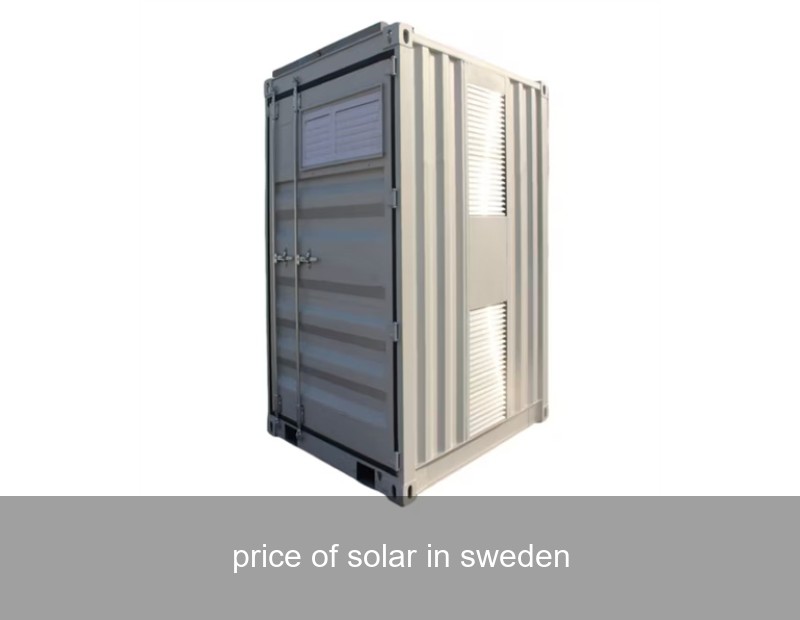
When you hear "price of solar in Sweden," what comes to mind? For many homeowners and business managers, it's that initial quote for panels on the roof. But if we pause there, we're missing the bigger, brighter picture. In Sweden's unique energy landscape—with its dramatic seasonal sunlight variations and a strong push for fossil-free living—the true "price" of solar is better understood as the cost of long-term energy independence and resilience. It's a shift from seeing an expense to evaluating a smart energy investment. While the upfront cost per installed watt is a starting point, the real conversation is about system design, integration with the grid, and crucially, pairing with intelligent storage to maximize every kilowatt-hour your system produces, even during the dark Scandinavian winters.
The Modern Solar Price Breakdown: More Than Just Panels
Let's demystify the components. The total price of a solar photovoltaic (PV) system is no longer dominated solely by panel costs, which have fallen dramatically globally. Today, a holistic quote includes:
- Solar Panels (Modules): The efficiency and brand impact cost. High-efficiency panels perform better in Sweden's lower-light conditions, potentially offering better long-term value.
- Inverters: The brain of your system, converting DC to AC power. Their quality dictates efficiency and system lifespan.
- Mounting System & Hardware: Engineered to withstand Swedish snow loads and weather.
- Installation & Labor: Professional design, permitting, and skilled installation.
- The Critical Enabler: Energy Storage. This is where the equation transforms. A battery storage system, like those offered by Highjoule, captures surplus daytime energy for use at night or during peak price hours, dramatically increasing self-consumption.
According to data from the Swedish Energy Agency, the installed capacity of solar power in Sweden continues to grow rapidly, supported by both private and commercial investments. The focus is shifting from pure capacity to optimized capacity.
The Role of Incentives and Total Cost of Ownership
Thankfully, the Swedish state supports this transition. The investment subsidy for solar electricity (solcellsstöd) can cover up to 20% of the installation cost for private individuals, directly affecting the net price. For businesses, favorable depreciation rules apply. When calculating, you must consider the Total Cost of Ownership (TCO) over 25+ years: initial cost minus subsidies, plus minimal maintenance, minus decades of reduced or eliminated electricity bills. This TCO lens reveals the genuine economic picture.
A Swedish Case Study: From Price Tag to Long-Term Value
Let's move from theory to a real-world example. Consider a medium-sized manufacturing workshop in Västerås. In 2022, they faced rising and volatile electricity prices and wanted to lock in long-term cost certainty and green their operations.
- Challenge: High daytime energy consumption, but solar production peaks midday. Without storage, excess energy would be sold to the grid at a lower price, and they'd still buy expensive power in the early morning and evening.
- Solution: A 100 kW solar PV system was paired with a Highjoule HES-50 commercial battery energy storage system (BESS). The system was designed not just to generate, but to intelligently manage power flow.
- Result: The company increased its self-consumption of solar power from an estimated 40% to over 85%. The battery provides backup power for critical processes during short grid outages. Their calculated payback period, factoring in the investment subsidy, dropped to under 7 years. The "price of solar" became a line item in a broader energy security and cost-optimization strategy.

Image: Solar installations on commercial properties in Scandinavia are becoming a common sight. (Photo by Unsplash, illustrative)
The Hidden Key: How Storage Unlocks Maximum Solar Value
This case highlights the pivotal role of storage. In Sweden, where winter days are short, summer surpluses can be banked more effectively with a high-performance battery. Think of your solar array as a factory producing energy, and the battery as its warehouse and logistics manager. Without it, much of the production can go to waste or be sold at a loss.
Highjoule's approach integrates AI-driven energy management software with our battery systems. Our Adaptive Storage Management (ASM) platform forecasts weather, consumption patterns, and grid electricity prices (in deregulated markets) to decide the optimal time to charge, discharge, or hold energy. This turns a static solar investment into a dynamic financial asset.
Highjoule's Intelligent Solutions for the Swedish Market
At Highjoule, with nearly two decades of global experience, we understand that the price of solar in Sweden is ultimately about the value it delivers. We don't just sell components; we provide integrated, intelligent power solutions.
For the Swedish residential and commercial market, we offer:
| Product Line | Best For | Key Value |
|---|---|---|
| HES Series (Home Energy System) | Detached houses, villas, small businesses | Seamless integration with new or existing solar, user-friendly app, peak shaving, and backup power. |
| CBS Series (Commercial Battery System) | Medium to large businesses, industrial facilities, agriculture | Scalable modular design, advanced grid services capability, significant reduction in demand charges. |
| Microgrid Controller | Remote communities, campuses, critical infrastructure | Can integrate solar, wind, diesel gensets, and multiple storage units for complete energy autonomy. |
Our systems are built with lithium iron phosphate (LFP) battery chemistry, known for its safety, long cycle life, and stable performance in a range of temperatures—a perfect fit for the Swedish climate. By choosing a Highjoule system, you're investing in a platform that maximizes the return on every krona spent on your solar panels.

Image: Integrated home energy systems with storage are key for maximizing solar investment. (Photo by Unsplash, illustrative)
The Future of Solar Prices in Sweden: What to Expect
Looking ahead, the hardware cost of solar modules may continue a gradual decline, but installation and grid-connection costs may stabilize. The real innovation—and value appreciation—will come from smarter software and system integration. As virtual power plants (VPPs) and more dynamic electricity tariffs emerge, a solar-plus-storage system will become an active participant in the energy market, generating additional revenue streams.
Furthermore, as noted by research from the International Energy Agency, the integration of renewables at scale requires flexible storage solutions. This macro-trend ensures that an investment in a coupled system today is future-proof.
Your Energy, Your Decision
So, when you evaluate the price of solar in Sweden, ask yourself and your provider these deeper questions: What is the system's true capability beyond the first sunny day? How will it perform in December? How does the proposed solution integrate with future technologies and market changes? The most competitive price is the one that delivers the highest energy independence and the lowest total cost of ownership over decades.
Is your organization ready to move beyond the simple price-per-watt discussion and explore how intelligent storage can redefine the economics of your solar investment? Contact Highjoule's Nordic energy specialists today for a free, personalized system value assessment.
 Inquiry
 Online Chat