


Understanding the 1MW Deye Energy Storage Cabinet: Powering Large-Scale Energy Independence
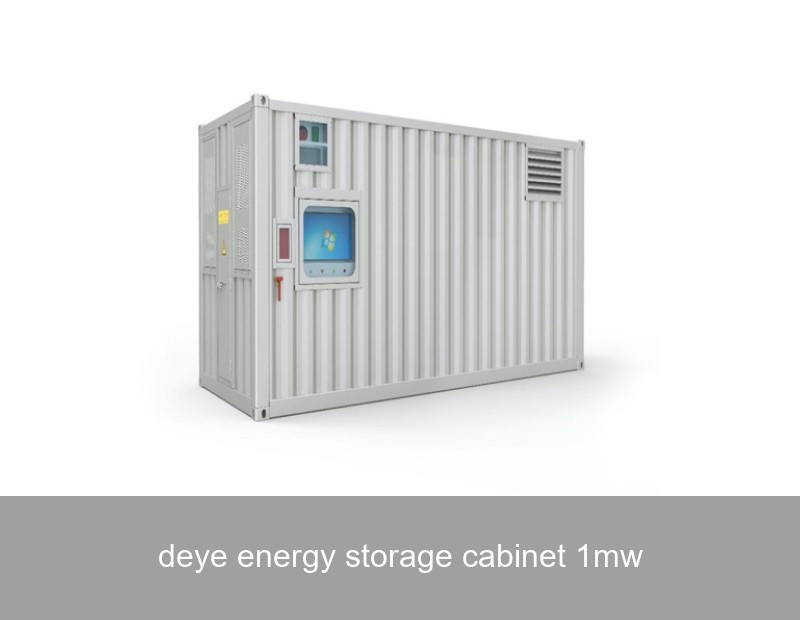
As businesses and communities across Europe and North America strive for energy resilience and cost control, a new class of energy storage is taking center stage. We're moving beyond small-scale batteries to robust, containerized solutions capable of powering factories, commercial campuses, or even small towns. A prime example of this powerful trend is the Deye energy storage cabinet 1MW system. This isn't just a battery; it's a sophisticated, grid-forming power hub designed to deliver megawatt-scale stability. In this article, we'll demystify this technology, explore its real-world impact, and explain how advanced providers like Highjoule integrate such solutions into reliable, intelligent power ecosystems for a sustainable future.
Table of Contents
The Megawatt Shift: Why Scale Matters in Energy Storage
For years, the conversation around battery storage focused on kilowatts (kW) – enough to shift a home's solar usage or provide backup power. Today, the urgency for decarbonization and energy security has pushed demand into the megawatt (MW) range. Why? Because the challenges are bigger. Industrial facilities face volatile time-of-use rates that can cripple operational budgets. Renewable microgrids need to smooth out the intermittent nature of solar and wind generation over hours, not minutes. Utilities require fast-responding assets to maintain grid frequency.
A 1MW energy storage system represents a fundamental shift in capability. To put it in perspective, 1MW of power can simultaneously support the base load of approximately 200-250 average EU households without any solar input. When paired with generation, it becomes the anchor for true energy independence. This scale is where technologies like the containerized Deye solution excel, offering a pre-integrated, plug-and-play answer to a complex power problem.
Decomposing the 1MW Cabinet: More Than Just a Big Battery
When you see a "1MW cabinet," it's crucial to understand you're looking at a complete power conversion and management system. Let's break down its core components:
- Battery Racks: The heart of the system, typically using Lithium Iron Phosphate (LFP) chemistry for its superior safety, long cycle life (often 6,000+ cycles), and stability. A 1MW/2MWh configuration would store enough energy to deliver 1 megawatt of power for two hours.
- Power Conversion System (PCS): This is the brain of the operation. It's a bi-directional inverter that manages AC/DC conversion, allowing the system to charge from the grid or renewables and discharge to the facility or grid. Its response time is critical for grid services.
- Thermal Management: A dedicated, precision cooling system is non-negotiable. It ensures all components operate within their ideal temperature range, maximizing efficiency, lifespan, and safety. Think of it as the system's immune system.
- Energy Management System (EMS): The strategic commander. This software layer controls when to charge and discharge based on electricity prices, grid signals, or renewable availability, optimizing for cost or carbon savings.

Image Source: Unsplash (Representative image of industrial energy storage)
Companies like Highjoule don't just supply these cabinets; they engineer the entire integration. Our role is to ensure the storage system communicates seamlessly with your existing solar arrays, wind turbines, diesel generators, and building management systems. We provide the system-level intelligence that turns a powerful component into a reliable, revenue-generating, or cost-saving asset.
A Real-World Case: Grid Support in Southern Europe
Let's move from theory to practice. In 2023, a large agricultural processing cooperative in Southern Spain faced a dual challenge: skyrocketing energy costs during their peak processing season and an increasingly unreliable local grid prone to voltage sags.
Their solution was a turnkey microgrid centered around a 1MW Deye energy storage cabinet (1MW/2.5MWh), integrated with an existing 1.8MW solar farm. Highjoule was selected to design the control architecture and provide the master EMS. Here are the results after one year of operation:
| Metric | Performance Data |
|---|---|
| Peak Shaving | Reduced grid power draw during peak hours by 92%, cutting demand charges by €18,000 monthly. |
| Solar Self-Consumption | Increased from 35% to over 85%, utilizing nearly all onsite solar generation. |
| Grid Services Revenue | By participating in the local frequency regulation market, the system generated an average of €2,200 per month in ancillary service revenue. |
| Reliability | Zero process interruptions due to grid instability, safeguarding a perishable product line. |
This case, documented in a renewable integration report by IRENA, illustrates the multi-faceted value proposition. The storage cabinet wasn't just a cost center; it became a strategic asset paying for itself while ensuring operational continuity. The Highjoule EMS dynamically prioritized between cost-saving and revenue-generating modes, extracting maximum value from every kilowatt-hour stored.
The Highjoule Advantage: Adding Intelligence to Raw Power
At Highjoule, founded in 2005, we've learned that hardware is only half the battle. Our expertise lies in creating intelligent, efficient, and sustainable power ecosystems. When a client considers a 1MW Deye cabinet or similar large-scale storage, we provide the critical layer on top:
- Smart Integration: Our proprietary platform, Highjoule Nexus™, acts as a universal translator and optimizer. It can orchestrate between storage, multiple renewable sources, backup gensets, and the grid, making real-time decisions that no standalone cabinet controller can.
- Performance Guarantees: We offer long-term performance monitoring and service agreements, ensuring your system delivers on its financial and operational promises for decades.
- Future-Proof Design: We design systems with expansion in mind. Starting with a 1MW cabinet? Our architecture allows for additional units to be added seamlessly as your energy needs grow.
For commercial and industrial clients, this means we transform a complex capital investment into a predictable, managed energy outcome. You focus on your business; we ensure your power is resilient, cheap, and green.
Image Source: Unsplash (Representative image of an energy management dashboard)
The Future Energy Landscape with Megawatt Storage
The proliferation of 1MW-scale energy storage cabinets is fundamentally reshaping how we build and interact with the electrical grid. They are the building blocks of a decentralized, resilient, and renewable-powered future. In the US, the Department of Energy highlights the critical role of storage in achieving a 100% clean electricity grid. In Europe, they are key to achieving the REPowerEU plan's independence goals.
We are moving towards an era where every large factory, data center, shopping mall, and community will have its own intelligent power hub. These hubs will trade energy with neighbors, provide emergency services to the grid, and create local energy economies. The technology, as exemplified by systems like the Deye 1MW cabinet, is ready. The question now is one of vision and implementation.
Is Your Organization Ready to Graduate to Megawatt-Scale Energy Intelligence?
The journey begins with a conversation. What are your true energy costs when you factor in demand charges, carbon taxes, and the risk of downtime? How much of your onsite renewable generation is going to waste because you can't use it when it's produced? Contact Highjoule's team of experts for a personalized assessment. Let's explore how a tailored, intelligent storage solution can transform your energy profile from a variable cost into a strategic advantage.
 Inquiry
 Online Chat