


Distributed Solar Power Generation: Powering a Resilient and Sustainable Energy Future
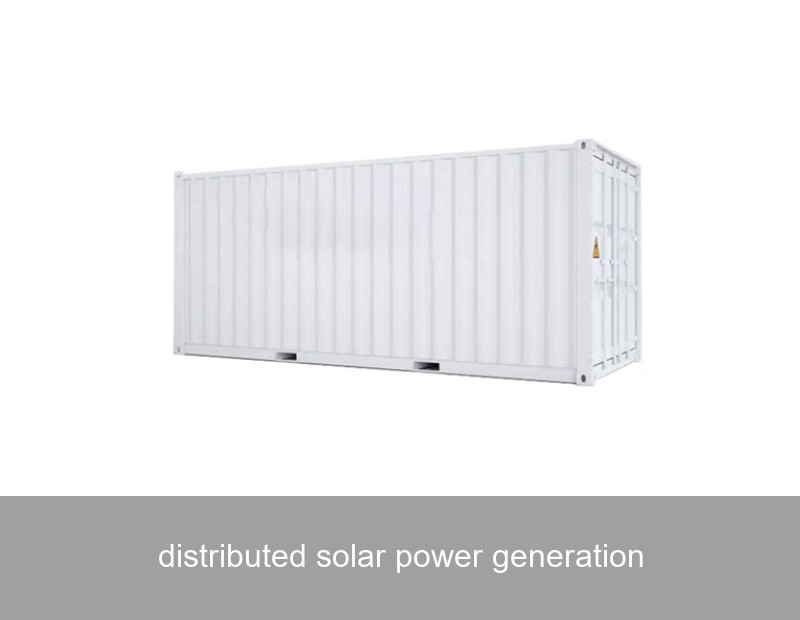
Table of Contents
- What is Distributed Solar Power Generation?
- The Central Challenge: Intermittency and Grid Integration
- The Storage Imperative: Unlocking True Energy Independence
- Case Study: A German Industrial Park's Journey to Self-Sufficiency
- Highjoule's Intelligent Solutions for Distributed Solar Systems
- The Future Outlook for Distributed Solar
Imagine a neighborhood where every rooftop not only shelters a family but also powers their home, their electric car, and even feeds clean energy back to the community. This isn't a distant utopia; it's the rapidly evolving reality of distributed solar power generation. For nearly two decades, since our founding in 2005, Highjoule has been at the forefront of this transformation, providing the intelligent energy storage backbone that makes solar energy reliable, efficient, and truly empowering for businesses, industries, and homes across Europe and the United States.
What is Distributed Solar Power Generation?
Unlike traditional, centralized power plants—massive coal, gas, or nuclear facilities that send electricity over long distances—distributed solar generation refers to a network of smaller-scale solar photovoltaic (PV) systems installed at or near the point of energy consumption. Think rooftop solar on homes and commercial buildings, ground-mounted arrays for factories, or community solar gardens serving a local area.
The benefits are compelling:
- Grid Resilience: Reduces strain on transmission lines and can provide backup power during outages, enhancing community-level energy security.
- Reduced Losses: Generating power close to where it's used minimizes energy losses that occur during long-distance transmission.
- Lower Carbon Footprint: Directly displaces fossil fuel-based electricity with zero-emission solar energy.
- Consumer Empowerment: Gives homeowners and businesses control over their energy costs and source.

Image Source: Unsplash - Illustrating residential distributed solar generation.
The Central Challenge: Intermittency and Grid Integration
Here's the catch: the sun doesn't shine on demand. This intermittency is the fundamental challenge of solar power. Generation peaks in the middle of the day, which may not align with an office building's highest consumption in the morning and evening, or a factory's 24/7 operations. This mismatch can lead to two issues:
- Excess Energy Waste: Surplus solar power generated at noon, if not consumed or stored, is often fed back to the grid, sometimes overloading local circuits and yielding minimal financial return as feed-in tariffs decline globally.
- Reliance on the Grid at Night: When the sun sets, the solar system produces nothing, forcing reliance on the traditional grid—often powered by fossil fuels—defeating the purpose of energy independence.
This is where the data tells a clear story. According to the International Energy Agency (IEA), solar PV is set to become the largest source of installed power capacity globally by 2027. However, they also emphasize that system integration and flexibility through storage are key to its sustainable growth. Simply put, solar without storage is an underutilized asset.
The Storage Imperative: Unlocking True Energy Independence
Battery Energy Storage Systems (BESS) are the game-changer. They act as a buffer, capturing the sun's bounty when it's plentiful and releasing it precisely when it's needed most. This transforms a solar installation from a passive generator into a dynamic, controllable energy resource.
| Solar-Only System | Solar + Storage System (e.g., Highjoule) |
|---|---|
| High self-consumption only during daytime. | Self-consumption rates of 70% to over 90%, day and night. |
| Limited backup power capability. | Provides reliable backup power during grid outages. |
| Exports surplus, low-value energy at peak solar hours. | Can store surplus and export or use during high-price, peak-demand periods (peak shaving). |
| Passive grid participant. | Active grid services participant (where markets allow). |
Case Study: A German Industrial Park's Journey to Self-Sufficiency
Let's look at a real-world example from Bavaria, Germany. A medium-sized manufacturing park with a peak load of 1.2 MW installed a 800 kW rooftop solar array. Initially, they were only using about 35% of their solar generation on-site, exporting the rest. Their grid dependency after sunset remained high, exposing them to volatile energy prices.
In 2022, they partnered with Highjoule to integrate a 1 MWh Highjoule HES-500 commercial battery storage system with our proprietary energy management software (EMS). The results after one year were striking:
- On-site solar consumption increased to 89%, drastically reducing grid imports.
- By implementing "peak shaving," they reduced their monthly grid capacity charges by an average of 40%.
- The system provided seamless backup power for critical processes during two brief grid disturbances.
- Projected return on investment (ROI) was achieved in under 6 years, enhanced by Germany's favorable framework for storage.
This case, mirrored by many of our clients in the U.S. and EU, demonstrates that distributed solar generation reaches its full economic and operational potential only when paired with intelligent storage.

Image Source: Unsplash - Example of commercial-scale distributed solar.
Highjoule's Intelligent Solutions for Distributed Solar Systems
At Highjoule, we don't just sell batteries; we provide integrated energy resilience. Our systems are designed specifically to maximize the value of distributed solar assets across all segments:
For Residential & Small Commercial (Highjoule Home & Business Series):
Our modular battery systems, like the Highjoule HES-10, are designed for easy integration with new or existing solar installations. User-friendly monitoring apps allow homeowners to track their energy independence in real-time, set preferences for backup power, and even participate in virtual power plant programs where available.
For Large Commercial & Industrial (Highjoule C&I Series):
Our scalable, containerized or rack-mounted BESS solutions, such as the HES-500 series, are engineered for high-cycling and demanding applications. Coupled with our advanced EMS, they perform sophisticated energy arbitrage, demand charge management, and ensure power quality for sensitive industrial equipment.
For Microgrids & Utilities:
Highjoule's systems form the core of community microgrids, enabling clusters of distributed solar resources to operate independently or in harmony with the main grid. This is crucial for enhancing local reliability and integrating higher shares of renewables, as noted by research from the National Renewable Energy Laboratory (NREL).
Our global experience since 2005 means we understand the distinct grid codes, market structures, and incentives in both Europe and North America, allowing us to tailor solutions that deliver optimal financial and operational outcomes.
The Future Outlook for Distributed Solar
The convergence of distributed solar, smart storage, electric vehicles (which are essentially batteries on wheels), and AI-driven energy management is creating a new paradigm: the prosumer-centric grid. In this future, millions of individual energy assets will interact dynamically to balance supply and demand. Policies like the U.S. Inflation Reduction Act and the EU's Green Deal are accelerating this trend by making investments in solar-plus-storage more accessible than ever.
However, the technology's success hinges on its seamless integration and reliability. This requires robust, safe, and smart storage systems from trusted providers. As the Energy Storage News industry outlet often reports, the focus is shifting from mere capacity to intelligence and lifecycle value—areas where Highjoule has deep expertise.

Image Source: Unsplash - The integrated future: solar, storage, and EVs.
Your Energy, Your Control
The journey toward a decentralized, resilient energy system is well underway. Distributed solar power generation is the catalyst, and intelligent storage is the enabler. Whether you're a homeowner looking to cut bills and gain security, a business aiming to lock in energy costs and sustainability goals, or a developer building the community microgrids of tomorrow, the question is no longer if you should combine solar with storage, but how to do it most effectively.
What is the biggest barrier—initial cost, system complexity, or regulatory uncertainty—holding you back from exploring a fully optimized solar-plus-storage solution for your property or project?
 Inquiry
 Online Chat