


Emergency Solar: How Much Power Do You Really Need?
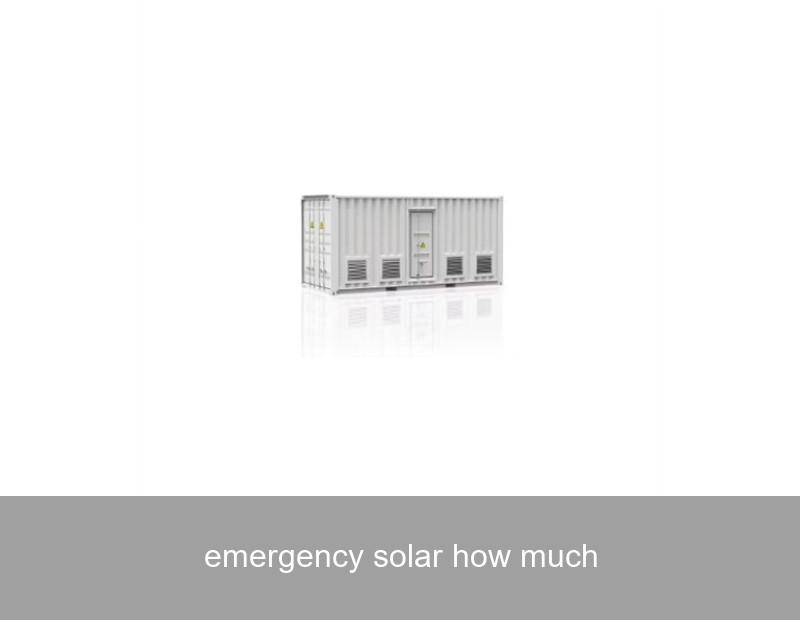
You've seen the news: a powerful storm knocks out the grid, leaving thousands in the dark. Or perhaps you've experienced a localized blackout that disrupts your home office or business operations. In these moments, the question shifts from theoretical to urgent: "How much emergency solar power do I actually need to keep the lights on and my family safe?" It's not just about having solar panels; it's about having a resilient, intelligent storage system that activates the instant the grid fails. Let's break down the real costs, capacities, and considerations to ensure your emergency solar solution is more than just a promise—it's guaranteed power.
Table of Contents
The Phenomenon: Grid Vulnerability in the 21st Century
Our modern electrical grids, while engineering marvels, are facing unprecedented stress. In the United States, the U.S. Energy Information Administration (EIA) reports that the average customer experienced just over eight hours of power interruptions in 2020, with major events being a primary driver. In Europe, climate-induced extreme weather, from heatwaves to severe storms, is increasingly testing infrastructure. The old model of relying solely on the centralized grid is becoming a risk. This vulnerability is pushing homeowners and business operators to ask a critical question: "How much emergency solar power is enough to create a true safety net?"

It’s a smart question. Simply having solar panels doesn't guarantee power during an outage. Most standard grid-tied systems shut down for safety when the grid fails. True emergency readiness requires a seamless transition to backup power, which is where advanced battery storage systems become the indispensable core of the solution.
The Data: Quantifying Your Emergency Power Needs
So, how much do you need? The answer isn't a one-size-fits-all number of kilowatt-hours (kWh). It's a personalized calculation based on load, duration, and priority.
First, distinguish between essential and non-essential loads. An emergency system is designed for critical circuits, not necessarily your entire property's peak demand.
| Essential Appliance | Estimated Power (Watts) | Estimated Daily Use (kWh) |
|---|---|---|
| Refrigerator | 150 - 400 | 1.5 - 4.0 |
| LED Lighting (5 bulbs) | 40 - 60 | 0.5 - 1.0 |
| Wi-Fi Router & Modem | 20 | 0.5 |
| Smartphone Charging | 10 | 0.2 |
| Furnace Blower Fan | 300 - 700 | 3.0 - 8.0* |
| Sump Pump | 500 - 1500 | 2.0 - 6.0* |
| *Highly variable based on runtime during an emergency event. | ||
A conservative estimate for a basic home emergency system might cover 5-10 kWh of usable storage. This could keep critical loads running for 8-24 hours, depending on usage. For a family wanting to maintain a near-normal lifestyle through a multi-day outage—including a well pump, larger refrigeration, and some climate control—the requirement can easily jump to 20-40 kWh or more.
This is where professional design is crucial. A system sized too small leaves you vulnerable, while an oversized system impacts your return on investment. The goal is intelligent sufficiency.
Case Study: A California Winery's Resilience Story
Let's look at a real-world example from California's wine country, an area prone to Public Safety Power Shutoffs (PSPS) due to wildfire risk. A medium-sized winery faced crippling losses during a 3-day grid outage: ruined fermentation batches, lost refrigeration, and halted operations.
Their goal was to protect critical cold storage (40,000 square feet of warehouse space) and key production equipment. After a detailed audit, their essential load during an outage was calculated at approximately 25 kW with a daily energy need of 120 kWh.
The solution deployed was a Highjoule Industrial Energy Hub (IEH) system. The installation featured a modular battery storage array with a total capacity of 150 kWh, integrated with their existing solar PV array. The system was configured for instantaneous islanding—severing from the grid and powering the designated critical loads within milliseconds of an outage.
The Result: During the next PSPS event, the winery operated autonomously for 78 continuous hours. It maintained precise temperature and humidity controls, safeguarding millions of dollars in inventory and enabling core administrative functions to continue. The system's intelligent management software prioritized loads and maximized solar self-consumption during the day, extending the backup duration beyond initial estimates. This investment not only provided emergency power but also delivered significant savings through daily peak shaving, paying for itself in under five years.

The Solution: Beyond Panels to Intelligent Storage
As the case study shows, answering "emergency solar how much?" is about the brain behind the battery. Modern energy resilience hinges on three pillars:
- Scalable Storage Capacity: Modular battery systems that can be expanded as your needs or budget grow.
- Seamless Islanding Capability: The automatic, sub-second switch to backup power that you don't even notice.
- Intelligent Energy Management (IEM): Software that learns your usage patterns, forecasts weather and solar production, and dynamically optimizes energy flow to maximize backup time and economic value.
This is the paradigm shift. An emergency solar system today is not a passive backup generator; it's an active, smart asset that works for you every single day, reducing your electricity bills, and transforms into a fortress of resilience when the grid fails.
How Highjoule Designs Your Emergency Solar System
At Highjoule, with nearly two decades of experience as a global leader in advanced energy storage, we approach the "how much" question through a meticulous, client-centric process. We don't just sell products; we engineer guaranteed power solutions.
For residential clients, our Highjoule HomePower Series offers scalable solutions from 10 kWh to 30+ kWh. These systems feature our proprietary IEM software, allowing homeowners to set backup priorities via a simple app and even participate in virtual power plant programs where available.
For commercial and industrial clients, our Industrial Energy Hub (IEH) and Microgrid Controller platforms provide robust, three-phase power protection. We conduct a thorough Load Analysis and Resilience Audit, simulating outage scenarios to precisely size the solar and storage components. Our systems are designed for the harsh realities of emergency events, built with industry-leading thermal management and safety protocols.
Our philosophy is that your emergency solar system should be as reliable as gravity. It should work when you need it most, without a second thought. By integrating high-density lithium iron phosphate (LFP) battery technology, high-efficiency hybrid inverters, and predictive software, we ensure your investment delivers both peace of mind and tangible financial returns.

Your Next Step Towards Energy Independence
The journey to answering "emergency solar how much?" begins with understanding your unique energy fingerprint. It's a conversation about what safety, comfort, and continuity mean for you, your family, or your business.
We invite you to reflect: What single electrical load would be most critical to maintain during a 24-hour blackout? How would protecting that load change your experience of an emergency? Now, imagine extending that protection to every essential circuit for days, powered silently and cleanly by the sun.
Are you ready to move from wondering about capacity to knowing your specific, professionally engineered solution?
 Inquiry
 Online Chat