


Your Complete Guide to Energie Solaire Installation: Powering a Sustainable Future
You’ve seen the sleek, dark panels appearing on rooftops across your neighborhood, from suburban homes in California to historic farmhouses in Provence. Energie solaire installation is more than a trend; it's a fundamental shift in how we generate and consume power. But moving from curiosity to a fully operational, efficient solar power system involves crucial decisions. It's not just about the panels—it's about integrating a complete, intelligent energy ecosystem that captures, stores, and manages solar power for maximum benefit. This guide will illuminate the path to a successful installation, focusing on the key considerations that transform sunlight into reliable, cost-effective energy for your home or business.
Table of Contents
- The Modern Solar Reality: Beyond Just Panels on a Roof
- The Data Driving the Solar Surge: Why Now is the Time
- A Case Study in Efficiency: The Bordeaux Winery Project
- The Intelligent Heart of Your System: Beyond Basic Batteries
- Choosing Your Solar Partner: Expertise Matters
- The Highjoule Difference: Smart, Integrated Solar Storage
The Modern Solar Reality: Beyond Just Panels on a Roof
Gone are the days when a solar installation simply meant mounting photovoltaic (PV) modules and connecting them to the grid. Today, a sophisticated energie solaire installation is a holistic energy solution. The true value is unlocked when you can use the solar energy you produce, on your terms—whether the sun is shining or not. This requires an intelligent storage system. Think of it this way: the solar panels are the diligent workers harvesting energy during the day, but without a smart battery system, much of that harvest can be sent back to the grid for minimal return, leaving you buying expensive power at night. The modern installation seamlessly integrates generation, storage, and intelligent energy management software.

This evolution addresses a core challenge: solar generation is intermittent, but energy demand is constant. An advanced system doesn't just produce; it predicts, stores, and optimizes. It allows homeowners to increase their self-consumption rate—the percentage of solar energy used directly in the home—from a typical 30-40% to over 70% or even 80%. For businesses, this means predictable energy costs and operational resilience.
The Data Driving the Solar Surge: Why Now is the Time
The numbers are compelling and explain the accelerating adoption rates in markets like the U.S. and Europe. According to the International Energy Agency (IEA), renewables are set to contribute 80% of new power capacity to 2030 under current policies, with solar PV alone accounting for more than half of this expansion. Let's break down the key drivers:
- Cost Competitiveness: The cost of solar PV modules has fallen by over 80% in the last decade, making the initial investment more accessible than ever.
- Energy Security & Price Volatility: Rising and unpredictable electricity prices, particularly in Europe following recent geopolitical events, have made energy independence a top financial priority for many.
- Policy Support: Incentives like the U.S. Investment Tax Credit (ITC) and various European Union grants and feed-in tariffs continue to improve the return on investment.
- Technological Maturity: Solar panel efficiency continues to improve gradually, but the most significant leaps have been in battery storage technology and energy management software, which are now reliable and cost-effective.
These factors converge to create a powerful economic and environmental case. The question is no longer "if" but "how" to implement a system that maximizes these advantages.
A Case Study in Efficiency: The Bordeaux Winery Project
Let's look at a real-world application that highlights the importance of integrated design. A renowned family-owned winery in Bordeaux, France, faced two challenges: skyrocketing energy costs for refrigeration and irrigation, and a commitment to 100% sustainable production. Their goal was to cover 90% of their annual energy needs with solar.
They installed a 250 kWp solar array on their warehouse roofs. Initially, they considered a simple grid-tie system. However, analysis showed that due to their operational schedule, over 60% of the solar energy would be exported at low rates, while they'd still buy expensive power in the evening. The solution was a custom-designed energie solaire installation coupled with a 200 kWh commercial battery storage system.
| Metric | Before Installation | After Installation |
|---|---|---|
| Grid Energy Consumption | 100% | < 15% |
| Self-Consumption of Solar | N/A | 92% |
| Annual Energy Cost | €48,000 | €6,500 |
| Carbon Footprint (Scope 2) | ~72 tonnes CO2e | ~8 tonnes CO2e |
The battery system stores excess midday solar production to power critical cooling systems during the late afternoon peak demand period and at night. This not only slashed their bills but also provided backup power, protecting valuable vintages during grid outages. The project's success hinged on the seamless integration of generation, high-capacity storage, and intelligent control—a principle at the core of every successful installation.
The Intelligent Heart of Your System: Beyond Basic Batteries
As the case study shows, the battery is the linchpin of a modern solar setup. But not all storage is created equal. When evaluating storage for your energie solaire installation, consider these critical features:
- Chemistry & Longevity: Lithium Iron Phosphate (LFP) chemistry is now the industry benchmark for safety, cycle life (often 6,000+ cycles), and stability, making it superior to older NMC blends for stationary storage.
- Scalability & Modularity: Your energy needs may grow. A modular battery system allows you to start with what you need and easily expand capacity later without replacing the entire unit.
- Integrated Energy Management System (EMS): This is the "brain." A sophisticated EMS uses algorithms and weather forecasting to decide when to charge from solar, discharge to power your home, or participate in grid services (where available), optimizing for self-consumption or revenue.
- Safety Certifications: Look for internationally recognized certifications like UL 9540 (USA) and IEC 62619 (EU), which test the entire energy storage system for safety under fault conditions.
Choosing a system that excels in these areas ensures your investment is safe, durable, and capable of adapting to future energy markets and needs.
Choosing Your Solar Partner: Expertise Matters
The technology is only as good as the design and installation. A qualified partner will conduct a thorough site assessment, analyze your historical energy usage (via utility bills), and model future production before proposing a system. They should transparently explain the components, the expected performance, and the financial payback. Key questions to ask include:
- Can you provide detailed simulations of my monthly self-consumption and savings?
- What is the warranty on the entire system, and what does it cover?
- How do you ensure the battery storage is safely integrated and compliant with local codes?
- Can the system be monitored and managed remotely?
Partnering with experts who understand both the local regulations (like building codes and grid connection rules in the EU or U.S.) and the intricacies of system integration is non-negotiable for a smooth, high-performing installation.
The Highjoule Difference: Smart, Integrated Solar Storage
At Highjoule, with nearly two decades of experience since 2005, we've witnessed and driven the evolution of the energie solaire installation from a simple PV array to an intelligent energy asset. Our philosophy is that storage is not an add-on; it's the essential component that completes your solar investment.
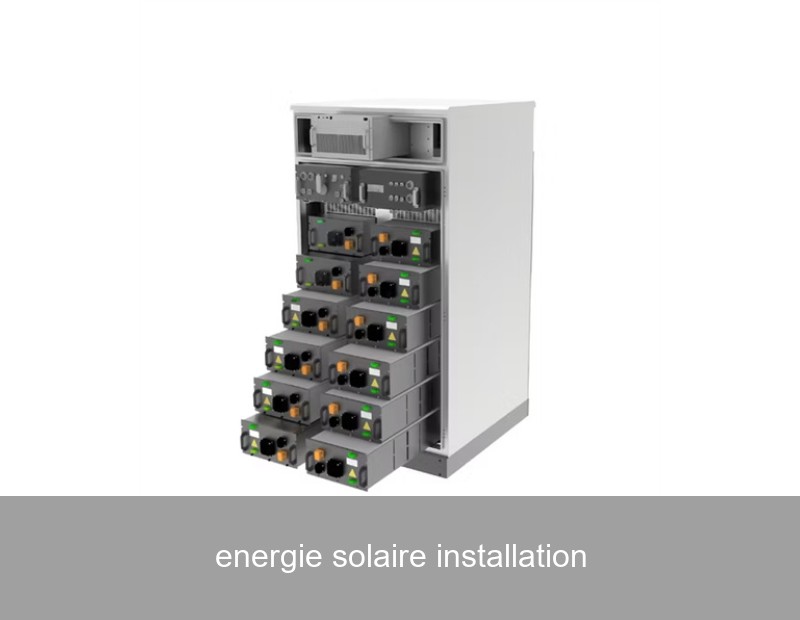
Our product suite is designed specifically for this integrated reality. The Highjoule H-Series residential storage systems feature modular LFP battery cabinets and our proprietary SynergyOS energy management platform. For commercial and industrial clients, our Cascade C&I solutions offer scalable, containerized storage that can be paired with any solar array to manage demand charges, provide backup power, and enable participation in grid-balancing programs.

What sets a Highjoule-powered installation apart is intelligence. SynergyOS doesn't just react; it learns your consumption patterns and, with optional grid signals, can automatically choose the most economical and sustainable operating mode. Whether for a home in Texas seeking backup during storm season or a manufacturing facility in Germany aiming for Netzunabhängigkeit (grid independence), we provide the core technology that makes solar work harder, 24/7.
Looking Ahead: Your Energy Ecosystem
The journey to a successful energie solaire installation is an exciting step toward energy autonomy. It's about creating a personal or organizational energy ecosystem that is resilient, economical, and sustainable. The technology is proven, the economics are clear, and the environmental imperative is urgent.
What will be the first load you choose to power with your own stored sunlight—the lights in your home office, the critical machinery on your factory floor, or the pump that irrigates your land?
 Inquiry
 Online Chat