


The Complete Guide to Choosing the Right Energy Storage Solution for Your Home
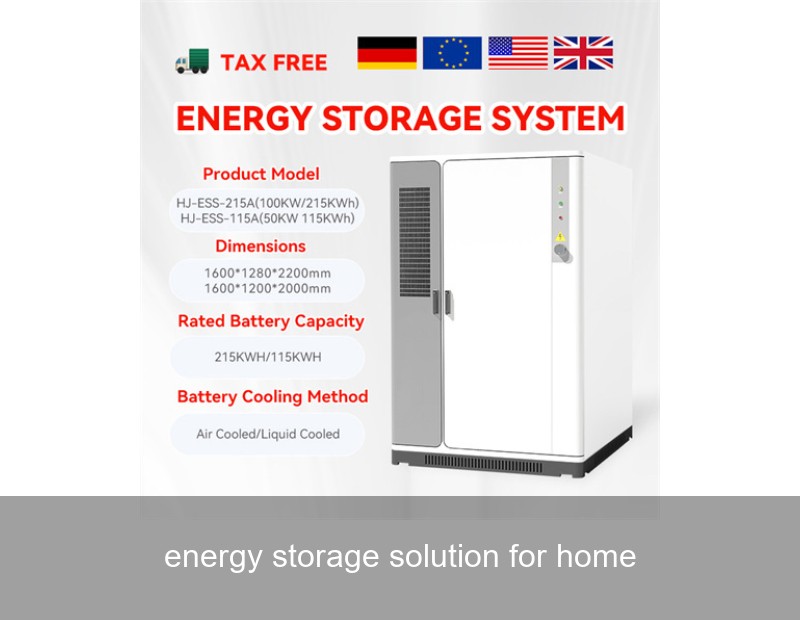
Have you ever watched your electricity meter spin and wondered where all that power—and money—is going? Or perhaps you've considered solar panels but were told you'd be sending excess energy back to the grid for a fraction of its cost. This is the modern homeowner's dilemma. But what if your home could capture, hold, and intelligently use every watt it generates or buys? Welcome to the era of the smart home energy storage solution. It's not just a battery in the garage; it's the heart of a resilient, efficient, and independent household. For nearly two decades, companies like Highjoule have been pioneering these systems, transforming how homes from California to Bavaria consume and think about power.
Why Home Energy Storage is Exploding in Popularity Now
The shift isn't accidental. Three powerful forces are converging. First, energy economics: Grid electricity prices in Europe and the U.S. have seen significant volatility and upward trends. Second, technology advancement: Lithium-ion battery costs have fallen dramatically, making storage systems more accessible. Third, climate consciousness: Homeowners are actively seeking to reduce their carbon footprint and increase self-sufficiency. A home energy storage solution sits perfectly at this intersection, turning a passive utility bill into an active asset management strategy.
The Data Behind the Trend
Let's look at the numbers. According to the U.S. Department of Energy, deployments of residential storage in the United States grew by over 400% between 2020 and 2023. In Europe, driven by the energy crisis and strong policy support in markets like Germany and Italy, the residential storage market is expected to add over 10 GWh of capacity annually by 2025. This isn't a niche product for enthusiasts anymore; it's entering the mainstream.

Credit: Photo by Possessed Photography on Unsplash
How a Modern Home Energy Storage System Works
Think of it as a high-tech, automated energy bank for your house. At its core is the battery storage unit, typically using sophisticated lithium iron phosphate (LFP) chemistry for safety and longevity. This unit is managed by an intelligent inverter and energy management system (EMS), the true "brain" of the operation.
- Energy Capture: If you have solar panels, excess generation not used immediately by your appliances is directed to charge the battery instead of being exported.
- Intelligent Discharge: The EMS decides when to use stored energy—powering your home during peak evening rates, during a grid outage, or when solar production is low.
- Grid Interaction: Advanced systems can participate in grid services (where allowed) or be configured for maximum self-consumption, depending on your goals and local regulations.
This is where integrated solutions from experienced providers make all the difference. Highjoule's HomePower Stack, for instance, combines a modular LFP battery system with a hybrid inverter and an intuitive AI-driven EMS. The system learns your household's energy patterns and automatically optimizes for cost savings or resilience, all controllable via a simple smartphone app.
Key Benefits: More Than Just Backup Power
While keeping the lights on during a storm is a huge advantage, the value proposition of a home energy storage solution is multi-layered.
| Benefit | Description | Impact |
|---|---|---|
| Bill Savings & Rate Arbitrage | Store cheap energy (from solar or off-peak grid rates) to use during expensive peak hours. | Can reduce electricity costs by 50-80% for homes with solar, depending on local rates. |
| Energy Independence | Dramatically increase your self-consumption of solar energy, reducing reliance on the utility grid. | Achieve 70-90% energy self-sufficiency, insulating yourself from price hikes. |
| Reliability & Resilience | Seamless backup power during grid outages, keeping essential circuits running. | Peace of mind and safety during extreme weather events or grid instability. |
| Environmental Contribution | Maximizes use of clean, renewable solar energy and reduces peak demand on often fossil-fuel-based grid plants. | Lowers your household's carbon footprint significantly. |
A Real-World Case Study: The Schmidt Family in Bavaria
Let's move from theory to practice. The Schmidt family, living in a detached home near Munich, Germany, installed a 10 kWp solar rooftop system in 2020. They were frustrated that they were exporting over 60% of their solar yield to the grid for a low feed-in tariff while still buying expensive power at night.
In early 2023, they integrated a Highjoule HomePower Stack 15 (a 15 kWh storage system). The results after one full year, monitored by their installer and shared (anonymized) with Highjoule for performance analysis, were striking:
- Self-Consumption Rate: Increased from 38% to 92%.
- Annual Electricity Bill: Reduced from €1,850 to €310 (an 83% reduction).
- Grid Independence: The home experienced two short grid outages; the system provided backup power seamlessly for over 8 hours each time.
- System Performance: The AI EMS adapted to seasonal changes, prioritizing different usage patterns in winter versus summer.
"It's not just about the savings, which are fantastic," Mrs. Schmidt noted. "It's the feeling of control. We are now masters of our own energy, and that aligns perfectly with our values." This case, mirrored by thousands across Europe and North America, illustrates the transformative potential of a well-integrated home energy storage solution.

Credit: Photo by Kindel Media on Pexels
Choosing the Right Solution: A Buyer's Checklist
Not all systems are created equal. Here’s what to consider when evaluating your options:
1. Battery Technology & Safety
Insist on Lithium Iron Phosphate (LFP) chemistry. It offers longer cycle life, superior thermal stability, and avoids cobalt. Highjoule's systems use proprietary LFP cells with a 10-year warranty, ensuring decade-long performance.
2. Capacity & Scalability
How much storage do you need? A good starting point is a system that can cover your evening and night consumption. Modular systems are key. The HomePower Stack allows you to start with, say, 10 kWh and add modules later as your needs grow (e.g., with an EV).
3. Intelligence & Software
The hardware stores energy; the software saves you money. Look for an EMS that offers smart features like time-of-use optimization, outage preparedness modes, and remote monitoring. Can it integrate with future smart home devices or EV chargers?
4. Installation & Service
Partner with a certified installer. Highjoule works with a vetted network of partners across the U.S. and Europe, ensuring professional installation, commissioning, and local service support. The quality of installation is as critical as the product itself.
The Future-Proof Home
Your home is evolving from a place that consumes energy to one that generates, manages, and stores it intelligently. A home energy storage solution is the central pillar of this evolution. It bridges the gap between renewable generation and reliable consumption, turning your household into a node of stability in a changing energy landscape. With solutions designed for durability, intelligence, and seamless integration, pioneers like Highjoule are making this future accessible today.
So, here's a question to ponder: If your home could generate its own power, store it for when you truly need it, and protect you from outages and price spikes—what would you do with the newfound control and savings?
 Inquiry
 Online Chat