


Energy Storage Systems Australia: Powering the Nation's Renewable Future
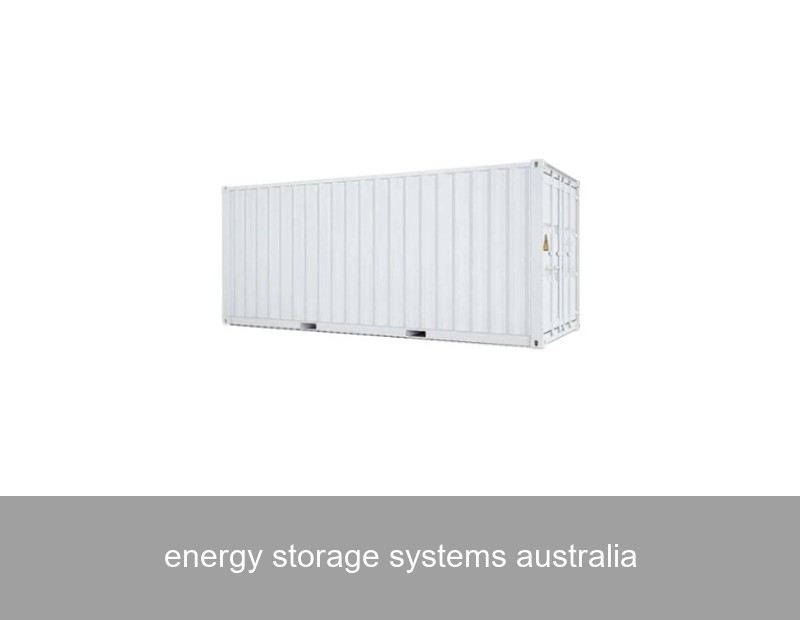
Australia is at an energy crossroads. Blessed with abundant sunshine and wind, the nation is rapidly embracing renewables. Yet, this transition brings a familiar challenge: how to ensure reliable power when the sun doesn't shine and the wind doesn't blow. The answer, increasingly, lies in advanced energy storage systems Australia-wide are deploying to stabilize grids, cut costs, and secure a sustainable energy future. For nearly two decades, Highjoule has been at the forefront of this global shift, providing intelligent storage solutions that turn renewable potential into dependable, 24/7 power.
Table of Contents
- The Australian Energy Phenomenon: From Sun-Drenched to Grid-Stressed
- The Data Behind the Demand: Why Storage is No Longer Optional
- Case Study: The South Australian Industrial Shift
- Beyond the Battery: What Makes a Modern Energy Storage System?
- The Highjoule Approach: Intelligent Storage for Australian Conditions
- What Does the Future Hold for Australia's Grid?
The Australian Energy Phenomenon: From Sun-Drenched to Grid-Stressed
one in three Australian homes now has rooftop solar panels, the highest uptake in the world. While this is a phenomenal achievement, it creates a unique "duck curve" effect—a dramatic midday plunge in grid demand as solar floods the system, followed by a steep evening ramp-up as the sun sets and everyone turns on their appliances. This rapid swing puts immense pressure on traditional coal and gas generators, leading to grid instability and price volatility. It's a classic case of having too much of a good thing at the wrong time. This is precisely where energy storage systems Australia needs come into sharp focus. They are the shock absorbers for the national grid, soaking up excess solar energy by day and releasing it when it's needed most.

This isn't just a technical issue; it's an economic and environmental imperative. The transition is well underway, but managing it smoothly requires a foundational technology: intelligent, large-scale energy storage.
The Data Behind the Demand: Why Storage is No Longer Optional
Let's look at the numbers. According to the Australian Energy Market Operator (AEMO), Australia's Integrated System Plan forecasts that by 2050, the National Electricity Market (NEM) will need a staggering 46 GW / 640 GWh of dispatchable storage and flexible generation capacity to support a renewable-dominated grid. To put that in perspective, that's over 50 times the capacity of the original Hornsdale Power Reserve (the "Tesla big battery").
The driver is clear: the retirement of aging coal-fired power plants. As these large, always-on generators exit, the market needs new, flexible assets to fill the gap. Battery Energy Storage Systems (BESS) are uniquely suited for this role, providing services like:
- Frequency Control Ancillary Services (FCAS): Stabilizing grid frequency in milliseconds to prevent blackouts.
- Energy Arbitrage: Buying and storing cheap renewable energy, then selling it during expensive peak periods.
- Network Deferral: Delaying costly upgrades to poles and wires by relieving local congestion.
- Backup Power: Providing seamless, uninterrupted power for critical commercial and industrial operations.
The business case is now proven. It's no longer a question of *if* storage will be deployed, but *how* and *which technology* will deliver the greatest reliability and return on investment.
Case Study: The South Australian Industrial Shift
South Australia offers a compelling real-world example. A state once plagued by grid instability and high prices now leads the world in renewable integration, thanks in large part to grid-scale storage. Beyond the famous Hornsdale project, a wave of commercial and industrial (C&I) users are taking control of their energy costs.
Consider a recent project Highjoule completed for a large food processing plant in Adelaide's industrial belt. The facility faced two major problems: exorbitant peak demand charges that made up 40% of their electricity bill, and vulnerability to grid fluctuations that risked spoiling perishable inventory.
Highjoule's solution was a tailored 2 MW / 4.6 MWh containerized battery storage system, integrated with the site's existing solar PV and controlled by our proprietary Adaptive Grid OS platform. The results over the first 12 months were transformative:
| Metric | Result |
|---|---|
| Peak Demand from Grid | Reduced by 62% |
| Annual Electricity Costs | Saved AUD $310,000 |
| Solar Self-Consumption | Increased from 35% to over 80% |
| Backup Power Coverage | Critical processes protected for up to 4 hours |
This isn't just a battery; it's an intelligent energy asset. Our system automatically "shaves" peak demand by discharging during the most expensive 30-minute periods and constantly participates in the FCAS market, generating an additional revenue stream for the business. This case exemplifies how modern energy storage systems Australia's industries are adopting are multi-functional financial and operational tools.
Beyond the Battery: What Makes a Modern Energy Storage System?
It's a common misconception that an energy storage system is just a battery rack. In reality, it's a sophisticated, integrated ecosystem. At Highjoule, we engineer our solutions around five core pillars:
- Advanced Battery Modules: Utilizing high-cycle life, safety-tested lithium-ion phosphate (LFP) chemistry, ideal for Australia's wide temperature ranges.
- Bi-Directional Inverters (PCS): The heart of the system, converting DC to AC power with industry-leading efficiency (over 98.5%) to maximize every kilowatt-hour.
- Thermal Management System: A dedicated cooling system designed for Australian heat, ensuring optimal performance and longevity even in 45°C+ ambient conditions.
- Energy Management System (EMS): The brain. This software platform controls charging/discharging based on weather forecasts, market prices, and site load patterns.
- Grid-Forming Capability: Our latest systems can "black start" and form a stable grid voltage and frequency independently, a critical feature for microgrids and areas with weak grid connections.
This holistic engineering approach is what separates a commodity product from a reliable, long-term infrastructure investment. It's why utilities and businesses choose a partner, not just a product.

The Highjoule Approach: Intelligent Storage for Australian Conditions
Founded in 2005, Highjoule has grown into a global leader by solving complex energy challenges. We understand that the Australian market is distinct. The vast distances, diverse climates, and unique market rules demand a tailored approach. Our product suite for the Australian context includes:
- H-Joule C&I Series: Scalable, all-in-one storage solutions from 100 kWh to 5 MWh, designed for factories, shopping centers, and agricultural facilities to reduce costs and ensure power quality.
- H-Joule Utility Scale Platform: Modular, multi-MW systems for network operators and renewable energy farms, featuring advanced grid-support functions and fleet-level management software.
- H-Joule Residential Ecosystem: A seamless integration of home battery storage, EV charging, and solar optimization, giving homeowners energy independence.
Our Adaptive Grid OS is the unifying intelligence layer. It doesn't just manage our hardware; it can integrate and optimize a site's entire energy asset portfolio—solar, wind, existing generators, and load—creating a true, autonomous microgrid if needed. This software-centric approach future-proofs investments, allowing systems to adapt to new market opportunities and regulations. For instance, as virtual power plants (VPPs) become more prevalent in Australia, as noted by resources like the International Energy Agency, our systems are already designed to participate and monetize their flexibility.
What Does the Future Hold for Australia's Grid?
The trajectory is clear. Australia's energy landscape is evolving from a centralized, one-way flow of power to a decentralized, interactive network of "prosumers"—consumers who also produce and store energy. This democratization of energy is empowering businesses, communities, and individuals. The next frontier is the seamless integration of electric vehicle fleets as mobile storage assets and the exploration of even longer-duration storage technologies to cover multi-day cloudy or windless periods.
For a business leader, council official, or project developer in Australia today, the question is not whether to consider storage, but how to navigate the options. It's about finding a technology partner with proven global experience, deep grid expertise, and a platform built for the next 20 years of energy evolution, not just the current market design.
Is your organization simply watching the energy transition, or are you actively building a more resilient, profitable, and sustainable energy strategy? What would achieving 100% renewable self-sufficiency do for your operational costs and corporate sustainability goals?
 Inquiry
 Online Chat