


Demystifying the Envision ESS 4LH3L7 280Ah LiFePO4 3.2V B Grade Cell: A Professional's Guide
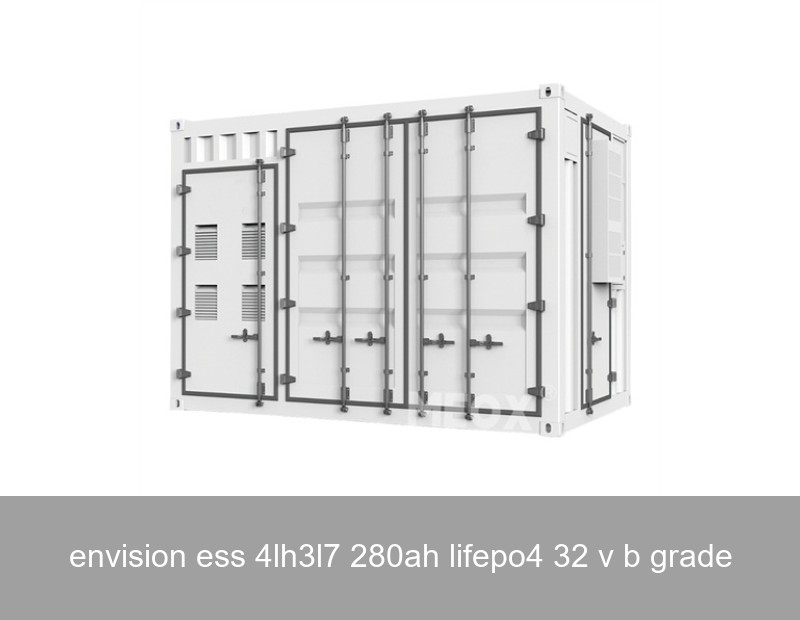
In the rapidly evolving world of battery energy storage, you've likely encountered a string of letters and numbers like "Envision ESS 4LH3L7 280Ah LiFePO4 3.2V B Grade." It sounds technical, and frankly, a bit cryptic. But what does it actually mean for your commercial, industrial, or residential energy project? More importantly, how does understanding this specific cell help you build a safer, more reliable, and cost-effective battery energy storage system (BESS)? As a leader in advanced energy storage solutions, Highjoule is here to translate the jargon. This article will unpack this key component, explain the critical importance of cell grading, and show you how top-tier system integrators turn raw cells into dependable power.
Table of Contents
- Breaking Down the Code: What "Envision ESS 4LH3L7 280Ah" Really Means
- The Heart of the Matter: LiFePO4 Chemistry and Its Advantages
- The Critical "B Grade" Designation: Quality, Safety, and Value
- From Cell to System: The Integration Imperative
- Case Study: Maximizing ROI with Graded Cells in a Commercial Storage Project
- Choosing Your Storage Partner: Beyond the Cell Spec Sheet
Breaking Down the Code: What "Envision ESS 4LH3L7 280Ah" Really Means
Let's decode this piece by piece. "Envision ESS" refers to the manufacturer, Envision Energy's Energy Storage System division, a major global player in renewable energy. "4LH3L7" is a model or batch number identifying the specific cell design. The core specifications follow: 280Ah indicates the cell's capacity in Ampere-hours. In simple terms, a higher Ah rating means the cell can store more energy—think of it as a larger fuel tank. 3.2V is the nominal voltage of a single LiFePO4 (Lithium Iron Phosphate) cell. These individual cells are then connected in series and parallel within a battery module and rack to achieve the required system voltage (e.g., 48V, 400V, 800V) and total energy capacity (kWh). Understanding this baseline is the first step in evaluating any storage system's potential.
The Heart of the Matter: LiFePO4 Chemistry and Its Advantages
Why has LiFePO4 become the dominant chemistry for stationary storage? The answer lies in a perfect balance of safety, longevity, and performance. Unlike other lithium-ion chemistries, LiFePO4 is inherently more stable due to its strong phosphate-oxygen bonds, making it highly resistant to thermal runaway—a critical safety priority for installations near homes or businesses. Furthermore, these cells boast an exceptionally long cycle life, often exceeding 6,000 cycles while retaining 80% of their original capacity. For a business running daily charge/discharge cycles, this translates to decades of reliable service. This durability, combined with excellent performance across a wide temperature range, makes LiFePO4, like the Envision ESS cell, the workhorse of modern renewable energy storage. At Highjoule, our commercial and industrial BESS platforms are engineered around these robust LiFePO4 cells, ensuring maximum safety and return on investment for our clients.

Image Source: Unsplash - A look inside a modern BESS rack utilizing LiFePO4 technology.
The Critical "B Grade" Designation: Quality, Safety, and Value
Now, let's tackle the most misunderstood part: "B Grade." This is not a mark of defect or danger. In high-volume cell manufacturing, strict quality control tests every cell for capacity, internal resistance, self-discharge rate, and voltage consistency. "A Grade" cells meet the tightest tolerances and are typically destined for electric vehicles. "B Grade" cells exhibit minor, non-safety-related deviations—perhaps a 275Ah capacity instead of the perfect 280Ah, or a slightly higher internal resistance. Their thermal and safety characteristics remain intact.
For stationary storage, where form factor and ultra-precise energy density are slightly less critical than in a moving vehicle, B Grade cells present a tremendous value opportunity. They allow system integrators like Highjoule to source high-quality cells at a lower cost, savings we pass on while maintaining rigorous system-level performance and warranty standards. Our proprietary battery management system (BMS) is precisely calibrated to manage the slight variances in B Grade cells, ensuring balanced operation and longevity across the entire battery pack. It's a smart engineering and economic choice that underpins many successful projects.
From Cell to System: The Integration Imperative
A single cell, even an A+ Grade one, is useless on its own. The true measure of a storage system lies in its integration. This is where Highjoule's expertise transforms components into a reliable asset. We don't just sell cells; we design and manufacture fully integrated, UL-certified systems. Consider what happens when you connect hundreds of 280Ah cells together:
- Battery Management System (BMS): The "brain" that monitors each cell group for voltage and temperature, ensuring safe operation and preventing overcharge or deep discharge.
- Thermal Management: A dedicated cooling/heating system to maintain optimal temperature, crucial for performance and lifespan.
- Power Conversion System (PCS): The inverter/charger that converts DC battery power to AC for your building and manages grid interaction.
- Safety & Grid Compliance: Enclosures, fire suppression, and advanced grid-support functions mandated by local codes (like UL 9540 in the US).
Our residential storage systems and large-scale microgrid solutions are built on this holistic philosophy. A great cell is just the starting point; intelligent integration is what delivers peace of mind.
Case Study: Maximizing ROI with Graded Cells in a Commercial Storage Project
Let's look at a real-world application. A mid-sized fruit cold storage facility in California faced high demand charges and sought to increase energy resilience. Their primary goal was a strong financial return, not necessarily the absolute highest energy density cell on the market.
| Project Parameter | Detail |
|---|---|
| System Size | 500 kWh / 250 kW |
| Core Cell Type | LiFePO4, 280Ah-class (B Grade) |
| Key Objectives | Demand charge reduction, backup for critical refrigeration |
| Integration Solution | Highjoule C&I All-in-One Rack System with advanced BMS |
By utilizing high-quality B Grade cells within a professionally engineered Highjoule system, the project achieved a 22% lower upfront capital cost compared to bids using premium A Grade cells. The intelligent BMS ensures perfect cell balancing. The system is projected to pay for itself in under 5 years through demand charge savings alone, while providing 10+ hours of backup for critical cooling loads. This case, verified by NREL research on storage economics, demonstrates that the strategic use of graded cells in a top-tier system is a winning formula for cost-sensitive commercial applications.

Image Source: Unsplash - A commercial facility utilizing solar plus storage for savings and resilience.
Choosing Your Storage Partner: Beyond the Cell Spec Sheet
So, when you see "Envision ESS 4LH3L7 280Ah LiFePO4 3.2V B Grade," you now know it represents a capable, safe, and cost-effective cell option. But your final question shouldn't be about the cell—it should be about the system integrator. Can they provide a certified, warrantied, and performance-guaranteed solution? Do they have a proven track record in your market and application? Do their systems comply with local fire and grid codes?
At Highjoule, with nearly two decades of experience, we handle the complex integration so you don't have to. We select the optimal cell for the application, whether A or B Grade, and engineer it into a system you can trust for the long term. The cell is a component; the reliable, intelligent, and safe energy storage system is the product you need.
Is your organization evaluating energy storage to reduce costs, enhance sustainability, or ensure operational resilience? What specific energy challenge could a strategically designed system, built on robust components like the LiFePO4 cell, solve for you today?
 Inquiry
 Online Chat