


The Equation for Solar Energy: Unlocking Your System's True Potential
You've likely seen the sleek panels on rooftops and the sprawling solar farms. The promise is clear: free, clean energy from the sun. But how do you move from that promise to a predictable, high-performing power source for your home or business? The answer lies in understanding the fundamental equation for solar energy. This isn't just a theoretical formula; it's the practical key to sizing your system, maximizing your return on investment, and achieving true energy independence. At Highjoule, we believe that an informed customer is an empowered one. Let's demystify the math that turns sunlight into savings and resilience.
Table of Contents
- The Core Formula: More Than Just Math
- Beyond the Basics: The Real-World Variables
- The Storage Factor: Completing the Energy Equation
- Case Study: A German Bakery's Recipe for Success
- Optimizing Your Equation with Smart Technology
The Core Formula: More Than Just Math
At its heart, the energy produced by a photovoltaic (PV) system is governed by a deceptively simple relationship. Think of it as the master recipe for solar harvest:
Energy Output = Solar Irradiance × Panel Area × Panel Efficiency × System Performance Ratio
Let's break down what each of these terms really means for you:
- Solar Irradiance: This is the "fuel" – the power per unit area received from the sun (measured in kW/m²). It's not constant; it varies by your geographic location, the season, the time of day, and even the local weather. A system in Arizona will have a higher base irradiance than one in Scotland.
- Panel Area: Simply put, this is your available roof or ground space. More area means more potential to capture sunlight, but it must be usable, unshaded space.
- Panel Efficiency: This percentage tells you how good your panels are at converting sunlight into electricity. While residential panels typically range from 19% to 22%, Highjoule utilizes premium-grade cells in our HeliosPrime series, which push efficiencies to 22.8% and above, ensuring you generate more power from the same footprint.
- System Performance Ratio (PR): This is the critical, often overlooked, factor. It's a holistic quality metric (typically between 0.7 and 0.85) that accounts for all real-world losses: inverter efficiency, wiring losses, dirt on panels, and temperature effects. A high PR is a sign of a well-designed and installed system.
So, the equation for solar energy shows us that simply buying the most efficient panels isn't enough. True optimization requires balancing all four variables, which is where expert design and quality components come in.
Beyond the Basics: The Real-World Variables
If the core formula is the recipe, then real-world conditions are the kitchen environment. Two critical factors dramatically impact the outcome: temperature and shading.
Temperature's Hidden Toll: Solar panels, ironically, lose efficiency as they get hotter. The temperature coefficient, a spec you'll find on panel datasheets, quantifies this loss. For every degree Celsius above 25°C (77°F), power output can drop by 0.3% to 0.5%. On a hot summer day, panel temperatures can exceed 60°C (140°F), leading to a 10%+ performance hit. Highjoule's HeliosPrime panels are engineered with advanced thermal management materials that dissipate heat more effectively, minimizing this loss and delivering more stable output during heatwaves.
The Shading Problem: Partial shading from a chimney, tree, or vent can have a disproportionately large impact. Modern panels use bypass diodes to mitigate this, but the energy loss is still significant. This is where system architecture matters. Highjoule's intelligent string inverters and power optimizers, part of our Neuron energy management platform, allow panels to operate independently, so shading on one module doesn't cripple the output of the entire array.

Image Source: Unsplash - Professional solar installation
The Storage Factor: Completing the Energy Equation
Here's the modern reality: the solar generation equation only tells half the story. What happens when the sun isn't shining? Your energy needs don't pause at sunset. This is where the equation expands to include storage, becoming the equation for energy independence.
Energy Independence = Solar Generation + Intelligent Storage - Grid Dependence
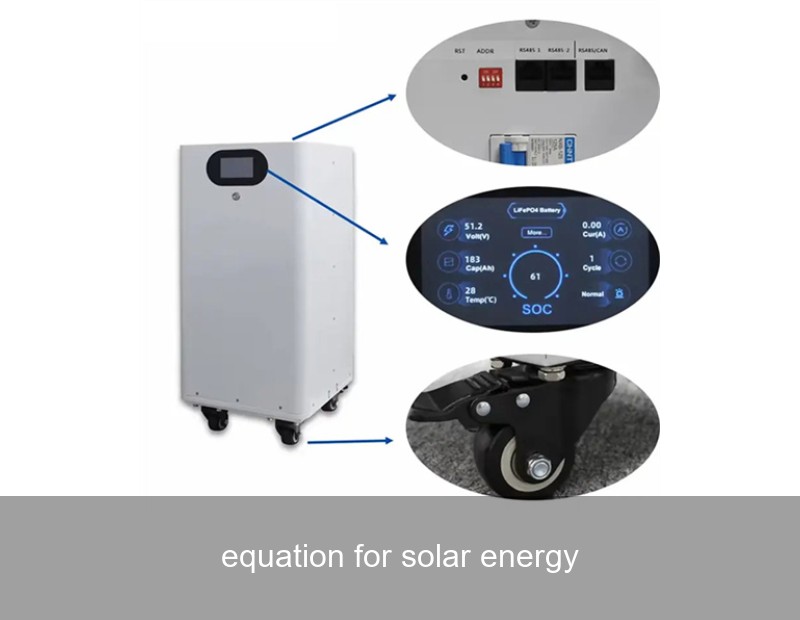
A battery energy storage system (BESS) is the variable that transforms solar from a supplemental power source to a primary one. It allows you to capture excess energy produced at midday for use in the evening, during peak rate periods, or during a grid outage. Highjoule's VoltStack series of lithium iron phosphate (LiFePO4) battery systems are designed specifically for this integration. With industry-leading cycle life (over 6,000 cycles) and a 95% round-trip efficiency, our storage solutions ensure minimal energy is lost between generation and use, maximizing the value of every kilowatt-hour your panels produce.
Case Study: A German Bakery's Recipe for Success
Let's see how this equation works in practice. Bäckerei Schmidt (name used with permission), a mid-sized artisan bakery in Bavaria, Germany, faced rising energy costs and sought to stabilize its operational budget. Their energy-intensive ovens and cooling systems created a demand profile with high morning and afternoon peaks.
| Challenge | Highjoule Solution | Data-Driven Outcome |
|---|---|---|
| High grid consumption during peak tariff hours (6-8 AM, 5-8 PM) | 120 kWp rooftop solar array with Highjoule HeliosPrime panels + 240 kWh VoltStack BESS | Grid consumption during peak hours reduced by 92% |
| Need for uninterrupted power for refrigeration | System integrated with Neuron energy management for seamless backup power | Critical loads secured against grid outages |
| Maximizing self-consumption of solar energy | Neuron AI forecasts production & demand, optimizing charge/discharge cycles | Self-consumption rate increased from 35% to 81% |
By solving the full energy equation—not just the solar generation part—Bäckerei Schmidt now covers 78% of its annual electricity needs independently, with a projected return on investment in under 7 years. The bakery has also enhanced its brand as a sustainable local business. You can explore more on the economic potential of solar+storage in commercial settings through this authoritative report on renewable costs by IRENA.
Optimizing Your Equation with Smart Technology
Today, the most advanced component in the energy equation is software. Highjoule's Neuron Energy Operating System acts as the brain of your system. It continuously solves the energy equation in real-time, factoring in:
- Weather forecasts for solar production
- Your historical and predicted energy consumption patterns
- Dynamic electricity tariff rates (where applicable)
- Battery state of health and cycle optimization
This isn't just passive monitoring; it's active optimization. The Neuron platform automatically decides when to store solar energy, when to use it, and when to potentially sell back to the grid for the best financial return. It turns a static system into a dynamic, profit-optimizing asset. For a deeper look at how smart technology is transforming grid management, consider this research from the National Renewable Energy Laboratory (NREL).

Image Source: Unsplash - Energy management system display
Bringing It All Together: Your Personalized Energy Blueprint
Understanding the equation for solar energy empowers you to ask the right questions. It's no longer about just the number of panels, but about the holistic system design, component quality, and intelligent management that ensures those panels work as hard as possible for you, day and night.
At Highjoule, with nearly two decades of experience across European and North American markets, we don't just sell components; we engineer solutions. From the initial site assessment that models irradiance and shading, to the design of a perfectly balanced PV array, to the integration of our high-cycle-life VoltStack batteries managed by the Neuron platform, we build systems that solve the complete equation for energy resilience and economic benefit.
What variable in your personal or business energy equation is currently costing you the most, and how ready are you to transform it from a cost into an asset?
 Inquiry
 Online Chat