


First Solar Series 6 CuRe: The Future of Sustainable and Reliable Photovoltaics
If you're involved in solar energy, you've likely heard the buzz about cadmium telluride (CdTe) thin-film technology and its remarkable progress. But what truly sets the latest generation apart? The answer lies in the First Solar Series 6 CuRe module. This isn't just another panel; it represents a significant leap in durability, efficiency, and long-term value, particularly for large-scale commercial, industrial, and utility projects. As a product technology expert at Highjoule, I've seen firsthand how pairing such advanced solar technology with intelligent energy storage creates truly resilient and cost-effective power systems. Let's explore what makes the Series 6 CuRe a game-changer and how it integrates into the modern energy landscape.
Table of Contents
- What is First Solar Series 6 CuRe?
- The Phenomenon: The Hidden Cost of Panel Degradation
- The Data: How CuRe Technology Redefines Longevity
- A Real-World Case: Enhancing a German Industrial Park's ROI
- The Critical Synergy: Why Advanced Solar Needs Smart Storage
- Highjoule's Role: Integrating Advanced PV with Intelligent BESS
- Looking Ahead: Is Your Energy Strategy Ready for 30+ Years?
What is First Solar Series 6 CuRe?
The "CuRe" in First Solar Series 6 CuRe stands for Copper Replacement. This proprietary technology is a fundamental enhancement to First Solar's proven cadmium telluride (CdTe) thin-film modules. Traditionally, a key connection within the cell used a material that could be susceptible to certain environmental stressors over very long periods. CuRe technology replaces this with a more robust, chemically stable copper-based compound. The result? A photovoltaic module engineered from the ground up for exceptional durability and a significantly extended lifespan, directly addressing the industry's need for higher and more predictable financial returns over decades.

Image: First Solar Series 6 modules deployed in a large-scale array. Source: Solar Power World Online
The Phenomenon: The Hidden Cost of Panel Degradation
Every solar panel degrades; its power output slowly decreases over time. The industry standard for crystalline silicon panels is around 0.5% to 0.7% degradation per year. While this seems small, it compounds. A panel with 0.7% annual degradation will lose nearly 20% of its initial output after 30 years. For a 10 MW solar farm, that's like losing a 2 MW asset by the end of its life—a massive impact on the project's lifetime energy yield and financial model. This phenomenon forces developers and asset owners to build in significant degradation buffers, affecting system sizing and long-term revenue projections.
The Data: How CuRe Technology Redefines Longevity
This is where the First Solar Series 6 CuRe data tells a compelling story. First Solar's enhanced modules now boast a degradation rate as low as 0.2% per year for the first 30 years of their life. Let's put that into a table to compare the stark difference in energy retention:
| Technology | Warranted Annual Degradation | Power Output After 30 Years (Minimum) | Relative Energy Loss Over 30 Years |
|---|---|---|---|
| Standard Crystalline Silicon | 0.7% | ~80.5% of nameplate | ~19.5% |
| First Solar Series 6 CuRe | 0.2% | ~94.1% of nameplate | ~5.9% |
This data, backed by First Solar's warranty, isn't just a technical spec—it's a financial supercharger. It means more guaranteed electricity generation over the asset's lifetime, leading to a higher net present value (NPV) and a lower levelized cost of energy (LCOE). Furthermore, CdTe thin-film panels, including the Series 6, have superior performance in high temperatures and low-light conditions compared to conventional silicon, adding another layer of real-world yield advantage.
A Real-World Case: Enhancing a German Industrial Park's ROI
Consider a recent project at an industrial park in North Rhine-Westphalia, Germany. The goal was to maximize on-site consumption of solar power to shield the facility from volatile grid prices. The developers chose First Solar Series 6 CuRe modules for their combination of reliable degradation profile and strong real-world energy yield. The 2.1 MW rooftop array was coupled with a 1.2 MWh battery energy storage system (BESS).
The result? Projections based on the CuRe warranty show that the solar array will deliver approximately 8-10% more total energy over 30 years compared to a similar system using standard technology. This directly increases the share of self-consumed solar electricity, reducing grid dependence. When paired with the BESS for time-shifting, the facility is projected to achieve over 75% energy autonomy, with a payback period reduced by nearly two years. This case exemplifies how technological innovation in PV durability translates directly into enhanced economic resilience for businesses.
The Critical Synergy: Why Advanced Solar Needs Smart Storage
An ultra-durable solar panel is a fantastic foundation, but the sun doesn't shine 24/7. To truly capitalize on every kilowatt-hour generated over those 30+ years, you need a way to store and manage that energy. This is where the synergy with advanced battery energy storage systems (BESS) becomes non-negotiable. A BESS allows you to:
- Time-Shift Energy: Store excess solar generation from midday for use during the evening peak, maximizing self-consumption.
- Enhance Grid Stability: Provide frequency regulation and other grid services, creating an additional revenue stream.
- Ensure Backup Power: Maintain critical operations during grid outages, a key concern for industrial and commercial entities.
Without storage, a significant portion of your high-quality solar generation might be exported to the grid at low prices. The combination of high-yield, long-life PV and intelligent storage locks in energy costs and provides operational independence.
Highjoule's Role: Integrating Advanced PV with Intelligent BESS
At Highjoule, our expertise lies in bridging this very gap. We don't manufacture solar panels, but we are experts in designing and integrating the intelligent storage solutions that unlock their full, long-term potential. When a client is considering a system with cutting-edge PV like the First Solar Series 6 CuRe, our role is to ensure the storage component is equally forward-thinking.
Our H-Series commercial and industrial BESS are built with similar principles of longevity, efficiency, and safety. They feature:
- Long Cycle Life Chemistry: Using LFP (Lithium Iron Phosphate) battery cells that align with the 30-year horizon of advanced solar assets.
- Advanced DC-Coupled Architecture: For higher round-trip efficiency, meaning more of your precious solar energy is saved and used, not lost in conversion.
- AI-Powered Energy Management System (EMS): This is the "brain" that optimizes energy flow in real-time, deciding when to charge, discharge, or hold based on weather forecasts, consumption patterns, and electricity tariffs.

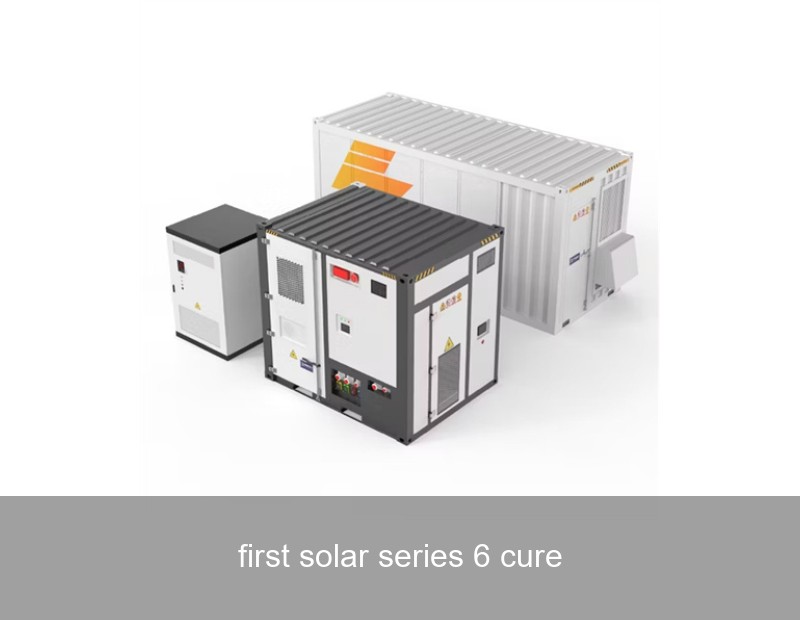
Image: A modern battery energy storage system installation. Source: Unsplash (Industry Professional Collection)
For microgrid and utility-scale applications, our GridMatrixTM platform allows for the seamless orchestration of multiple solar-plus-storage assets, creating a virtual power plant (VPP) that can participate in wholesale markets and provide community resilience. By choosing Highjoule, you're not just adding a battery; you're adding a sophisticated energy asset optimized to work with premium solar generation for decades. You can learn more about grid-scale storage challenges and solutions from the U.S. Department of Energy.
Looking Ahead: Is Your Energy Strategy Ready for 30+ Years?
The First Solar Series 6 CuRe technology pushes the boundary of what we expect from a solar asset, fundamentally changing long-term energy yield calculations. But this advancement asks a crucial question of project developers, asset owners, and energy managers: Is your overall system design—especially your storage strategy—engineered to match this 30-year, high-performance horizon? The true value of durable solar is only fully realized when paired with storage that is equally durable, efficient, and intelligent.
What specific energy resilience or financial target could a combination of ultra-low-degradation solar and a smart, high-efficiency BESS help you achieve in your next project?
 Inquiry
 Online Chat