


What Can a 20 kW Solar System Unit Generation Really Do for Your Home or Business?
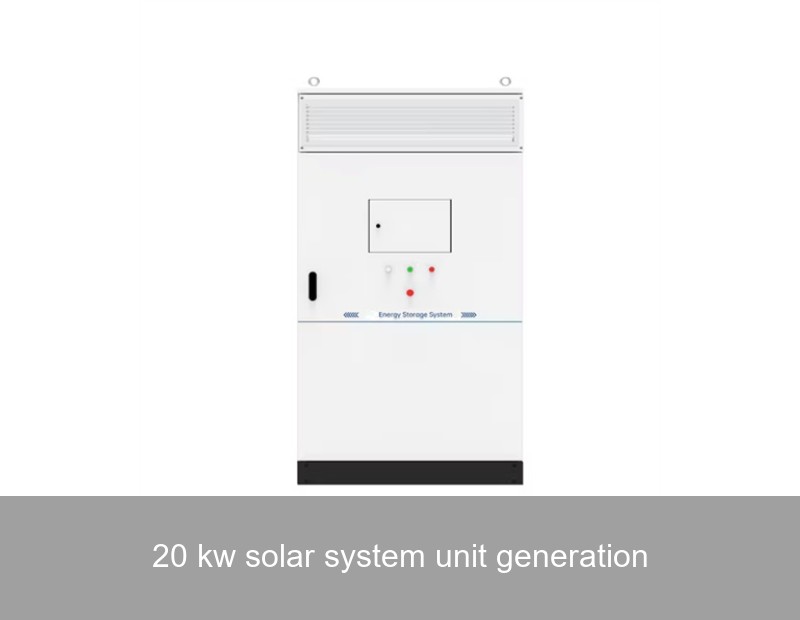
You've likely heard the buzz about solar power. Maybe your neighbor just installed panels, or your business is looking to cut soaring energy bills. Among the popular options, a 20 kW solar system stands out as a powerful solution for larger homes, small to medium businesses, and farms. But what does "20 kW solar system unit generation" actually mean in practical terms? How much energy does it produce, and is it the right fit for your energy independence goals? Let's demystify the numbers and explore the real-world potential of this robust solar unit.
Table of Contents
- Understanding 20 kW Unit Generation: More Than Just a Number
- Key Factors Affecting Your System's Output
- A Real-World Case Study: The German Bakery
- Beyond Solar Panels: The Role of Intelligent Storage
- The Highjoule Solution: Engineering Your Energy Independence
- Making the Decision: Is a 20 kW System Right for You?
Understanding 20 kW Unit Generation: More Than Just a Number
First, let's clarify the terminology. A "20 kW solar system" refers to the DC (Direct Current) power rating of the photovoltaic (PV) panels under ideal laboratory conditions. Think of it as the system's maximum engine size. However, "unit generation" is what you care about—the actual electricity (measured in kilowatt-hours, kWh) that this engine produces over time.
Here’s the crucial distinction: kW is power, kWh is energy. Your 20 kW system will rarely, if ever, produce exactly 20 kW of continuous power. Its output fluctuates with sunlight. So, the key question becomes: how many kWh does a 20 kW unit generate daily or annually?
As a rule of thumb, in sun-rich regions like Southern California or Southern Europe, you can expect a well-situated 20 kW system to produce 28,000 to 34,000 kWh per year. In regions with moderate sun like Germany or the UK, annual generation might range between 18,000 and 22,000 kWh. That's enough to power 3-4 average U.S. households or significantly offset the energy demands of a thriving small business.

Image: A commercial-scale solar installation similar to a 20 kW system. Source: Unsplash
Key Factors Affecting Your System's Output
Your actual generation will dance around these averages based on several critical factors:
- Location & Solar Insolation: This is the biggest variable. Arizona gets more annual sun than Washington state.
- Roof Orientation and Tilt: In the Northern Hemisphere, south-facing roofs at an optimal angle capture the most energy.
- Shading: Even partial shading from trees or chimneys can dramatically reduce output.
- Panel Efficiency & Technology: Higher-efficiency monocrystalline panels, like those used by Highjoule, generate more power in the same space.
- System Health & Maintenance: Dust, debris, and component degradation can lower production over time.
To get a precise estimate, tools like the NREL PVWatts Calculator are invaluable. They use historical weather data to model your specific potential.
A Real-World Case Study: The German Bakery
Let's move from theory to practice. Consider a family-run bakery in Munich, Germany. Facing rising electricity costs for ovens, refrigeration, and lighting, they installed a 20.4 kW rooftop solar system in early 2022.
- System Size: 20.4 kWp (48 high-efficiency panels)
- Location: Munich, Germany (moderate solar region)
- Primary Goal: Reduce operational costs and carbon footprint.
The system was projected to generate approximately 19,500 kWh annually. After one full year of operation, the monitored data revealed an actual generation of 20,110 kWh—slightly exceeding expectations due to a sunnier-than-average year.
| Metric | Result | Impact |
|---|---|---|
| Annual Solar Generation | 20,110 kWh | Covers ~65% of bakery's total electricity demand |
| Annual Energy Cost Savings | €5,800 (at local rates) | Significant reduction in variable costs |
| CO2 Emissions Avoided | ~9.2 tonnes annually | Equivalent to planting over 200 trees |
The bakery uses most of the solar power during the day when production is highest, aligning perfectly with their operational hours. The surplus energy fed back to the grid provides an additional small income stream through feed-in tariffs. This case illustrates a successful, predictable return on investment for a commercial 20 kW unit.
Beyond Solar Panels: The Role of Intelligent Storage
Here's a common puzzle our clients at Highjoule present: "My 20 kW system produces plenty of energy at noon, but my business runs into the evening, and my home energy use peaks at night." This is the fundamental challenge of solar—the intermittency gap.
A system without storage is like a reservoir with a hole in the bottom. You capture water (energy) when it's raining (sunny), but you can't save it for a drought (nighttime). This is where pairing your 20 kW solar unit with a battery energy storage system (BESS) becomes a game-changer.
An integrated solar-plus-storage solution allows you to:
- Maximize Self-Consumption: Store excess daytime generation for use in the evening, reducing reliance on the grid.
- Ensure Backup Power: Keep critical loads running during grid outages—a vital feature for businesses and homeowners alike.
- Enhance Grid Stability: Advanced systems can provide grid services, potentially creating new revenue streams.
The Highjoule Solution: Engineering Your Energy Independence
At Highjoule, we understand that a solar installation is not just about panels on a roof. It's about delivering reliable, intelligent, and sustainable power. For a robust application like a 20 kW solar system, we recommend our integrated HPS Series (Highjoule PowerStack).
Our HPS is a modular, lithium-ion battery storage system designed to seamlessly couple with solar arrays of this scale. What sets it apart is its AI-driven energy management system. It doesn't just store energy; it learns your consumption patterns, weather forecasts, and electricity rate schedules to autonomously optimize when to charge, discharge, or hold—putting every kilowatt-hour your 20 kW unit generates to its most economical use.
For larger commercial or microgrid applications, our containerized CESS (Containerized Energy Storage System) solutions offer utility-scale storage capacity, turning a solar installation into a true 24/7 power plant.

Image: A modern battery storage system, enabling energy independence. Source: Unsplash
Making the Decision: Is a 20 kW System Right for You?
So, how do you know if investing in a 20 kW solar system unit generation is your next smart move? Ask yourself these questions:
- What is my annual electricity consumption? (Check your utility bills; a 20 kW system often suits annual usage above 15,000 kWh).
- Do I have sufficient, unshaded space? Typically, a 20 kW system requires 1,000-1,300 sq. ft. of roof or ground area.
- What are my primary goals? (Maximum bill savings, backup power, sustainability targets, or a combination?).
- What is the net metering or feed-in tariff policy in my area? This greatly impacts financial returns. You can review policies for the U.S. on the DSIRE database.
The journey to energy independence is exciting but requires careful planning with experts who consider the entire ecosystem—solar generation, intelligent storage, and smart management.
A Final Thought to Power Your Decision
Imagine your energy bill not as a variable cost you dread, but as a predictable, shrinking line item. Imagine your business or home having its own resilient, clean power station. The technology, from high-efficiency photovoltaics to AI-optimized storage, is here and proven. The question is no longer "Can a 20 kW solar system work?" but rather, "What specific energy challenges do you want your customized 20 kW solar and storage solution from Highjoule to solve for you?"
 Inquiry
 Online Chat