


Is a Free Solar Power System for Home Truly Possible? Demystifying the Pathways
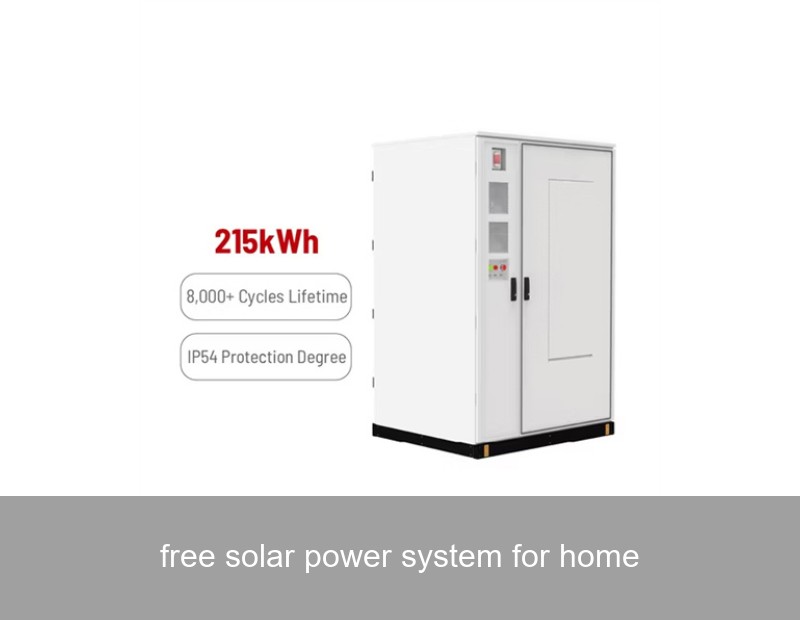
Imagine opening your electricity bill to see a credit instead of a charge. The concept of a free solar power system for home use is a powerful dream for homeowners across Europe and the US, promising liberation from rising energy costs. But is it a marketing myth or an achievable reality? The truth lies in understanding the evolving landscape of solar incentives, innovative financing, and the critical role of intelligent energy storage. Let's unpack how you can power your home with sunlight at minimal net cost and what it truly takes to achieve energy independence.
Table of Contents
- The "Free" Illusion: What Does It Really Mean?
- The Real Pathways to Net-Zero Cost Solar
- A Real-World Case Study: The German Family Home
- Beyond Panels: The System That Earns Its Keep
- What's Your Home's Solar Potential?
The "Free" Illusion: What Does It Really Mean?
First, let's be clear: the solar panels, inverters, and batteries themselves are not magically free. The phrase "free solar power system for home" typically refers to financial structures that eliminate or drastically reduce the upfront capital expenditure. You gain access to solar energy without a large initial payment, but you either pay for the electricity it produces over time or you leverage substantial subsidies that cover most of the system cost. The goal isn't literal zero cost, but achieving a situation where the savings on your utility bill immediately exceed your financing payment, creating a positive cash flow from day one.
The Real Pathways to Net-Zero Cost Solar
Several legitimate models can make solar feel "free" by removing the barrier of high initial investment.
Power Purchase Agreements (PPAs) & Leases
With a PPA, a third-party company owns, installs, and maintains the solar system on your roof. You simply agree to purchase the electricity it generates at a set rate, typically lower than your local utility's rate. This requires no money down and offers immediate savings. A lease is similar, where you pay a fixed monthly rent for the equipment. While these offer hassle-free entry, the long-term financial benefits are usually lower than owning the system outright.
Government Incentives & Tax Rebates
This is where the math gets exciting. In the United States, the federal Investment Tax Credit (ITC) allows you to deduct 30% of the system cost from your federal taxes. Coupled with state-level rebates and net metering policies, the effective cost can be halved. In Europe, countries like Germany, Italy, and Spain offer attractive feed-in tariffs or tax deductions. For example, in 2023, Germany's support for residential solar and storage made systems payback in under 8 years on average.

Image Source: Unsplash (Representative image of home solar and finance)
The Self-Consumption & Storage Multiplier
Here's the key insight: incentives alone don't maximize value. A system designed for high self-consumption—using your solar power directly—is crucial. Without storage, excess solar energy is sold to the grid at a low rate, while you buy back expensive power at night. Adding a battery changes the game entirely. It stores your daytime surplus for use in the evening, dramatically increasing self-consumption from ~30% to 70% or more. This directly slashes your bill and accelerates the payback period, making the net cost approach zero faster.
A Real-World Case Study: The German Family Home
Let's look at concrete data from Freiburg, Germany. The Schmidt family installed a 9.8 kWp solar array in 2022. With the German KfW subsidy, they received a 30% grant on their system, which included a Highjoule H2-Cube 10 kWh lithium-ion battery.
- System Cost (after grant): €14,000
- Annual Solar Production: 9,500 kWh
- Self-Consumption Rate (with Highjoule battery): 78%
- Annual Grid Electricity Purchased (previously 4,500 kWh): Reduced to 1,000 kWh
- Annual Savings on Energy Bill: €1,700
By combining the upfront subsidy with high self-consumption enabled by smart storage, the system pays for itself in approximately 8.2 years. Given a conservative system lifespan of 20+ years, that's over 12 years of virtually free solar power for their home. The Highjoule system's intelligent energy management software optimizes this flow, deciding when to store, use, or sell energy based on real-time tariffs and consumption patterns.
Beyond Panels: The System That Earns Its Keep
To approach "free" energy, every component must be reliable and synergistic. This is where choosing a provider with deep system integration expertise matters. Highjoule, as a global leader since 2005, doesn't just supply batteries; we provide intelligent, integrated storage solutions. Our systems are designed to seamlessly connect with leading solar inverters, creating a unified home energy ecosystem.
Our Residential Energy Hub platform includes:
- High-Density Battery Modules: Scalable from 5 kWh to 30+ kWh, using safe, long-life LiFePO4 chemistry.
- AI-Powered Energy Manager: Learns your household patterns, weather forecasts, and utility rate schedules to optimize financial savings automatically.
- Grid Services Readiness: In some markets, systems can participate in virtual power plants, earning you small revenues for supporting grid stability.
| Component | Role in Cost Reduction |
|---|---|
| Solar Panels | Generates "free" fuel (sunlight) |
| Highjoule Battery System | Maximizes use of that fuel, reducing grid purchases by 70%+ |
| Smart Energy Manager | Ensures every kilowatt-hour is used or sold at the most profitable time |
| Government Incentives | Lowers the initial investment hurdle dramatically |
How Highjoule's Smart Storage Enables True Energy Freedom
Think of your solar panels as a spring that produces water only during the day. Without a tank (battery), most of that water flows away unused. Highjoule's storage systems are the intelligent, high-capacity tank that stores it for when you need it most. For homeowners in the US and Europe navigating complex tariff structures like time-of-use rates, this intelligence is priceless. Our systems can be programmed to discharge during peak rate periods (e.g., 4-9 pm), avoiding the most expensive grid electricity.
Furthermore, Highjoule's focus on safety and durability means your system is a one-time investment that protects itself. With comprehensive monitoring via a user-friendly app, you have complete visibility and control over your home's energy flow, turning the abstract concept of "free solar" into a daily, tangible reality on your screen and your bill.

Image Source: Unsplash (Representative image of energy monitoring app)
What's Your Home's Solar Potential?
The journey to a near-zero cost solar power system for your home starts with a personalized assessment. It depends on your location, roof orientation, local electricity rates, and available incentives. The combination of strategic financing, available subsidies, and a high-efficiency, storage-optimized system from a provider like Highjoule makes the dream of energy independence more achievable than ever. What is the first question you need answered to evaluate if your home can join the energy freedom revolution?
 Inquiry
 Online Chat