


Understanding Commercial Generator Price and the Smart Energy Alternative
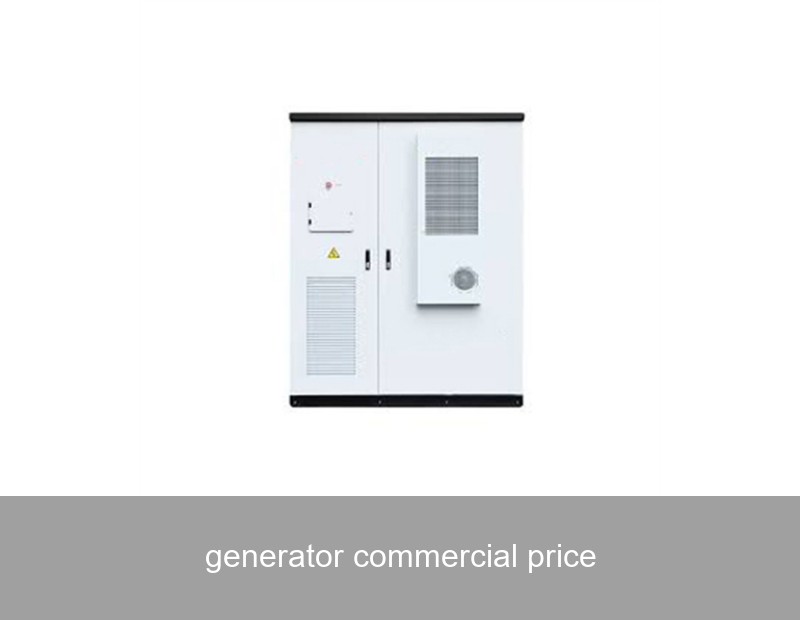
Table of Contents
- The Price Puzzle: More Than Just a Sticker Shock
- The True Cost Breakdown of a Commercial Generator
- The Data Reality: Fuel, Maintenance, and Carbon
- Case Study: A European Logistics Center's Journey
- The Modern Alternative: Battery Energy Storage Systems (BESS)
- The Highjoule Solution: Intelligent Storage for Commercial Resilience
- Making the Choice: A Framework for Decision-Makers
When a business considers backup power, the "commercial generator price" is often the first and sometimes the only figure they look up. It seems straightforward: you pay a sum, you get a machine that keeps the lights on during an outage. But as any seasoned facilities manager or business owner in Europe or the U.S. will tell you, that initial purchase price is just the tip of the iceberg. The real story of cost, reliability, and sustainability lies beneath the surface. In today's energy landscape, driven by volatility and a push for decarbonization, understanding the total cost of ownership (TCO) of a traditional generator is crucial. More importantly, it's vital to explore how modern battery energy storage systems (BESS) are not just an alternative but a strategic upgrade, offering control and savings that go far beyond mere backup.
The Price Puzzle: More Than Just a Sticker Shock
You've seen the quotes. A 500 kW diesel standby generator might have a listed price that seems manageable for the insurance it provides. But this figure rarely includes installation, wiring, fuel system integration, sound attenuation, and permitting—a process that can be lengthy and costly, especially in urban areas with strict emissions and noise regulations. The initial "commercial generator price" quickly inflates before the unit even rumbles to life for its first test. This upfront capital expenditure (CAPEX) is just the first chapter in a long-term financial commitment centered on a fuel-dependent asset.
The True Cost Breakdown of a Commercial Generator
To make an informed decision, we must dissect the TCO. Let's move beyond the sticker price.
Capital Expenditure (CAPEX)
- Unit Purchase: The base price of the generator set.
- Installation & Civil Works: Concrete pad, enclosure, exhaust system, electrical tie-ins.
- Fuel Storage: Tanks and related safety infrastructure, which must comply with environmental codes.
- Engineering & Permits: Design fees and regulatory compliance costs.
Operational Expenditure (OPEX)
- Fuel Costs: The most volatile and significant ongoing expense. Diesel or natural gas prices fluctuate with geopolitics and market dynamics.
- Scheduled Maintenance: Regular oil changes, filter replacements, coolant servicing, and load bank testing to ensure readiness.
- Unscheduled Repairs: Component failure after long periods of inactivity (a common issue for standby units).
- Emission Compliance: Potential costs for after-treatment systems or penalties in regions with carbon pricing.
Hidden and Contingency Costs
- Operational Noise & Pollution: Can affect community relations and employee well-being.
- Decommissioning: Cost of safely removing old fuel and disposing of the unit at end-of-life.
- Business Risk: The generator may fail to start or transfer power seamlessly, leading to potential data, product, or revenue loss.
The Data Reality: Fuel, Maintenance, and Carbon
The numbers speak volumes. According to the U.S. Energy Information Administration (EIA), diesel fuel prices for commercial customers have experienced significant volatility over the past decade. Running a large diesel generator can cost hundreds of dollars per hour in fuel alone during an extended outage. Furthermore, a report by the U.S. Department of Energy highlights that generator maintenance, especially for units that don't run frequently, is critical and costly to prevent failure. From a sustainability angle, the carbon footprint is substantial. For a business with ESG (Environmental, Social, and Governance) commitments, this is a major operational contradiction.

Image Source: Unsplash (Photographer: American Public Power Association)
Case Study: A European Logistics Center's Journey
Let's consider a real-world scenario. A major logistics hub in Germany, operating 24/7, relied on a 1 MW diesel generator for backup. Their annual cost analysis revealed:
| Cost Category | Annual Expense (EUR) | Notes |
|---|---|---|
| Fuel (Testing & Minor Outages) | 12,000 | Based on 50 hrs runtime |
| Scheduled Maintenance | 8,500 | Contract with service provider |
| Carbon Tax/Offset | 3,200 | Based on local emissions pricing |
| Total Annual OPEX | 23,700 |
Facing rising diesel costs and corporate net-zero targets, they sought an alternative. They partnered with Highjoule to deploy a 1.2 MWh Highjoule CUBE battery storage system, integrated with their existing solar PV array. The system provides seamless backup power for critical sorting operations. The result? Backup runtime is now powered by clean, self-generated solar energy stored in the batteries. The diesel generator is relegated to an emergency-only role, slashing its runtime and associated fuel and maintenance costs by over 90%. Furthermore, the system participates in grid-balancing services, creating a new revenue stream. The initial investment in the BESS is being offset by the dramatic OPEX reduction and new income, projecting a full payback in under 7 years.
The Modern Alternative: Battery Energy Storage Systems (BESS)
This is where the energy landscape is decisively shifting. A commercial-scale BESS is not a simple generator replacement; it's a multi-functional energy asset. Its "price" is an investment in a smarter infrastructure. Key advantages include:
- Near-Silent & Zero-Emission Operation: Can be installed indoors or close to operations without noise or fumes.
- Instantaneous Response: Provides backup power in milliseconds, far faster than generators which can take 10-60 seconds to start and stabilize.
- Multi-Revenue Streams: Beyond backup, it can perform peak shaving (reducing demand charges), time-of-use arbitrage (storing cheap energy for expensive periods), and provide grid services.
- Renewables Integration: Unlocks the full potential of onsite solar or wind by storing excess generation for use anytime.
- Lower Operational Costs: No fuel, minimal moving parts, and dramatically lower maintenance needs compared to combustion engines.
The Highjoule Solution: Intelligent Storage for Commercial Resilience
At Highjoule, we've been at the forefront of this transition since 2005. We understand that the conversation needs to shift from "commercial generator price" to "total value of energy resilience." Our solutions are designed to deliver that value comprehensively.
Our flagship Highjoule CUBE series for commercial and industrial applications is a modular, containerized BESS built with top-tier lithium-iron-phosphate (LFP) battery cells for safety and longevity. What sets it apart is the Highjoule Energy Operating System (EOS), an AI-driven software platform that makes the system intelligent. The EOS doesn't just manage backup power; it continuously analyzes your energy consumption, utility rates, and weather forecasts to autonomously optimize the system's operation for maximum financial return and resilience.
For businesses with existing generators, we offer hybrid solutions. Our systems can be configured to prioritize battery power during an outage, using the generator only for extended blackouts or as a backup to the backup. This "generator assist" mode drastically reduces generator wear, fuel consumption, and emissions, protecting your existing investment while modernizing your infrastructure.

Image Source: Unsplash (Photographer: American Public Power Association)
Making the Choice: A Framework for Decision-Makers
So, how should you evaluate your next power resilience investment? Ask these questions:
- What is the total cost of ownership over 10 years for a generator, including all projected fuel, maintenance, and compliance costs?
- What are the financial benefits (demand charge reduction, arbitrage, incentives) a BESS could bring in addition to backup?
- How does each option align with our corporate sustainability and ESG goals?
- What is the critical load we need to support, and for how long? (BESS can be sized precisely for this).
- Are there federal, state, or utility incentives (like the ITC in the U.S. or various EU grants) that significantly improve the economics of a BESS?
The choice is no longer binary. The most resilient and cost-effective solution is often an integrated one, blending solar generation, intelligent storage, and, if necessary, a minimized generator role.
Given the clear trajectory of energy prices and climate policy, is your business prepared to move beyond the traditional generator quote and invest in an energy asset that pays you back?
 Inquiry
 Online Chat