


GMI Grid Tie Micro Inverter: The Intelligent Heart of Modern Solar Arrays
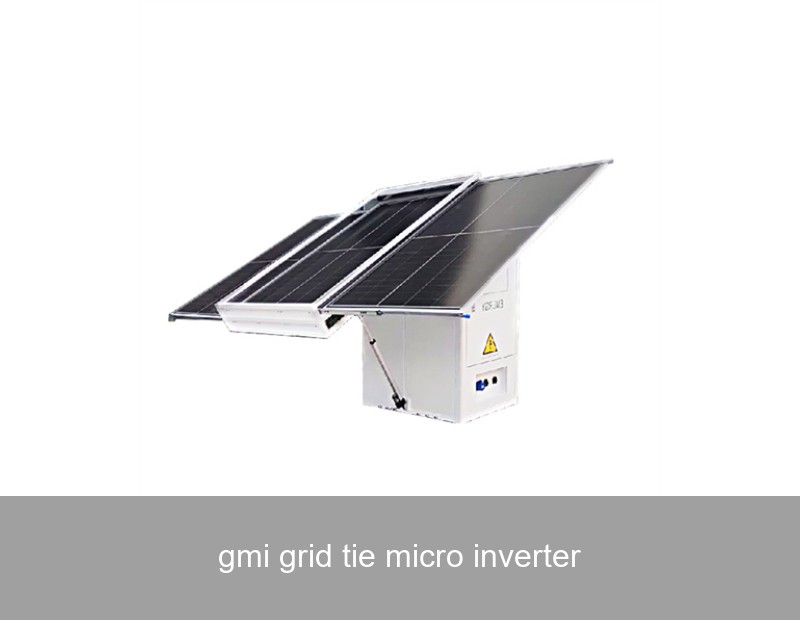
If you're exploring solar for your home or business, you've likely encountered a crucial choice: the type of inverter. While the large, central "string inverter" has been the traditional workhorse, a smarter, more resilient technology is rapidly becoming the preferred choice for savvy energy producers. Enter the GMI Grid Tie Micro Inverter. This isn't just a piece of hardware; it's a paradigm shift in how we harvest and manage solar energy, bringing intelligence, safety, and maximum output to every single panel on your roof.
What is a GMI (Grid Tie Micro Inverter)?
At its core, a Grid Tie Micro Inverter (GMI) is a small, powerful device attached to each solar panel in an array. Its primary job is the same as any inverter: converting the direct current (DC) electricity generated by the panel into the alternating current (AC) used by your home and the grid. The revolutionary difference lies in its architecture. Unlike a single, central inverter managing a whole "string" of panels, a microinverter system is decentralized. Each panel operates independently with its own GMI grid tie micro inverter, optimizing performance and turning a collection of panels into a true, intelligent network.
The Phenomenon: The Rise of Module-Level Power Electronics
For years, the solar industry faced a fundamental challenge: partial shading, debris, or panel mismatch could drag down the performance of an entire string, just like old Christmas lights. If one panel underperformed, every panel after it in the series suffered. This "weakest link" phenomenon meant homeowners weren't getting the full potential from their investment, especially on roofs with complex angles, chimneys, or nearby trees.
The market responded with a move towards Module-Level Power Electronics (MLPE), with microinverters being a leading category. By 2022, MLPEs had captured over 80% of the residential market share in the United States, a clear signal of the value homeowners and installers place on resilience and maximum energy harvest.
The Data Advantage: Why GMIs Outperform String Inverters
Let's break down the concrete benefits that make a GMI grid tie micro inverter system a superior choice for most installations:
- Maximum Power Point Tracking (MPPT) Per Panel: This is the killer feature. Each microinverter continuously finds the optimal operating voltage and current for its specific panel. If one panel is in shade, the others continue producing at 100% of their capability.
- Increased Energy Yield: Studies and real-world data consistently show microinverter systems can produce 5-25% more energy annually than string inverter systems, particularly on partially shaded roofs.
- Enhanced Safety: GMIs convert DC to AC right at the panel, meaning the wiring in your conduit is always low-voltage AC. This eliminates the risk of dangerous high-voltage DC "arc faults," a significant safety advancement.
- Panel-Level Monitoring: You can see the performance of every individual panel on your phone or computer. If a panel's output dips, you know immediately—no more guessing which panel in a string is underperforming.
- Design Flexibility & Scalability: Systems are easier to design for complex roofs, and you can easily add panels later without re-engineering the entire inverter system.
| Feature | GMI Microinverter System | Central String Inverter |
|---|---|---|
| Power Optimization | Per panel (Module-Level) | Per string (System-Level) |
| Shading Impact | Minimal; only affects the shaded panel | High; can reduce entire string output |
| Monitoring Granularity | Individual panel performance | Overall system performance only |
| Safety | Low-voltage AC on roof, no high-voltage DC | High-voltage DC runs from roof to inverter |
| Scalability | Easy to expand | Limited by inverter capacity |
A Real-World Case: Overcoming Shading in a California Neighborhood
Consider a real scenario from a suburban neighborhood in Sacramento, California. A homeowner had a south-facing roof, but two beautiful Redwood trees in the neighbor's yard cast moving shadows across parts of the array in the afternoon. A quote using a string inverter projected significant afternoon production losses.
The installer instead proposed a system using a leading GMI grid tie micro inverter solution. The result? First-year production data showed a 22% higher yield during the critical summer months compared to the string inverter projection. The microinverters allowed the unshaded panels to operate at peak efficiency while the shaded ones contributed what they could. The homeowner's ROI improved dramatically, and they gained peace of mind knowing their system was resilient against seasonal shading changes.

Image Source: Unsplash (Representative image of partial shading on a rooftop solar array)
Expert Insights: Safety, Monitoring, and Longevity
From a technical and fire safety perspective, the shift to AC-coupled systems with GMIs is a major step forward. The National Renewable Energy Laboratory (NREL) has highlighted the reduced fire risk associated with eliminating long runs of high-voltage DC wiring. Furthermore, the granular data from each GMI grid tie micro inverter is a diagnostic treasure trove. It enables predictive maintenance—catching issues like a failing panel or wiring problem long before it causes a noticeable dip in total system output.
Regarding lifespan, while central inverters typically need replacement after 10-15 years (often before the panels themselves), quality microinverters come with 25-year warranties, matching the panel warranty and simplifying long-term system ownership.
The Highjoule Solution: Smart Energy, Panel by Panel
At Highjoule, we've built our philosophy around intelligent, resilient, and sustainable energy independence. Our approach to solar integration fully embraces the power of module-level intelligence. While we partner with leading microinverter manufacturers to provide top-tier GMI grid tie micro inverter hardware, our true value lies in the holistic system.
We don't just sell components; we deliver integrated energy ecosystems. Our smart energy management platform seamlessly connects your microinverter-based solar array with Highjoule's advanced battery storage systems (like our H-Joule Cube for residential or H-Joule Matrix for commercial use). This platform uses the rich data from every microinverter to make intelligent, real-time decisions: storing excess solar energy, optimizing self-consumption, and providing backup power during outages.
For a business with a large, complex roof or a homeowner who wants the absolute maximum from every ray of sunshine, our systems are designed to ensure no kilowatt-hour is left behind. We provide end-to-end solutions—from design and financing to installation and lifetime monitoring—ensuring your investment in a GMI grid tie micro inverter system delivers its full potential for decades.

Image Source: Unsplash (Representative image of an energy management system)
GMIs and the Future of the Prosumer Grid
The decentralized, intelligent nature of GMI grid tie micro inverter systems perfectly aligns with the future of electricity grids. As grids modernize, they require more flexibility and two-way communication. Systems using GMIs can more easily participate in virtual power plants (VPPs) and grid services, allowing you to contribute to grid stability and potentially earn revenue. The panel-level data is also crucial for advanced applications like dynamic rate management, where your system can automatically adjust consumption and storage based on real-time electricity prices.
As the International Energy Agency (IEA) notes, distributed solar PV is a cornerstone of the global energy transition. Technologies that maximize its yield and reliability, like microinverters, will be indispensable.
Ready to See the Difference for Your Roof?
Understanding the technology is the first step. The next is seeing how a modern, intelligent solar and storage system with GMI grid tie micro inverter technology can transform your energy independence. What unique challenges does your property's roof present, and how much more energy could you harvest with a system that optimizes every single panel?
 Inquiry
 Online Chat