


Green Power Technologies: Your Guide to a Sustainable and Resilient Energy Future
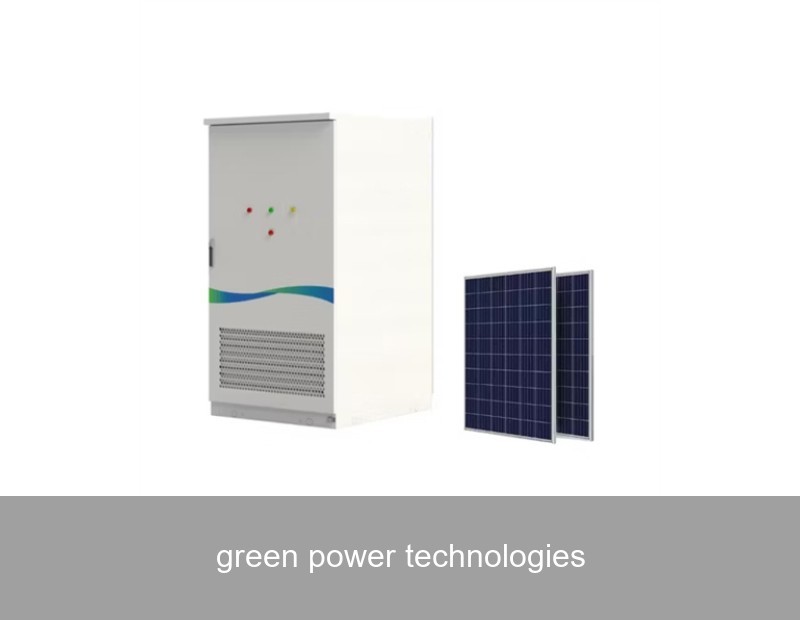
Have you ever watched your electricity bill climb with a sense of helplessness, or wondered what happens when the grid falters during a storm? You're not alone. Across homes, businesses, and entire communities, a quiet revolution is underway. People are moving from passive consumers to active energy managers, and the key to this shift is the intelligent adoption of green power technologies. But what exactly does this term encompass, and more importantly, how can it deliver real-world benefits for your wallet and the planet? Let's demystify the journey from renewable generation to reliable power in your hands.
Table of Contents
- The Phenomenon: Energy Anxiety in a Changing World
- The Data: Why Green Tech is More Than an Environmental Choice
- The Core Technologies: Solar, Storage, and Smart Management
- A Real Case Study: The Bavarian Bakery Embracing Energy Independence
- Beyond the Basics: The Highjoule Approach to Integrated Energy
- Your Next Step: Is Your Property Ready for a Green Power Audit?
The Phenomenon: Energy Anxiety in a Changing World
We're experiencing a perfect storm in energy. Extreme weather events, from heatwaves in Europe to deep freezes in Texas, are stressing aging power grids. Simultaneously, the geopolitical landscape has injected volatility into fossil fuel prices. This combination creates "energy anxiety" – the real concern over cost, reliability, and environmental impact. It’s no longer a niche worry; it's a boardroom and household discussion point. The logical response? Taking greater control. This is where modern green power technologies shine. They are no longer just about being "green" in an abstract sense; they are practical tools for resilience, predictability, and financial savings.
The Data: Why Green Tech is More Than an Environmental Choice
Let's talk numbers. According to the International Energy Agency (IEA), renewable capacity additions grew by almost 50% in 2023, reaching nearly 510 gigawatts. That's the fastest growth rate in two decades. But here's the critical insight: the value of renewables is massively amplified when paired with storage. The U.S. Energy Information Administration notes that while solar generation is often highest in the middle of the day, peak electricity demand for many regions occurs in the early evening. This creates a "duck curve" – a mismatch between supply and demand.

Image: Solar arrays are a foundational green power technology. Source: Unsplash
Without storage, excess solar energy is wasted. With a battery energy storage system (BESS), that midday sun can power your home or business at night. This isn't just theory. The levelized cost of energy from solar PV has plummeted by over 80% in the last decade, making it the cheapest source of electricity in history for many regions. When you layer in storage for time-shifting that power, the economic case becomes compelling, turning a clean choice into a shrewd financial one.
The Core Technologies: Solar, Storage, and Smart Management
So, what are the key components of a robust green power system? Think of it as a three-legged stool: generation, storage, and intelligence.
- Solar Photovoltaics (PV): The workhorse. Modern panels are highly efficient, durable, and form the primary generation asset for most distributed systems.
- Battery Energy Storage Systems (BESS): The game-changer. Lithium-ion batteries, particularly in safe, stable chemistries like Lithium Iron Phosphate (LFP), store excess energy. They provide backup power during outages and allow you to use your solar energy on demand.
- Energy Management Systems (EMS): The brain. This software intelligently controls when to charge from solar or the grid, when to discharge to power your loads, and when to participate in grid services. It maximizes self-consumption and ROI.
It's the seamless integration of these three that transforms a collection of hardware into a true green power technology solution. This is where expertise matters immensely. A poorly integrated system can underperform, while a harmonized one delivers results beyond the sum of its parts.
What to Look For in a Storage System
| Feature | Why It Matters |
|---|---|
| Battery Chemistry (e.g., LFP) | Safety, longevity, and thermal stability. LFP is known for a long cycle life and excellent safety profile. |
| Modular & Scalable Design | Allows you to start with what you need and expand capacity as your energy needs grow. |
| Grid-Forming Capability | Advanced systems can "island" and create a stable microgrid during a blackout, without needing the main grid as a reference. |
| Intelligent Software & Monitoring | Provides real-time insights, control, and optimization algorithms to maximize financial returns. |
A Real Case Study: The Bavarian Bakery Embracing Energy Independence
Let's make this concrete. Consider "Brotzeit," a mid-sized artisanal bakery in southern Germany. Their challenges were classic: high energy costs for refrigeration and electric ovens, and a need for uninterrupted power to prevent spoilage and production halts. They had a rooftop solar array, but were still exporting a lot of power at low feed-in tariffs in the afternoon and buying expensive power in the morning.

Image: Commercial operations like bakeries have critical, high-energy loads. Source: Unsplash
Their solution was an integrated green power technology upgrade. They installed a Highjoule HiveStack Commercial BESS, a modular 100 kWh system, alongside an upgraded energy management system. The results, measured over one year, were striking:
- Self-Consumption of Solar: Increased from 35% to over 85%.
- Grid Energy Costs: Reduced by 68%.
- Backup Power: The system now provides full backup for critical refrigeration and lighting for up to 10 hours, securing their inventory.
- ROI Timeline: Projected payback period of just under 5 years, thanks to energy arbitrage and reduced demand charges.
The bakery manager noted, "It's not just about saving money. It's about the peace of mind. Our dough won't spoil, and our ovens will stay on. We've future-proofed our business." This case exemplifies the triple win of modern green tech: economic, operational, and environmental.
Beyond the Basics: The Highjoule Approach to Integrated Energy
As a leader in advanced energy storage since 2005, Highjoule's philosophy is that true power comes from integration. Our products are designed from the ground up to be more than just batteries in a box.
For residential clients, our HomePower series offers sleek, scalable storage with an intuitive app that puts energy control in the homeowner's pocket. It seamlessly integrates with existing or new solar, creating a personal power plant.
For commercial and industrial (C&I) applications, the HiveStack system is a workhorse. Its modular design means businesses can start with a 50 kWh unit and scale to multiple megawatt-hours. Its advanced grid-forming inverters allow facilities to operate independently during outages—a critical feature for data centers, manufacturing, and cold storage.

Image: A commercial-scale battery energy storage system installation. Source: Unsplash
Our most sophisticated offering is for microgrids. Highjoule designs and deploys turnkey systems that can combine solar, wind, storage, and backup generators into a resilient, self-sufficient energy network for campuses, remote communities, or industrial parks. Our proprietary energy management software acts as the central nervous system, optimizing for cost, carbon, and reliability every second of the day. By viewing green power technologies as an interconnected ecosystem, we help our clients achieve a level of energy security and efficiency that was previously out of reach.
Your Next Step: Is Your Property Ready for a Green Power Audit?
The journey toward energy resilience often starts with a simple question: How much of my own clean energy am I wasting? The data from your utility bill and your site's solar potential hold the answer. The evolution of green power technologies has moved them from the fringe to the core of smart energy planning.
We've seen how a bakery in Bavaria transformed its operations. The same principles apply to a family home in California looking to offset rising rates, a hospital in Sweden needing critical backup, or a factory in Poland aiming to meet EU sustainability targets. The technology is proven, the economics are solid, and the need for energy independence is clearer than ever.
What does your current energy consumption pattern look like, and what would a 70% reduction in grid dependence mean for your operational stability or household budget this coming year?
 Inquiry
 Online Chat