


Grid Following Inverters: The Quiet Maestros of Modern Power Systems
Imagine the electrical grid as a vast, complex orchestra. The power plants are the booming brass and percussion, setting the fundamental frequency. Now, enter a new wave of performers—solar panels, wind turbines, and battery storage systems. How do these diverse, variable energy sources play in perfect harmony with the established grid? The answer lies in a critical, often unsung, piece of technology: the grid following inverter. As we transition to a renewables-dominated landscape, understanding the role of these intelligent devices is key to a stable and efficient energy future.
Table of Contents
- What Are Grid Following Inverters?
- How They Work: The PAS Framework in Action
- The Data Challenge: Stability in a Decentralized World
- A Real-World Case: California's Duck Curve & Inverter Solutions
- Beyond Following: The Future with Highjoule's Smart Systems
- Choosing the Right Inverter Technology for Your Project
What Are Grid Following Inverters?
At its core, a grid following inverter is the essential bridge between a distributed energy resource (DER)—like a solar array or a battery—and the main utility grid. Its primary job is to convert the direct current (DC) produced by solar panels or stored in batteries into the alternating current (AC) used by our homes, businesses, and the grid. But the "following" part is crucial. These inverters are programmed to synchronize with the existing grid. They constantly monitor the grid's voltage and frequency (like a musician listening for the conductor's tempo) and adjust their output to match it precisely. They rely on a strong, stable grid signal to operate and are, by design, reactive to the grid's conditions.
The Core Components of a Grid Following System
- Phase-Locked Loop (PLL): The "listening ear" that locks onto the grid's AC waveform.
- DC-AC Conversion Circuitry: The power electronics that perform the actual current conversion.
- Control Algorithms: The software brain that dictates how much power to inject based on available DC input and grid parameters.
- Protection Relays: Safety mechanisms that disconnect the system in case of grid faults (anti-islanding).
How They Work: The PAS Framework in Action
Let's break down their operation using the PAS (Problem-Agitate-Solution) framework, which mirrors the real-world challenges they solve.
| Stage | Description | Grid Following Inverter's Role |
|---|---|---|
| Problem | Renewables generate DC power, but the grid and loads need stable AC power. Intermittent generation can cause instability. | Acts as the mandatory translator, enabling solar/battery power to be usable by the grid. |
| Agitate | Without proper synchronization, out-of-phase power can cause equipment damage, grid faults, and blackouts. The inverter must also stop feeding power during a grid outage for safety (anti-islanding). | Continuously monitors grid health. If the grid deviates or fails, it shuts down, highlighting a limitation in standalone backup scenarios. |
| Solution | Provide a reliable, automated way to integrate variable renewables seamlessly, maintaining grid stability and power quality. | Its sophisticated controls ensure smooth synchronization, precise power injection, and safe operation, making large-scale renewable integration possible. |
The Data Challenge: Stability in a Decentralized World
Here's where it gets interesting. As documented by the National Renewable Energy Laboratory (NREL), high penetration levels of inverter-based resources (like solar PV) can lead to new stability challenges. Traditional power plants with large spinning generators provide inherent "inertia" that helps the grid ride through disturbances. Grid following inverters, by contrast, are inherently "inertia-less." They follow the grid but don't actively help hold it up during sudden shifts in supply or demand.
This phenomenon is not just theoretical. Grid operators are seeing faster frequency deviations and voltage fluctuations. The data shows that while grid following inverters are perfect for moderate renewable penetration, a future where renewables supply 50%, 70%, or more of instantaneous power demands a more proactive approach from inverter technology.

Large-scale solar farms rely on thousands of grid-following inverters. The future grid will require these systems to be more interactive. (Image: Unsplash / American Public Power Association)
A Real-World Case: California's Duck Curve & Inverter Solutions
Perhaps no case study illustrates the evolution of inverter needs better than California's famous "Duck Curve." This graph, from the California Independent System Operator (CAISO), shows the sharp net load drop in midday (due to high solar production) and the steep ramp-up required in the evening as the sun sets and demand rises.
Phenomenon: The deep "belly" of the duck represents times when solar (via grid-following inverters) is flooding the grid. Data: In 2020, CAISO reported over 10,000 MW of utility-scale solar capacity, primarily using grid-following technology. Case: This massive, concentrated output can lead to over-voltage issues and requires fossil-fuel plants to ramp down inefficiently. Insight: While grid-following inverters enabled this solar boom, managing the Duck Curve requires more than just following; it requires active grid support.
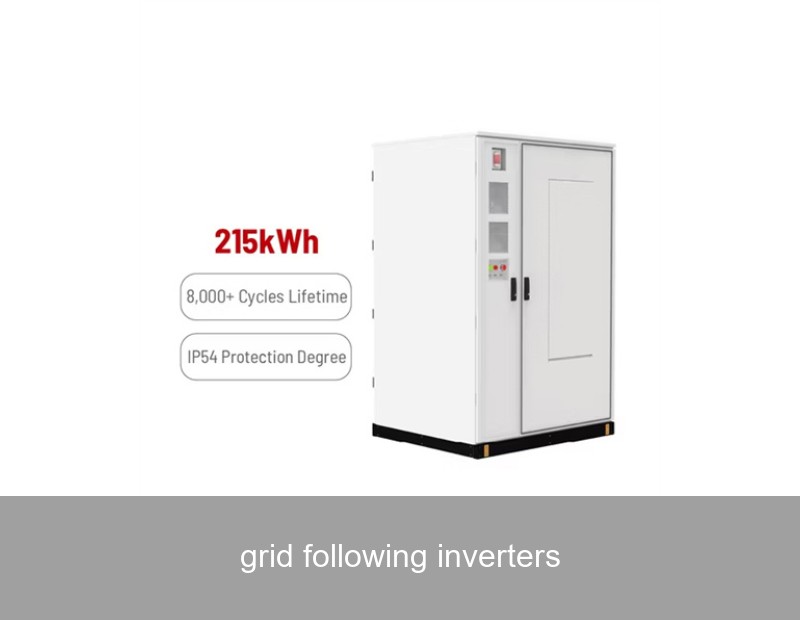
This is where advanced energy storage systems paired with smarter inverters come in. Companies like Highjoule address this exact challenge. For instance, our Highjoule HPS Series commercial battery energy storage systems (BESS) utilize advanced grid-following inverters that can be programmed for sophisticated ramp rate control and time-of-day shifting. They absorb excess solar during the day and release it during the evening ramp, effectively "flattening the duck." Our systems go beyond basic following by offering grid-support functions like frequency-watt response, which allows them to subtly adjust output based on grid frequency, providing a layer of stability as renewable penetration grows.
Beyond Following: The Future with Highjoule's Smart Systems
The industry is now moving towards grid-forming inverters—technology that can create a stable voltage and frequency waveform independently, acting like a virtual power plant. While this is the frontier, the transition will be gradual. At Highjoule, we believe in pragmatic innovation. Our product roadmap is built on hybrid intelligence.
Our latest Residential HySwitch and Industrial Microgrid Controller platforms often employ a combination of technologies. During normal operation, our inverters operate in high-efficiency grid-following mode. However, in the event of a grid disturbance or in an intentional islanded microgrid setup, key units can seamlessly transition to a grid-forming mode to maintain power stability for critical loads. This dual capability offers the best of both worlds: cost-effective, efficient grid-tied operation and resilient backup power.
Our services extend beyond hardware. Highjoule's Energy Management Software (EMS) platform orchestrates fleets of inverters—whether grid-following or forming—to act as a unified resource. This allows a business park or a community microgrid to optimize self-consumption, participate in utility demand response programs, and provide valuable grid services, all managed through an intuitive cloud-based interface.

Modern BESS installations, like those from Highjoule, integrate advanced inverters that are software-upgradable to meet evolving grid standards. (Image: Unsplash / ThisisEngineering)
Choosing the Right Inverter Technology for Your Project
So, how do you, as a business owner, project developer, or sustainability manager, navigate this technical landscape? The choice between grid-following and more advanced inverters isn't binary; it's about matching the technology to your application.
- Standard Grid-Tied Solar Array: For a straightforward commercial solar installation where the primary goal is offsetting utility bills and the grid is reliable, high-quality grid-following inverters remain the economical and effective choice. Highjoule's solar integration solutions provide robust, reliable performance in this space.
- Solar + Storage for Resilience: If your goal includes backup power or maximizing self-consumption, you need a system capable of islanding. Look for hybrid inverters or storage systems (like the Highjoule HPS Series) that can operate in both grid-following and off-grid modes.
- Microgrids & Weak Grids: For remote industrial sites, campuses, or areas with unstable grid infrastructure, investing in inverters with advanced grid-forming capabilities is essential. These systems can form the "heartbeat" of a stable local grid.
The key is partnering with a provider that understands the full spectrum of needs. Highjoule's expertise lies in designing tailored systems that not only meet today's grid interconnection standards but are also future-ready through software-upgradable controls.
A Final Thought: What Role Will Your Energy Assets Play?
The grid is evolving from a one-way street to a collaborative network. Your solar panels or battery system, through its inverter, is no longer just a passive generator or load. It's a potential grid citizen. The question is no longer just "how much power can I generate?" but rather "how can my energy assets contribute to a more resilient and sustainable grid ecosystem?" Whether starting with sophisticated grid-following or pioneering grid-forming, the journey begins with choosing technology that sees the bigger picture. What's the first step you'll take to ensure your energy investment is both smart for you and supportive of the grid's future?
 Inquiry
 Online Chat