


Unlocking the Full Potential of Your Solar Investment with High Efficient Solar Panels
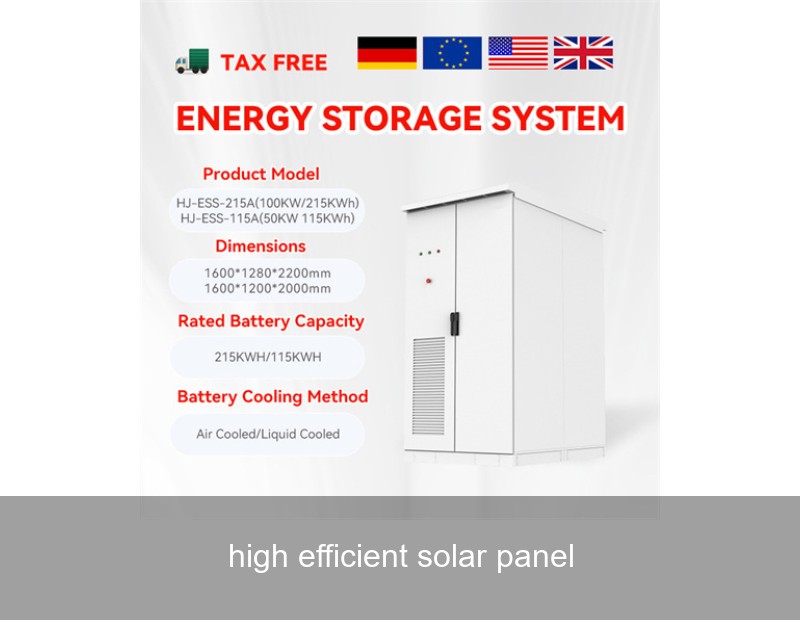
So, you've decided to go solar. That's a fantastic step towards energy independence and sustainability. But if you're like most homeowners and business owners, you're probably wondering: "Are all solar panels created equal?" The short answer is no. The key to maximizing your return lies in choosing and utilizing high efficient solar panels. But here's the catch many don't see coming: the most advanced panel on your roof is only as good as the system that manages its power. This is where intelligent energy storage and management becomes non-negotiable. Let's explore why pairing high-efficiency panels with a smart storage system is the ultimate power move.
Table of Contents
- The Efficiency Gap: More Sunlight, More Complexity
- The Data Reality: Curtailment is Costing You Money
- The Storage Solution: From Spillover to Savings
- Case Study: A Bavarian Bakery's Recipe for Energy Success
- Highjoule's Role: The Intelligent Brain for Your Solar Power
- Future-Proofing Your Energy Setup
The Efficiency Gap: More Sunlight, More Complexity
Modern high efficient solar panels, often using monocrystalline PERC, N-Type, or even heterojunction (HJT) cells, can convert over 22% of sunlight into electricity. That's a significant leap from the 15-17% common just a decade ago. This means you can generate more power from the same rooftop space—a crucial advantage for properties with limited area.
However, this blessing creates a new challenge. These panels produce peak power intensely during midday sun hours, often far exceeding a home or business's immediate consumption. Without a way to capture this surplus, it gets fed back to the grid, typically for a minimal feed-in tariff that's much lower than the retail price you pay for electricity later. It's like having a high-flow faucet but only a thimble to catch the water; the rest just drains away.
The Critical Midday Spike
Think about your own energy use. Are you home using major appliances at 1 PM on a sunny Tuesday? Probably not. For businesses, consumption patterns vary, but the sun doesn't. This mismatch between solar production and energy consumption is the fundamental hurdle that high efficient solar panels alone cannot solve.
The Data Reality: Curtailment is Costing You Money
Let's talk numbers. The National Renewable Energy Laboratory (NREL) has extensively studied solar integration. Their research indicates that in scenarios with high solar penetration, curtailment—the deliberate reduction of solar output—becomes common without storage. For a residential system with premium panels, you might be "throwing away" 30-50% of your potential solar generation annually because it's produced when you don't need it.
| Scenario | Solar Generation | Direct Self-Consumption | Excess (Curtailed or Exported) |
|---|---|---|---|
| Home without Storage | 10,000 kWh/year | ~3,500 kWh | ~6,500 kWh |
| Home with Intelligent Storage | 10,000 kWh/year | ~8,000 kWh+ | ~2,000 kWh |
This table illustrates the stark difference. High efficiency panels boost the "Solar Generation" column, but only storage dramatically improves the "Direct Self-Consumption" column—which is where real savings live.
The Storage Solution: From Spillover to Savings
This is where the narrative shifts. An advanced battery energy storage system (BESS) acts as a reservoir for your solar bounty. Instead of sending excess midday power to the grid for pennies, you store it. Then, during the evening peak when grid prices are high, you draw from your battery. This simple shift—consume what you produce—is the secret to unlocking the true financial return of your high-efficiency panels.
But not all storage is created equal. The system must be:
- High-Efficiency Itself: Just as you care about panel efficiency, look for a storage system with a high round-trip efficiency (like Highjoule's systems, which exceed 96%). You don't want to lose a chunk of your hard-won solar energy in the storage process.
- Intelligently Managed: It should learn your consumption patterns, weather forecasts, and even utility rate schedules to autonomously decide when to charge, store, and discharge for maximum economic benefit.
- Scalable and Safe: It must grow with your needs and be built with proven, safe battery chemistry and robust thermal management.

Credit: Photo by Andreas Gücklhorn on Unsplash. A modern home solar installation, where adding a battery storage unit is key to maximizing the value of the panels.
Case Study: A Bavarian Bakery's Recipe for Energy Success
Let's look at a real-world example. Schmidt Bakery, a family-owned business in southern Germany, installed a 50 kW rooftop array of top-tier high efficient solar panels in 2021. Their goal was to cut soaring energy costs for their ovens and refrigeration.
The Problem: Their solar system produced 75% of its daily output between 10 AM and 3 PM. However, their baking cycle started at 4 AM, and a second major energy load hit after 5 PM for cleaning and preparation. They were exporting most of their solar energy and buying expensive grid power during their operational hours.
The Solution: In 2023, they integrated a Highjoule HiveStack Commercial 50 battery storage system. This 50 kWh system was paired with Highjoule's EnergyOS platform, which intelligently manages the flow of energy.
The Data-Driven Outcome (First Year):
- Self-Consumption of Solar Power: Increased from 35% to 88%.
- Grid Electricity Purchases: Reduced by 70%.
- Payback Period for the Storage System: Projected under 5 years, thanks to Germany's high electricity prices and intelligent peak shaving.
- The system automatically charges the batteries with midday solar surplus and discharges during their morning and evening peaks, effectively making the bakery's own solar power available on demand.
This case shows that high efficient solar panels are the engine, but intelligent storage is the transmission that delivers power exactly when and where you need it.
Highjoule's Role: The Intelligent Brain for Your Solar Power
At Highjoule, we've focused on this very synergy since 2005. We understand that a solar installation is not complete without a plan for the energy it produces. Our product suite is designed to be the perfect partner for your high efficient solar panels.
For residential clients, our HomePower series of lithium iron phosphate (LFP) battery systems are built for safety, longevity, and seamless integration with any major solar inverter. The accompanying app gives you full visibility and control, allowing you to tailor your energy strategy.
For commercial and industrial applications, our modular HiveStack systems can scale from 30 kWh to multiple megawatt-hours. Crucially, the EnergyOS software platform is what sets us apart. It doesn't just store energy; it optimizes it. By considering time-of-use rates, demand charges, and solar forecasts, it makes autonomous decisions to maximize your financial return and energy resilience.

Credit: Photo by American Public Power Association on Unsplash. The interior of a scalable, containerized battery storage system like Highjoule's HiveStack for commercial use.
Why Our Technology is a Perfect Match for High-Efficiency Panels
- Ultra-High Efficiency: Our systems minimize energy loss, ensuring more of your premium solar generation is available for use.
- Dynamic Power Management: They can handle the high output of modern panels, preventing inverter clipping and capturing every possible kilowatt-hour.
- Grid Services Ready: In some markets, our systems can even provide grid stabilization services, creating an additional revenue stream from your solar+storage asset.
Future-Proofing Your Energy Setup
The energy landscape is shifting. Net metering policies are changing, as seen in states like California, making self-consumption more valuable than ever. Electricity prices continue to be volatile. Investing in high efficient solar panels is a wise first step, but it's only half of the equation.
By pairing them with an intelligent storage system from Highjoule, you're not just buying hardware; you're investing in an energy ecosystem. You build resilience against outages, take control of your energy costs, and ensure that no drop of your solar investment is wasted.
So, as you research the best high efficient solar panels for your roof, we invite you to ask this critical question: What is my plan for the energy they will produce, not just during the day, but around the clock? How will you capture the full value of your solar potential?
 Inquiry
 Online Chat