


The Solar Power Kit Revolution: How Microinverters Are Changing the Game
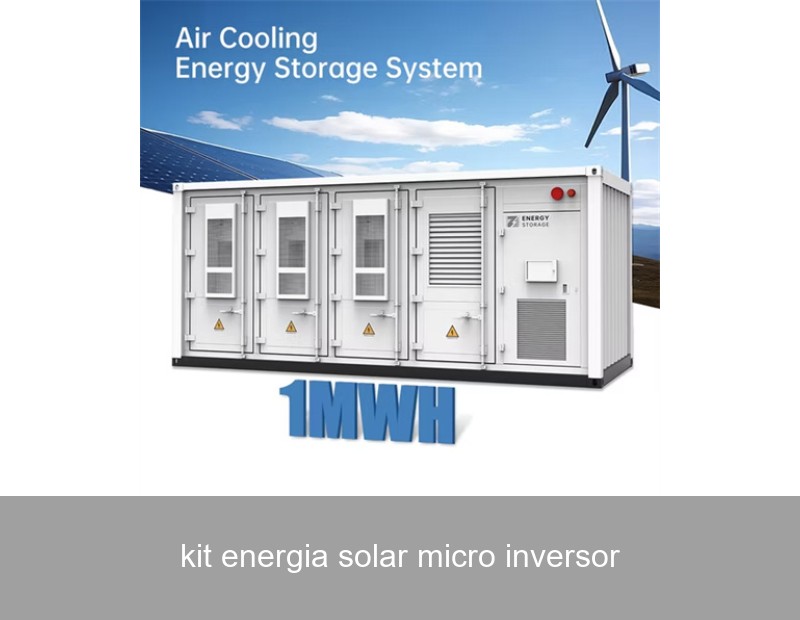
You've decided to go solar. You're picturing lower energy bills, a smaller carbon footprint, and energy independence. But when you start researching, you're hit with a wave of technical jargon. One term you'll encounter frequently is the "kit energia solar micro inversor" – a solar power kit built around microinverter technology. This isn't just another component; it represents a fundamental shift in how we capture and use solar energy. For homeowners and businesses across Europe and the U.S., understanding this technology is key to unlocking a smarter, more resilient, and more efficient solar energy system.
What is a Solar Kit with a Microinverter?
Let's break it down. A traditional solar setup uses a single, central "string" inverter. All your solar panels are connected in a series, like old Christmas lights, sending DC power to one box on the side of your house. A kit energia solar micro inversor flips this concept. It includes solar panels where each panel, or pair of panels, has its own small inverter – a microinverter – attached directly to the racking underneath. This means power conversion from DC to usable AC happens right at the source, on your roof.
Think of it this way: a string inverter is like a single, powerful engine for a whole train (all your panels). If one car has a problem, the whole train slows down. A microinverter system gives each car its own efficient, independent engine. The performance of one doesn't drag down the others.

Image Source: Unsplash (Representative image of solar panel installation)
Microinverters vs. String Inverters: A Clear Comparison
Choosing the right technology impacts your system's output, monitoring, and longevity. Here’s a straightforward comparison:
| Feature | Microinverter System (Kit) | Traditional String Inverter |
|---|---|---|
| Power Harvesting | Panel-level Maximum Power Point Tracking (MPPT). Each panel operates independently at peak efficiency. | System-level MPPT. The entire string performs at the level of the weakest panel. |
| Shade & Debris Impact | Minimal loss. Shade on one panel only affects that panel's output. | Significant loss. Shade on one panel can reduce output for the entire string. |
| Monitoring | Granular, per-panel performance data via an app. You see the health of each individual panel. | Typically, only whole-system monitoring. Hard to pinpoint underperforming panels. |
| Expansion | Easily scalable. You can add more panels with their own microinverters later. | Complex. Often limited by the capacity of the central inverter. |
| Longevity & Warranty | Longer warranties (often 25 years), matching panel life. Components are distributed. | Shorter warranties (typically 8-12 years). A single point of failure. |
Key Benefits of a Microinverter-Based Solar Kit
So, why is the market shifting towards these kits? The advantages are compelling, especially for the diverse climates and roof types found in Europe and North America.
- Maximum Energy Harvest: With panel-level MPPT, you squeeze every possible watt-hour from your roof, even if parts are in shade at different times of the day. According to a U.S. Department of Energy resource, shading even a small portion of a string system can lead to disproportionate power loss, a problem microinverters virtually eliminate.
- Enhanced Safety: The system outputs low-voltage DC on the roof, converting to AC immediately. This reduces fire risk associated with high-voltage DC arcs, a concern noted by several fire safety organizations.
- Superior Monitoring and Diagnostics: Receive instant alerts if a specific panel's output drops due to dirt, a defect, or physical damage. No more guessing games.
- Design Flexibility: You can install panels on multiple roof planes with different orientations (e.g., east and west-facing) without worrying about complex string design penalties. This is ideal for non-standard roofs common in older European cities.
Highjoule's Intelligent Approach to Solar & Storage
At Highjoule, we see the kit energia solar micro inversor as the perfect starting point for a truly intelligent home energy ecosystem. Since 2005, we've evolved from a battery specialist to a complete energy solutions provider. Our HelioSmart Microgrid Kit integrates premium microinverter-based solar with our advanced, modular battery storage systems.
Here’s how we add value: our proprietary energy management system (EMS) doesn't just connect the solar and battery; it orchestrates them. It considers your consumption patterns, real-time electricity prices (critical in markets with time-of-use rates), and weather forecasts to decide in milliseconds whether to store solar energy, power your home, or sell it back to the grid for maximum benefit. For commercial clients, this level of control is transformative for managing demand charges and ensuring operational continuity.

Image Source: Unsplash (Representative image of a modern solar-powered home)
A Real-World Case: Performance in Partial Shade
Let's look at data from a residential installation in Stuttgart, Germany. The homeowner had a south-west facing roof with a chimney causing afternoon shade on two panels. A competitor proposed a standard string inverter system. Highjoule proposed a HelioSmart kit with microinverters.
- System Size: 8 kWp (22 panels)
- Shading Period: 2-5 PM daily on 2 panels.
- Estimated Annual Production (String Inverter): 7,200 kWh (modeled with string losses)
- Actual Annual Production (Highjoule Microinverter Kit): 7,950 kWh
- Gain: 750 kWh annually – enough to power a highly efficient refrigerator for a full year. Over the system's life, this difference amounts to significant financial savings and extra clean energy. The homeowner's monitoring portal clearly shows the two shaded panels dip in output while the rest continue at full capacity, validating the technology's promise.
This case highlights a common scenario. As the National Renewable Energy Laboratory (NREL) has documented, "mismatch losses" from shading or soiling are a major factor in real-world underperformance, making module-level power electronics a key mitigation strategy.
The Future is Modular and Smart
The trend is clear: the future of residential and commercial solar is modular, intelligent, and storage-ready. A kit energia solar micro inversor is not an endpoint but the brain of your future energy system. It seamlessly integrates with home batteries, EV chargers, and smart appliances, creating a responsive network.
For businesses, this modularity means you can start with a solar kit on your warehouse roof and later add battery storage to participate in grid-balancing services or provide backup for critical loads. Highjoule's platform is designed for this evolution, ensuring your investment is protected and scalable.
Ready to See the Difference for Yourself?
The best way to understand the impact of a modern solar kit is to see a personalized simulation. How much more energy could your specific roof produce with panel-level optimization compared to an old-fashioned string system? What would the financial and energy independence benefits look like when paired with intelligent storage? Contact Highjoule's energy consultants today for a free, no-obligation analysis of your property. What's the first appliance you'd like to power forever with the extra energy a smarter system could capture?
 Inquiry
 Online Chat