


Unlocking Greater Efficiency: The Rise of the High Voltage Battery Pack in Modern Energy Storage
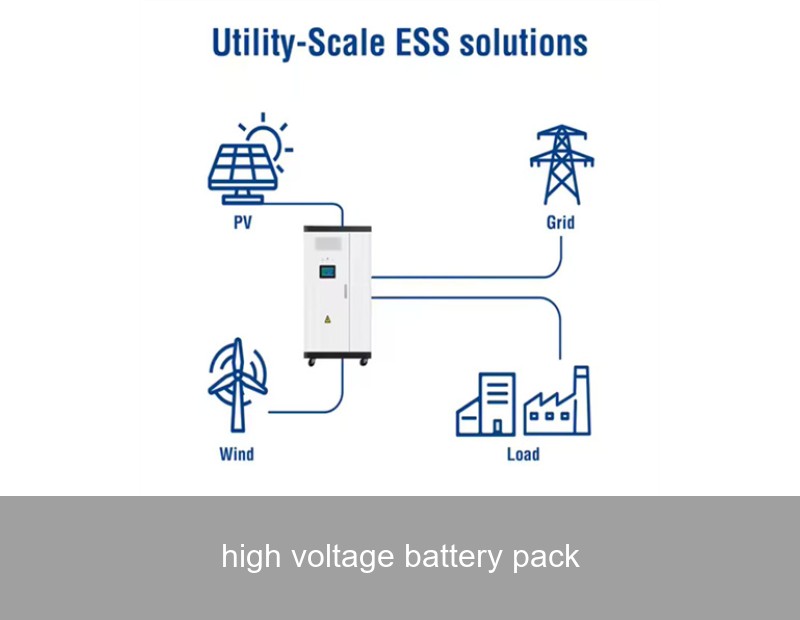
If you're involved in renewable energy, whether managing a commercial facility, planning a microgrid, or simply researching home storage, you've likely heard the term "high voltage battery pack" with increasing frequency. It's not just industry jargon; it represents a fundamental shift in how we store and deliver electricity. But what exactly makes this technology so compelling for today's demanding applications? Let's explore how moving to higher voltages is reshaping the landscape of efficiency, scalability, and cost-effectiveness for solar and storage systems across Europe and the US.
Table of Contents
- The Voltage Shift: More Than Just a Number
- Data-Driven Advantages: Why High Voltage Wins
- A Real-World Case: Powering a German Manufacturing Plant
- Highjoule's Approach: Intelligent High-Voltage Systems for Demanding Needs
- Safety and Compatibility: Addressing Common Concerns
- Is a High Voltage System Right for Your Next Project?
The Voltage Shift: More Than Just a Number
Traditionally, many residential and small commercial battery systems operated at lower voltages, similar to your car battery. A high voltage battery pack, in the context of stationary energy storage, typically refers to a system where the direct current (DC) bus operates at 400 volts or higher, often reaching 600V or more. This isn't about brute force; it's about intelligent electrical engineering. Think of it like plumbing: to deliver the same amount of water (energy), you can use a wide pipe with low pressure (high current, low voltage) or a narrower pipe with high pressure (lower current, high voltage). The high-pressure system uses thinner, lighter, and less expensive wiring, with significantly lower energy losses along the way.

Image Source: Unsplash (Representative image of battery technology)
Data-Driven Advantages: Why High Voltage Wins
The move to high voltage architecture delivers tangible benefits, backed by physics and real-world performance data:
- Higher Efficiency & Reduced Losses: With lower current for the same power (Power = Voltage x Current), resistive losses (I²R) in cables and components plummet. This can boost round-trip efficiency by 2-4%, a critical factor when storing valuable solar energy. Over a system's lifetime, this translates to thousands of additional kilowatt-hours delivered.
- Improved Power Density & Scalability: Higher voltage allows for more power to flow through a given conductor size. This means systems can be more compact, use less copper, and are easier to scale up for large industrial or microgrid applications by simply adding more battery modules in series.
- Seamless Integration with High-Voltage Inverters: Modern commercial solar inverters and variable frequency drives often operate at high DC input voltages. A matching high-voltage battery simplifies the system design, reduces the need for complex voltage conversion stages, and improves overall reliability.
- Potential for Lower Long-Term Costs: While the battery cells themselves may have similar costs, savings on balance-of-system (BOS) components—thinner cables, smaller conduits, reduced labor for installation—can make high-voltage systems more economical, especially for larger installations.
According to a 2023 NREL report on stationary storage, system-level innovations like higher voltage architectures are identified as key pathways to reducing installed costs and improving performance.
A Real-World Case: Powering a German Manufacturing Plant
Let's ground these concepts in a concrete example. A mid-sized automotive parts manufacturer in Bavaria, Germany, faced two challenges: volatile energy prices and a corporate mandate to reduce its carbon footprint. Their 500 kW rooftop solar array was underutilized, often curtailing production during sunny weekends.
The Solution: The facility integrated a 1 MWh containerized high voltage battery pack system operating at a nominal 600V DC. This voltage was chosen to directly interface with their existing central solar inverter and to efficiently handle the high power demands of their injection molding machines.
The Results (18-month post-installation data):
| Metric | Performance |
|---|---|
| Self-Consumption of Solar | Increased from 35% to over 85% |
| Peak Grid Demand | Reduced by 40%, saving €18,000 annually in capacity charges |
| System Round-Trip Efficiency | Measured at 96.5% at the point of common coupling |
| Installation Time & Cabling Cost | Estimated 15% lower vs. a comparable low-voltage design |
This case, mirrored by many across Europe and North America, shows how the technical advantages of high voltage directly translate into financial and operational resilience.
Highjoule's Approach: Intelligent High-Voltage Systems for Demanding Needs
At Highjoule, our experience since 2005 has taught us that voltage is just one piece of the puzzle. A reliable high voltage battery pack must be part of an intelligently managed system. That's why our HVS Series for commercial and industrial applications is engineered not just for high voltage, but for high performance and longevity.
Our systems incorporate:
- Advanced Battery Management System (BMS): Critical for safety and performance at high voltages, our proprietary BMS ensures precise cell monitoring, balancing, and thermal management across the entire series-connected string.
- Native Compatibility: The HVS Series is designed for plug-and-play integration with leading high-voltage inverters from manufacturers like SMA, Sungrow, and others, simplifying design and commissioning.
- Scalable Architecture: From a single cabinet offering 100 kWh to multi-container solutions exceeding 5 MWh, the modular design allows capacity to grow with your needs, all within the efficient high-voltage framework.
- Grid Services Ready: For our utility and microgrid partners, these systems provide the rapid response and high power capabilities needed for frequency regulation and peak shaving, enabled by their high-voltage DC bus.

Image Source: Unsplash (Representative image of industrial solar and storage)
Safety and Compatibility: Addressing Common Concerns
Naturally, "high voltage" raises questions. It's a valid consideration. Modern high-voltage battery systems are built with rigorous safety standards (like UL 9540 and IEC 62619) at their core. Key protections include:
- Comprehensive isolation monitoring and ground fault detection.
- Contactor-less pre-charge circuits to prevent arcing.
- Multiple, redundant disconnect devices (both manual and automatic).
- Integrated fire suppression and environmental controls in enclosed units.
Furthermore, for existing facilities with lower-voltage infrastructure, solutions exist. Highjoule's design services often include feasibility studies to determine the optimal voltage architecture, balancing efficiency gains with retrofit costs. Sometimes, a hybrid approach or a step-up transformer is the most practical path forward. The U.S. Department of Energy provides excellent resources on the fundamentals of safe storage system design.
Is a High Voltage System Right for Your Next Project?
The trend is clear: for applications above ~50 kW of power, the efficiency, scalability, and cost benefits of a high voltage battery pack are becoming difficult to ignore. Whether it's maximizing the return on a large-scale solar investment, hardening a critical microgrid, or simply taking control of unpredictable energy costs, this technology offers a powerful tool.
But the decision isn't automatic. It depends on your specific energy profile, existing infrastructure, and long-term goals. What's the peak power demand you need to support? Are you planning a new build or a retrofit? How do you prioritize upfront cost versus lifetime efficiency?
We invite you to share your current challenge: Is it reducing demand charges at an industrial site, achieving 24/7 renewable power for a remote community, or future-proofing a new commercial development? What's the main hurdle you're facing in your energy storage planning?
 Inquiry
 Online Chat