


Unlocking Grid Resilience: The Rise of High Voltage Battery Systems
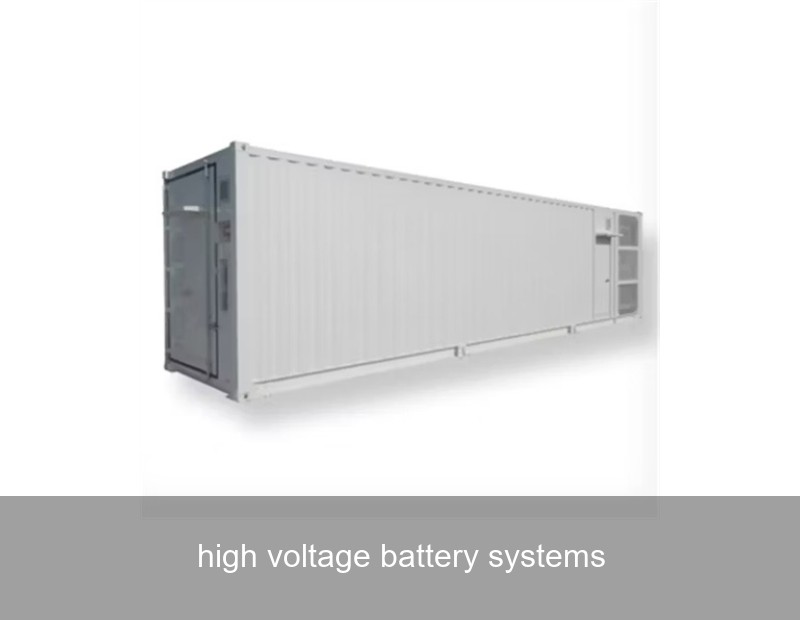
Imagine a world where power outages are a distant memory, renewable energy flows seamlessly day and night, and industries operate with unwavering electrical stability. This vision is rapidly becoming a reality, thanks in large part to the strategic deployment of high voltage battery systems. These aren't your typical home backup batteries; they are the robust, grid-scale powerhouses redefining how we store and manage electricity. For commercial, industrial, and utility leaders across Europe and the US, understanding this technology is no longer optional—it's a strategic imperative for energy security, cost control, and sustainability.
Table of Contents
What Are High Voltage Battery Systems?
Let's break it down simply. A high voltage battery system typically operates at a direct current (DC) voltage of 800 volts or higher. By connecting many individual battery cells in a long series string, these systems achieve a much higher operating voltage than standard low-voltage (e.g., 48V or 400V) alternatives. This architectural shift isn't just a technical detail; it's a fundamental redesign for performance. Think of it like water pressure: sending power at high voltage is like moving water through a high-pressure pipeline—it travels more efficiently over long distances with significantly lower energy losses compared to a low-pressure, high-volume flow. In practical terms, these systems are the backbone for large-scale applications, from stabilizing national grids to powering massive factories and data centers.

Image: Modern control systems are crucial for managing high voltage battery assets. Source: Unsplash
Why Voltage Matters: Efficiency at Scale
The push for higher voltages is driven by cold, hard economics and physics. Here’s the logical progression:
- Phenomenon: The global transition to intermittent renewables (solar and wind) creates a pressing need for massive, multi-hour energy storage to shift excess daytime solar to nighttime use.
- Data: According to the International Energy Agency (IEA), the global grid-scale battery storage capacity is set to multiply 15-fold by 2030. To achieve this cost-effectively, system-level efficiency is paramount.
- Technical Insight: Higher voltage directly reduces electrical current (Amperes) for the same power level (Watts). Lower current means:
- Reduced Energy Loss: Power losses due to resistance in cables and components (I²R losses) are drastically minimized.
- Lower Balance-of-System Costs: Thinner, less expensive cables can be used, and power conversion equipment can be smaller and more efficient.
- Enhanced Power Quality: They provide stronger, more stable support for grid voltage and frequency regulation.
For a megawatt-scale project, these efficiency gains translate into millions saved in capital expenditure (CAPEX) and increased lifetime energy throughput, delivering a superior return on investment.
The PAS Framework: Problem, Agitation, Solution
Let's apply a proven problem-solving lens to see why high voltage battery systems are the definitive answer.
Problem: The Grid Stability & Cost Dilemma
Industrial facilities and utilities face a dual challenge: volatile energy prices and increasing grid instability. A single voltage dip can halt sensitive manufacturing lines, causing hundreds of thousands in losses. Meanwhile, the duck curve—the steep evening ramp in demand as solar generation drops—forces utilities to rely on expensive, polluting peaker plants.
Agitation: The Limitations of Legacy Approaches
Traditional low-voltage battery banks for large-scale applications become cumbersome. They require massive, costly copper busbars, complex parallel wiring, and multiple heavy inverters, leading to higher installation costs, more points of failure, and significant floor space consumption. The inefficiency eats into the very savings the storage system was meant to provide.
Solution: Integrated High Voltage Architecture
This is where modern, purpose-built high voltage battery systems shine. Companies like Highjoule have pioneered integrated solutions that elegantly solve these pain points. Highjoule's HVS Series, for instance, is engineered from the ground up for commercial and industrial applications. By delivering a pre-integrated, containerized system operating at 800V+ DC, it eliminates the need for complex on-site stringing. The system includes built-in advanced battery management (BMS), fire suppression, and thermal control, ensuring safety and longevity. The result? A plug-and-play solution that offers higher energy density (more kWh per square foot), superior round-trip efficiency (often exceeding 95% at the system level), and a streamlined installation process that cuts project timelines by weeks.
Case Study: Real-World Impact in US Manufacturing
Let's move from theory to tangible results. A prominent automotive parts manufacturer in Ohio faced crippling demand charges from their utility and frequent grid disturbances threatening just-in-time production.
- Goal: Reduce peak demand charges, provide backup power for critical loads, and participate in grid frequency regulation programs.
- Solution Deployed: A 2 MW / 4 MWh Highjoule HVS-1500 high voltage battery system installed at the facility's main substation.
- Implementation & Data: The containerized system was connected in Q2 2023. Its high-voltage design minimized AC/DC conversion losses. The intelligent energy management system (EMS) precisely shaved peak loads by discharging the battery during the facility's highest 15-minute consumption periods each month.
- Quantifiable Outcomes (First 12 Months):
Metric Result Peak Demand Charge Reduction 28% Annual Energy Cost Savings $215,000 Grid Services Revenue $42,000 Critical Load Backup 4 hours for essential lines Projected Payback Period Under 5 years
This case, documented in a U.S. Department of Energy presentation on storage economics, exemplifies the multi-revenue stream potential of modern high-voltage storage when paired with intelligent software.
Highjoule's Role: Engineering Intelligent High Voltage Solutions
As a global leader founded in 2005, Highjoule doesn't just supply batteries; it delivers comprehensive power resilience platforms. Our expertise lies in tailoring high voltage battery systems to the nuanced needs of different markets. In Europe, where grid codes are stringent and space is at a premium, our systems' high efficiency and compact footprint are critical. In the US, where demand charge management and grid service markets are lucrative, our integrated EMS software unlocks maximum value.
Our services extend beyond the hardware:
- Feasibility & System Design: Our experts model your load profile and energy costs to right-size the solution.
- Turnkey Delivery: From permitting and grid interconnection support to installation and commissioning.
- Performance Guarantee & Remote Monitoring: We stand by our systems with robust warranties and offer 24/7 monitoring from our global operations centers.
- Software for Lifecycle Value: The Highjoule Neuron™ platform continuously optimizes system dispatch for economic and operational goals.
Whether for a hospital requiring flawless backup, a factory pursuing decarbonization, or a utility building a virtual power plant, Highjoule's high voltage battery systems provide the foundational intelligence for a sustainable energy future.

Image: Solar farms paired with battery storage are a key application for high voltage systems. Source: Unsplash
Future Trends and Your Next Step
The trajectory is clear. Battery chemistries like Lithium Iron Phosphate (LFP) are making high voltage battery systems safer and longer-lasting. We're also seeing a convergence with electric vehicle charging infrastructure, where high-voltage DC fast-charging hubs can be directly supported by on-site storage to avoid costly grid upgrades. The question for forward-thinking organizations is no longer "if" but "how and when."
What specific energy challenge—be it demand charges, renewable integration, or power quality—is currently creating the biggest bottleneck for your operational or sustainability goals, and have you evaluated how a strategic storage investment could turn that challenge into a competitive advantage?
 Inquiry
 Online Chat