


Navigating the Landscape: Your Guide to Choosing a Reliable Hitachi BESS Supplier
In the dynamic world of renewable energy integration, finding the right technology partner is as crucial as the technology itself. You've likely heard of Hitachi Energy and their robust Battery Energy Storage Systems (BESS). Their technology is a powerful piece of the puzzle. But here’s a key insight: the success of your storage project often hinges less on the brand name on the battery rack and more on the expertise, integration capabilities, and long-term support of the Hitachi BESS supplier you choose. This article will guide you through what truly matters when selecting a partner to deploy and manage this advanced technology for your commercial, industrial, or utility-scale project.
Table of Contents
The Core Challenge: Beyond the Brand Badge
Let's address the elephant in the room. Why focus on the supplier when the OEM (Original Equipment Manufacturer) like Hitachi is so well-established? Think of it like building a high-performance home. You can buy the world's best HVAC system, but if it's not properly sized, integrated with your solar panels, and controlled by a smart management system, you won't achieve comfort or efficiency. The same applies to BESS.
A top-tier Hitachi BESS supplier acts as your system architect and conductor. They don't just deliver hardware; they provide the critical layer of intelligence and customization that transforms a standardized battery product into a tailored power solution. This involves advanced system design, sophisticated energy management software (EMS), seamless integration with existing infrastructure, and guaranteed performance.
The Evolving Role of a BESS Supplier
Gone are the days when a supplier's role ended at delivery. Today's energy challenges require a partner for the long haul.
- System Design & Optimization: A true partner analyzes your load profiles, energy costs, renewable generation, and grid constraints to design a system that maximizes ROI, not just kilowatt-hours.
- Technology Agnosticism: While specializing in Hitachi BESS, the best suppliers understand how to integrate them with other technologies—be it different inverter brands, legacy SCADA systems, or third-party renewable assets.
- Software & Intelligence: The hardware stores energy; the software creates value. Suppliers must offer proprietary or best-in-class EMS platforms for real-time control, market bidding, and predictive analytics.
- Long-Term Performance Assurance: This includes comprehensive O&M (Operations & Maintenance), performance monitoring, and warranties that ensure your system delivers over its entire 15-20 year lifespan.
Key Criteria for Evaluating Your Hitachi BESS Partner
When vetting potential suppliers, move beyond the sales brochure. Dig into these essential areas:
| Criteria | What to Look For | Why It Matters |
|---|---|---|
| Integration Portfolio | Case studies showing integration with complex industrial sites, microgrids, or utility substations. | Proven experience reduces project risk and ensures reliable interoperability. |
| Software Capabilities | A demonstrated EMS platform with features like automated market participation, peak shaving algorithms, and remote fleet management. | This is where your system's financial and operational value is unlocked. |
| Technical Support Structure | 24/7 NOC (Network Operations Center) availability, local service engineers, and clear escalation paths. | Downtime is lost revenue. Immediate, expert support is non-negotiable. |
| Financial Health & Longevity | A stable company history and financial backing to honor long-term service agreements. | You need a partner that will be there for the decades-long lifecycle of your asset. |
Case Study: Grid Stability and Revenue Stacking in Germany
Let's look at a real-world application. In 2022, a medium-sized utility in Northern Germany faced dual challenges: intermittent renewable curtailment from local wind farms and growing grid stability needs identified by the transmission system operator (TSO).
Their chosen Hitachi BESS supplier delivered a 20 MW / 28 MWh system built around Hitachi's robust battery technology. However, the supplier's true value was in the integration and control layer:
- Dual-Revenue Stream Design: The system was configured to primarily provide primary frequency regulation (a grid service paid by the TSO), while secondarily capturing energy arbitrage from the wind farm.
- Advanced Grid Compliance: The supplier's proprietary control system ensured the BESS met stringent German grid connection codes (e.g., VDE-AR-N 4110/4120), a complex but critical requirement.
- Result: The project achieved a 15% higher annual revenue than base-case models by effectively stacking value streams. It also helped integrate over 50 GWh of renewable energy annually that might have otherwise been curtailed. This case exemplifies how the right supplier transforms a capital asset into a dynamic, profit-generating grid citizen.

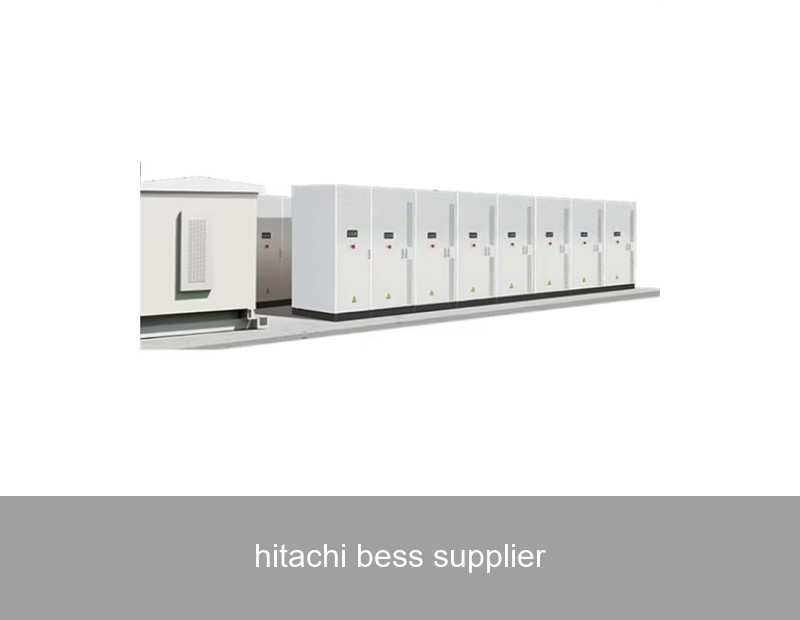
Image: A utility-scale BESS installation, similar to the case study project. The supplier's expertise ensures such systems meet both technical and financial goals.
The Highjoule Approach: Intelligent Integration as a Service
At Highjoule, with nearly two decades of experience since 2005, we have built our reputation on being more than a supplier; we are a long-term performance partner. Our work with Hitachi BESS technology is a cornerstone of our offering for large-scale commercial, industrial, and microgrid applications.
We provide a holistic service we call Intelligent Integration:
- Highjoule Core EMS: Our proprietary, AI-driven energy management platform is the brain of the system. It doesn't just control the Hitachi BESS; it optimizes the entire site's energy ecosystem, making autonomous decisions to reduce costs and maximize value. The IEA emphasizes the critical role of smart software in storage value.
- Customized System Architecture: Our engineers design the balance-of-system (BOS)—the inverters, transformers, switchgear, and safety systems—to ensure the Hitachi batteries perform optimally and safely within your specific environment.
- Performance Guarantee: We stand behind our systems with performance-based service agreements. Our global 24/7 monitoring center ensures proactive maintenance and rapid response, safeguarding your investment's output.
For a manufacturing plant in the US Midwest, for instance, we integrated a Hitachi-based BESS with their on-site solar and legacy CHP (Combined Heat and Power) system. Our EMS seamlessly dispatches energy to shave over $200,000 annually in demand charges, provides backup power for critical processes, and even participates in local grid programs—all managed from a single, intuitive interface.
Is Your Storage Solution Future-Ready?
The energy landscape is shifting faster than ever. Regulations change, electricity tariffs evolve, and new revenue opportunities emerge. A static storage system is a depreciating asset. The right Hitachi BESS supplier equips you with the agility to adapt.
Can your current storage partner offer a software update to let you participate in a new wholesale market program? Can they safely integrate a second technology, like flow batteries for long-duration storage, alongside your existing Hitachi system a few years from now? As noted by NREL, the future lies in hybrid and multi-technology storage plants.
This is the final, and perhaps most important, question to ask any potential partner: How will you help me future-proof my investment today?
 Inquiry
 Online Chat