


Understanding Home Solar System Prices in South Africa: A Smart Investment Guide
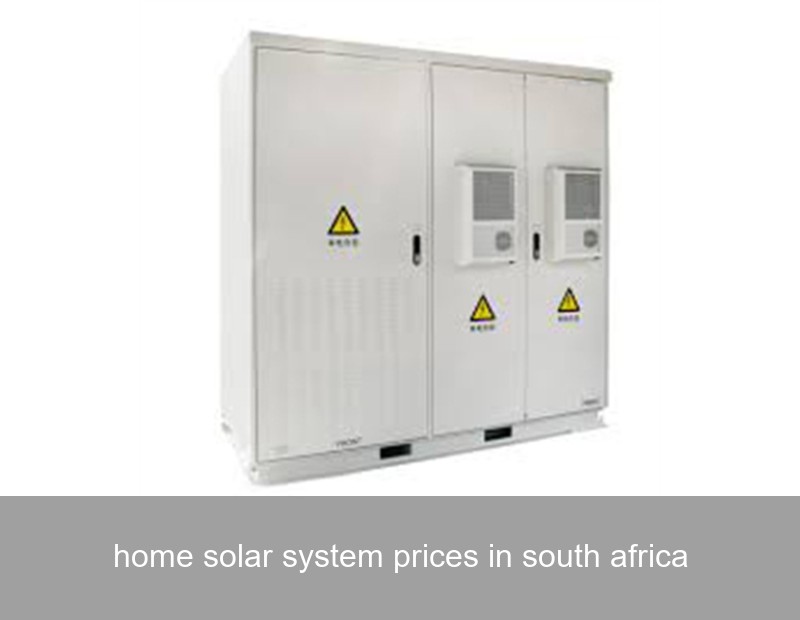
If you're a homeowner in South Africa, you've likely felt the pinch of rising electricity costs and the frustration of load-shedding. You're also probably asking, "What are the real home solar system prices in South Africa, and is it worth the investment?" The good news is that solar power has never been more accessible or financially sensible. This guide will demystify the costs, explore the value beyond the price tag, and show you how a quality system from a global leader like Highjoule can turn sunlight into serious savings and security for your family.
Table of Contents
- The Real Price Breakdown: What You're Paying For
- Key Factors Influencing Your Solar Quote
- A Real-World Case Study: The Pretoria Family
- Looking Beyond the Price: Quality and Intelligence Matter
- The Highjoule Advantage: Smart, Integrated Energy Solutions
- Calculating Your True Return on Investment (ROI)
- Your Energy Independence Journey
The Real Price Breakdown: What You're Paying For
A home solar system is not a single product but a sophisticated energy ecosystem. The total price typically includes several core components, each with its own cost range based on quality and capacity.
| System Component | Typical Share of Total Cost | What It Does |
|---|---|---|
| Solar Panels (PV Modules) | 25-35% | Converts sunlight into direct current (DC) electricity. |
| Inverter(s) (The System's Brain) | 20-25% | Converts DC electricity from panels into usable AC electricity for your home. |
| Battery Storage System | 25-40% | Stores excess energy for use at night or during outages. A critical add-on for load-shedding resilience. |
| Mounting, Cabling & Balance of System | 10-15% | The physical hardware and electrical components that tie the system together safely. |
| Installation & Professional Services | 10-20% | Expert design, permitting, installation, and commissioning. |
As of 2024, a basic 5kW solar system without battery storage in South Africa can start from around ZAR 100,000. However, a fully-fledged 8kW to 10kW system with a high-capacity battery for full energy independence can range from ZAR 250,000 to ZAR 500,000 or more. The variation is vast because every home's energy appetite and goals are unique.
Key Factors Influencing Your Solar Quote
Why such a wide price range? Let's break down the variables:
- System Size & Energy Usage: The first step is understanding your monthly kWh consumption. A detailed energy audit is crucial.
- Battery Capacity: How many hours of backup do you need? Battery technology (e.g., Lithium Iron Phosphate - LFP) and usable capacity are major cost drivers.
- Component Quality: Not all panels and inverters are created equal. Tier-1 panels with longer performance warranties and hybrid inverters with smart features command a premium but offer far greater long-term value.
- Roof Complexity & Site Access: Installation on a simple, tiled roof is more straightforward than on a complex slate or metal roof.
- Grid-Tie vs. Off-Grid: A system designed to occasionally feed back to the grid might have different requirements than a fully off-grid setup.

Source: Unsplash
A Real-World Case Study: The Pretoria Family
Let's move from theory to practice. The Van der Merwe family in Pretoria was spending an average of ZAR 2,800 monthly on electricity in 2022 and suffering through daily load-shedding. Their primary goal was to eliminate their Eskom bill and gain uninterrupted power for their home office and two children.
They opted for a 9.8kW solar array paired with a 15kWh Highjoule H-Stack lithium battery system and a 8kW hybrid inverter. The total installed cost was ZAR 385,000.
- Monthly electricity bill: Reduced to a minimal ZAR 450 (fixed grid connection fee).
- Annual savings: Approximately ZAR 28,200.
- Load-shedding impact: Zero. The system automatically switches to battery power during outages.
- Estimated payback period: Roughly 13.5 years, not accounting for future Eskom tariff increases (historically ~10-15% per year), which would shorten it significantly.
This case highlights that while the upfront home solar system price in South Africa is substantial, the operational savings and quality-of-life benefits are transformative. For more data on South Africa's energy landscape, see the Council for Scientific and Industrial Research's latest reports here.
Looking Beyond the Price: Quality and Intelligence Matter
Choosing a system based solely on the lowest price per watt is a common pitfall. The true cost includes long-term performance, safety, and reliability. A cheaper system with inferior components or poor installation can lead to:
- Faster degradation of panels, producing less energy over time.
- Inverter failure, which shuts down your entire system.
- Battery safety risks or dramatically reduced cycle life.
- Difficulty finding support or honouring warranties from fly-by-night installers.
This is where partnering with an established, technology-focused provider makes all the difference.
The Highjoule Advantage: Smart, Integrated Energy Solutions
At Highjoule, we view a home solar system not just as a collection of parts, but as an intelligent energy management platform. Our solutions, trusted by commercial and residential clients across Europe, North America, and now South Africa, are designed for maximum efficiency and peace of mind.
Our Residential Energy Hub integrates top-tier monocrystalline panels with our proprietary H-Core™ Battery Systems. What sets us apart is the software: our EnergyOS™ platform learns your consumption patterns, optimizes energy flow between panels, battery, grid, and home loads, and gives you full control via a simple smartphone app. You can prioritize essential circuits during an outage, schedule charging from the grid during off-peak rates (where applicable), and monitor your system's health and savings in real-time.
For South African homeowners, this means not just surviving load-shedding, but thriving through it. Our batteries use ultra-safe LFP chemistry and are built for thousands of deep-cycle charges, ensuring your investment lasts for decades. When evaluating home solar system prices in South Africa, the intelligence, safety, and longevity baked into a Highjoule system provide a value proposition that far exceeds the initial invoice.
Source: Unsplash
Calculating Your True Return on Investment (ROI)
The financial return is more than just bill savings. Consider this holistic ROI calculation:
- Direct Savings: Immediate reduction in monthly Eskom payments.
- Inflation Hedge: You lock in your energy cost at "sun-rate," protecting yourself from annual tariff hikes. The Eskom tariff history speaks for itself.
- Property Value Increase: Studies show homes with solar and storage sell faster and at a premium.
- Productivity & Asset Protection: No more lost work hours or spoiled food during outages. The value of continuous power for security systems, Wi-Fi, and medical devices is immense.
When you factor in all these elements, the payback period for a quality system often becomes much more attractive than a simple component-cost calculation suggests.
Your Energy Independence Journey
Understanding home solar system prices in South Africa is the first step toward energy freedom. The next step is to move from a generic online quote to a personalized design that matches your home's architecture, your family's lifestyle, and your financial goals.
What specific energy challenge in your home—whether it's keeping the lights on during Stage 6 load-shedding or finally slashing that ever-growing electricity bill—is most important for you to solve with solar power?
 Inquiry
 Online Chat