


Solar Panels for Home Cost in Poland: A 2024 Investment Guide
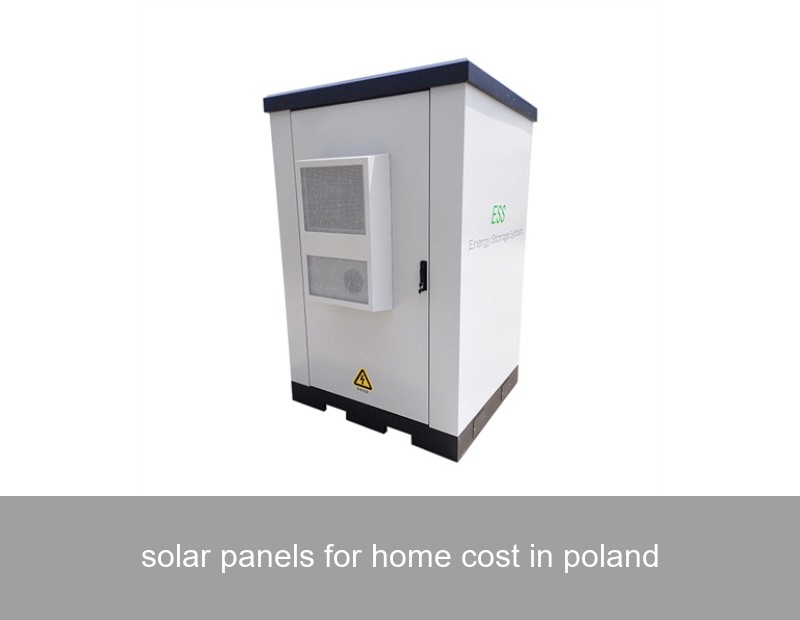
Thinking about harnessing the Polish sun to power your home? You're not alone. The interest in residential solar energy in Poland has skyrocketed, driven by rising electricity prices and a growing desire for energy independence. But the first question on every homeowner's mind is invariably: "What is the real cost of solar panels for my home in Poland?" The answer isn't just a single number—it's an equation involving system size, technology, installation, and, crucially, the long-term value of a quality energy storage solution. Let's demystify the investment and explore how companies like Highjoule are shaping a smarter energy future for Polish households.
Table of Contents
- Breaking Down the Cost: What You're Paying For
- The Polish Market Context: Incentives and Energy Prices
- A Real-World Case: The Nowak Family Home in Wroclaw
- Thinking Beyond Panels: The Critical Role of Energy Storage
- The Highjoule Advantage: Intelligent Storage for Polish Homes
- Calculating Your True Return on Investment (ROI)
Breaking Down the Cost: What You're Paying For
A typical residential photovoltaic (PV) system cost in Poland is quoted per kilowatt-peak (kWp). As of 2024, the gross price range is approximately PLN 4,500 to PLN 7,000 per kWp for a fully installed system. This wide range depends on several key factors:
- System Size: A standard Polish home typically needs a 4 kWp to 10 kWp system. A 5 kWp system, a common choice, could thus have a gross cost between PLN 22,500 and PLN 35,000.
- Component Quality: High-efficiency monocrystalline panels (like those often paired with premium systems) cost more but produce more energy in limited space.
- Inverter Type: A standard string inverter is more affordable, while microinverters (optimizing each panel) add cost but increase efficiency, especially on partially shaded roofs.
- Installation Complexity: Roof type, angle, and accessibility can affect labor costs.
Remember, this is the initial cost. The real economic picture emerges when you factor in available subsidies.
The Polish Market Context: Incentives and Energy Prices
Poland's support schemes significantly reduce the net investment. The most prominent is the "Mój Prąd" (My Electricity) grant, which as of its latest phases offers a fixed subsidy for PV system installation. Furthermore, the prosument (prosumer) model of net-metering, while evolving, allows homeowners to send surplus energy to the grid for later use, though this is becoming less favorable than self-consumption.
The driving force behind ROI is the soaring cost of grid electricity. The European Commission's Eurostat data consistently shows Poland's household electricity prices following an upward trend. Every kilowatt-hour (kWh) you produce yourself is a kWh you don't buy at these retail rates, effectively creating a "virtual income."
A Real-World Case: The Nowak Family Home in Wroclaw
Let's look at concrete data. In 2023, the Nowak family installed an 8 kWp PV system on their detached house in Wroclaw.
- Gross System Cost: PLN 48,000 (approx. PLN 6,000/kWp for high-efficiency panels and a hybrid inverter).
- "Mój Prąd" Grant: PLN 6,000 (based on the grant level at time of application).
- Net Investment: PLN 42,000.
- Annual Production: Estimated 8,000 kWh.
- Self-Consumption (without storage): About 30-40% of production used directly. The rest was exported to the grid.
Their first-year savings on electricity bills were around PLN 5,200. However, they realized a major limitation: exporting surplus energy for grid credits was less valuable than using it themselves, especially in the evening when solar production is zero but demand is high. This is the pivotal moment where the conversation shifts from just panels to a complete system.
Image Source: Unsplash (Representative image of a modern home with solar installation)
Thinking Beyond Panels: The Critical Role of Energy Storage
This is the core insight for modern solar investments: Panels generate energy, but storage unlocks independence and maximizes value. A Battery Energy Storage System (BESS) allows you to store your daytime surplus and use it at night, dramatically increasing self-consumption to 70% or more. This shields you from peak grid tariffs and provides backup power during outages. The initial cost of a solar-plus-storage system is higher, but the financial and resilience benefits are transformative.
The Highjoule Advantage: Intelligent Storage for Polish Homes
This is where Highjoule enters the equation. As a global leader in advanced energy storage since 2005, we don't just sell batteries; we provide intelligent, integrated power solutions. For the Polish homeowner, our Residential Energy Hub is designed to tackle local challenges.
Our systems feature high-cycling lithium iron phosphate (LFP) batteries, renowned for their safety and long lifespan—crucial for a long-term investment. The intelligent energy management system is the real brain: it learns your household's consumption patterns, automatically optimizes charging and discharging based on weather forecasts and time-of-use tariffs, and seamlessly integrates with your existing PV installation. With the Highjoule system, the Nowak family could increase their self-consumption to over 80%, reducing their reliance on the grid and accelerating their payback period.
Highjoule's commitment goes beyond hardware. We offer comprehensive remote monitoring and maintenance services, ensuring your system performs optimally for decades. For Polish installers and homeowners, this means partnering with a technology provider that brings global expertise to local energy needs.
| System Component | Typical Cost Range (PLN) | Key Consideration |
|---|---|---|
| PV Panels (5 kWp) | 22,500 - 35,000 | Efficiency & manufacturer warranty |
| Basic Inverter | Included in above | Type (string vs. hybrid) |
| Highjoule Energy Storage (10 kWh) | 25,000 - 35,000 (installed) | Cycle life, system intelligence, integration |
| Total Solar + Storage System | ~47,500 - 70,000 (before grants) | Net cost after "Mój Prąd" can be significantly lower |
Calculating Your True Return on Investment (ROI)
So, is it worth it? Let's reframe the "solar panels for home cost in Poland" question into an ROI analysis for a solar-plus-storage system. Using data from the Polish International Renewable Energy Agency (IRENA) on typical system performance and current electricity price forecasts:
- Net System Cost (after grant): Estimate PLN 55,000 - 20% grant = PLN 44,000 net.
- Annual Energy Savings & "Earnings": With high self-consumption enabled by storage, you might offset 90% of a 5,000 PLN annual bill = 4,500 PLN/year.
- Simple Payback Period: ~9.8 years. With expected annual electricity price increases of 5-7%, this period shortens significantly.
- 25-Year Benefit: Over the system's lifetime, total savings can exceed 150,000 PLN, not to mention the value of uninterrupted power during grid failures.

Image Source: Unsplash (Representative image of a modern home battery system)
The initial cost is an investment in a fixed, predictable energy rate for the next 25+ years. In an era of volatile energy markets, that certainty is priceless. When evaluating quotes, look beyond price per kWp. Assess the system's intelligence, the storage solution's quality, and the provider's long-term service capability. A partnership with a technology leader like Highjoule ensures your home energy system is not just a cost today, but a growing asset for tomorrow.
Ready to calculate your personalized path to energy independence? What specific questions do you have about integrating intelligent storage with your future or existing solar panels to maximize your investment in the Polish climate?
 Inquiry
 Online Chat