


House Solar Panel Battery: The Key to Unlocking True Energy Independence
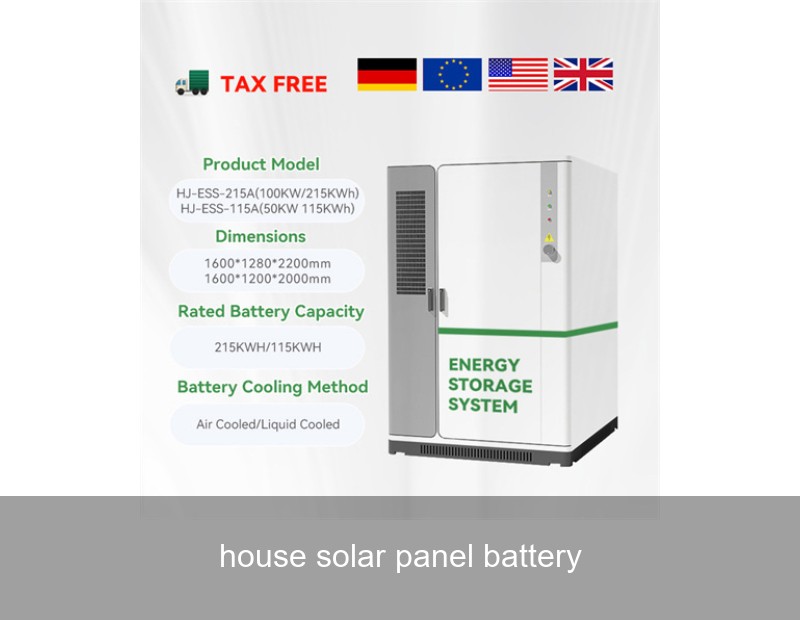
You've made the smart investment in solar panels for your house. You're generating clean energy, reducing your carbon footprint, and watching your meter spin backwards on sunny afternoons. But what happens when the sun sets, or a cloud passes over? That's where the house solar panel battery transforms from an optional add-on to the essential heart of a modern home energy system. It's the missing piece that stores your sunshine for use anytime, turning your home into a personal power station.
Table of Contents
- The Storage Gap: When Your Solar Panels Sleep
- How Does a House Solar Panel Battery System Work?
- The Real-World Impact: Data, Savings, and Resilience
- Case Study: A Family Home in Bristol, UK
- Choosing the Right Battery for Your Home
- The Highjoule Solution: Intelligent Storage for Modern Living
- The Future of Home Energy is Self-Consumption
The Storage Gap: When Your Solar Panels Sleep
Here's a common phenomenon for solar homeowners without storage: peak production occurs midday when you're likely at work. Your system exports excess energy to the grid, often for a modest feed-in tariff. Then, in the evening when everyone is home, cooking, watching TV, and turning on lights, your panels are offline. You're forced to buy electricity back from the grid at a much higher retail rate. This mismatch creates a frustrating gap between your generation and your consumption.

This isn't just an inconvenience; it's a financial and efficiency drain. The U.S. Energy Information Administration notes that residential electricity demand often peaks in the early evening, precisely when solar output is zero. A battery bridges this gap seamlessly.
How Does a House Solar Panel Battery System Work?
Think of your house solar panel battery as a high-tech energy savings account. The process is elegantly simple:
- Step 1: Capture & Store: During the day, your solar panels generate more electricity than your home needs. Instead of sending it all to the grid, the inverter directs the surplus to charge your battery.
- Step 2: Intelligent Management: An advanced energy management system (like Highjoule's NeuronOS) constantly monitors your home's consumption, solar production, battery level, and even grid electricity rates.
- Step 3: Discharge on Demand: When solar production drops, the system automatically draws power from the battery to run your appliances. This happens in milliseconds—you'll never notice a switch.
- Step 4: Grid Interaction (Optional): In some markets, you can program your system to sell stored energy back to the grid during peak price periods, a practice known as arbitrage, or use it as a backup during outages.
The Real-World Impact: Data, Savings, and Resilience
The benefits of adding a battery are tangible and multi-faceted. Let's break them down:
| Benefit | Description | Typical Outcome |
|---|---|---|
| Increased Self-Consumption | Using more of the solar energy you produce. | Can increase from 30-50% to 70-90%. |
| Reduced Electricity Bills | Minimizing expensive grid imports, especially during peak times. | Bill reductions of 60-90% are common, depending on location and system size. |
| Backup Power | Providing electricity during grid outages. | Keeps essential circuits (lights, fridge, internet) running for hours or even days. |
| Grid Support & Stability | Reducing peak demand on the local grid. | Contributes to community energy resilience. |
Case Study: The Thompson Family Home in Bristol, UK
Let's look at a real example. The Thompson family installed a 6 kW solar array on their detached home in 2020. In 2023, they added a 10 kWh house solar panel battery to their system.
- Pre-Battery (2022): Annual solar self-consumption: 42%. They exported over 2,800 kWh to the grid and still bought 3,100 kWh from it, with an annual electricity bill of £820.
- Post-Battery (2023): Annual self-consumption jumped to 85%. Grid imports plummeted to 800 kWh. Their annual bill was reduced to £185—a 77% saving.
- Additional Benefit: During a winter storm that caused a 5-hour local outage, their battery seamlessly powered their heating circulation pump, refrigerator, and lights, providing comfort and security.
This data, mirrored by studies from sources like Lazard's Levelized Cost of Storage Analysis, shows the economic logic is now undeniable.
Choosing the Right Battery for Your Home
Not all batteries are created equal. Key considerations include:
- Capacity (kWh): How much energy it can store. Think about your nightly usage.
- Power Rating (kW): How much power it can deliver at once. Can it run your kettle and oven simultaneously?
- Depth of Discharge (DoD): The usable percentage of the battery's total capacity. A higher DoD means more usable energy.
- Efficiency: The round-trip efficiency (AC-AC) indicates how much energy is lost during storage and conversion. Look for figures above 90%.
- Chemistry: Lithium Iron Phosphate (LFP) is now the industry benchmark for safety, longevity, and performance.
- Warranty & Lifespan: A 10-year warranty with a guaranteed end-of-warranty capacity (e.g., 70% remaining) is standard for quality products.
The Highjoule Solution: Intelligent Storage for Modern Living
This is where Highjoule's expertise, honed since 2005, becomes critical. We don't just sell battery units; we provide integrated, intelligent energy ecosystems. Our Halo Home Battery System is engineered specifically for the residential market in Europe and North America.

What sets the Halo system apart?
- LFP Battery Chemistry: The safest, most durable option for your home, with a lifespan exceeding 6,000 cycles.
- Scalable Design: Start with a base unit and easily expand capacity from 5 kWh to 30 kWh as your needs evolve.
- NeuronOS AI Platform: This is the brain. It learns your consumption patterns, integrates with time-of-use utility rates, and can even factor in weather forecasts to optimize energy flow, maximizing your savings automatically.
- Seamless Backup: Provides uninterrupted backup power in the event of a grid failure, switching on in less than 20 milliseconds.
- Professional Integration: Highjoule works with a certified network of installers to ensure your system is perfectly sized, safely installed, and compliant with all local regulations and incentives.
For homeowners looking to future-proof their energy supply, our systems are also designed for integration with electric vehicle charging, creating a cohesive and efficient home energy hub.
The Future of Home Energy is Self-Consumption
The energy landscape is shifting from centralized grids to decentralized, resilient networks. With volatile energy prices and an increasing frequency of extreme weather events, the value of a house solar panel battery extends beyond monthly savings to energy security and independence.
Governments are recognizing this. In the US, the Inflation Reduction Act provides a 30% federal tax credit for qualifying battery installations. Similar incentives exist across many European countries, making the investment more accessible than ever.
So, the question is no longer "Can I afford a battery?" but rather, "Can I afford to keep sending my cheap, clean solar energy to the grid only to buy back expensive, grid-power at night?" With the technology proven, the economics clear, and solutions like Highjoule's Halo system available, the path to true energy independence is fully illuminated.
Is your home's solar system operating at its full potential, or is it time to capture the power you're letting slip away?
 Inquiry
 Online Chat