


How Much Does a 60 kW Generator Cost? The Modern Energy Answer
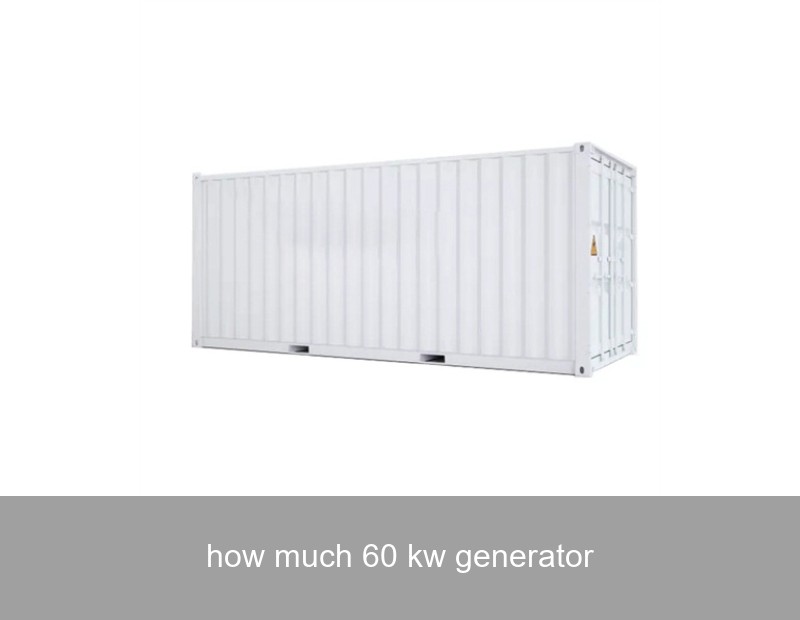
When a business or large property owner asks, "How much does a 60 kW generator cost?", they're usually bracing for a significant upfront investment, ongoing fuel expenses, and operational noise. But what if the question itself is evolving? In today's energy landscape, the traditional diesel or natural gas generator is no longer the only—or even the smartest—answer for reliable backup or primary power. The real cost isn't just the price tag; it's the total cost of ownership, environmental impact, and operational flexibility. This is where modern solar-plus-storage systems are changing the game, offering a cleaner, quieter, and often more economical alternative for that critical 60 kW power range.
Table of Contents
The Traditional 60 kW Generator: Price & Hidden Expenses
Let's address the initial question directly. A new 60 kW diesel generator typically has a purchase price between $20,000 and $40,000, depending on brand, features, and installation complexity. However, this is merely the entry fee. The true cost unfolds over years:
- Fuel Costs: A 60 kW generator running at 75% load can consume about 4-5 gallons of diesel per hour. With volatile fuel prices, this becomes a massive, unpredictable operating expense.
- Maintenance: Regular oil changes, filter replacements, and major engine overhauls are necessary to ensure reliability, adding thousands annually.
- Environmental & Regulatory: Emissions, noise pollution, and potential fuel spill liabilities are growing concerns, especially in Europe and environmentally conscious U.S. states.
- Operational Inertia: It's a single-purpose asset: it burns fuel to make power. It doesn't generate revenue or savings when the grid is stable.
So, when calculating "how much," the figure easily doubles or triples over a 10-year lifespan.
The Paradigm Shift: From Fuel to Photons
The alternative is a 60 kW-rated battery energy storage system (BESS), often paired with solar PV. Instead of generating power, it stores it—from the grid during off-peak hours or directly from your solar panels. During an outage, it silently discharges to keep your essential loads running. The "fuel" is sunlight or low-cost electricity, and the "engine" is a bank of advanced lithium-ion batteries and sophisticated power electronics.

Image Source: Unsplash - A commercial solar and storage installation.
The 60 kW Battery Energy Storage System (BESS) Breakdown
A 60 kW BESS has two key ratings: Power (kW) and Energy (kWh). The 60 kW tells you how much power it can deliver at once (equivalent to the generator's output). The kWh rating (e.g., 120 kWh, 180 kWh) tells you for how long. A 60 kW / 120 kWh system can deliver 60 kW for two hours, or 30 kW for four hours, and so on.
System Cost Range: A commercial-grade 60 kW / 120 kWh solar-coupled storage system might have an installed cost in the range of $80,000 to $150,000. Yes, the upfront cost is higher than a generator. But here’s the critical financial pivot: this system makes and saves money every single day.
| Cost/Benefit Factor | Traditional 60 kW Generator | 60 kW Solar + Storage System |
|---|---|---|
| Upfront Capital Cost | $20k - $40k | $80k - $150k+ |
| Operational "Fuel" Cost | High & Volatile | Very Low (Sunlight) / Optimized Grid Purchase |
| Maintenance Cost | Moderate to High | Very Low |
| Revenue Generation | None | Yes (Solar Export, Grid Services, Demand Charge Reduction) |
| Lifespan | 10-20 years (with major overhauls) | 15-20+ years (battery lifespan) |
| Payback Period | Never (pure cost center) | 5-10 years (investment with ROI) |
Case Study: A German Bakery's Sweet Switch
Consider a real-world example from Bavaria, Germany. A medium-sized bakery with cold storage and sensitive baking equipment needed reliable backup for its ~60 kW critical load. Initially considering a diesel generator, they opted for a 75 kWp solar array coupled with a 60 kW / 144 kWh Highjoule Harmony BESS.
- Data: The system covers their daytime load directly with solar. Excess solar charges the battery. The battery provides backup during grid outages (up to 4 hours for full load) and performs peak shaving, reducing their grid demand charges by over 30% monthly.
- Financial Outcome: With Germany's high electricity prices and Fraunhofer ISE data showing continued solar cost declines, the project achieved a simple payback of under 7 years. The generator would have only added cost.
- Operational & Brand Benefits: Silent operation, zero emissions, and a powerful "green" marketing story aligned with local values.
The Highjoule Solution: Intelligent, Integrated Power
This is where Highjoule's expertise transforms the equation. We don't just sell battery boxes; we provide intelligent energy platforms. For a 60 kW power need, our Harmony Commercial Energy System is a prime fit. It's a modular, all-in-one unit integrating battery storage, advanced inverter/charger, and sophisticated energy management software (EMS).
The Highjoule EMS is the brain. It constantly analyzes your load, solar production, grid conditions, and utility rate schedules. It autonomously decides when to charge, discharge, or hold to maximize your economic return and ensure backup readiness. For a business, this means:
- Unbreakable Power: Seamless transition to backup power in milliseconds during an outage.
- Cost Optimization: Automatic demand charge reduction and time-of-use arbitrage.
- Solar Self-Consumption: Increase the usage of your own solar energy from 30-50% to over 80%.
- Scalability: Start with a 60 kW system and easily expand as your needs grow.

Image Source: Unsplash - Engineer monitoring a modern energy storage system.
Making the Right Choice for Your Energy Needs
The question "how much does a 60 kW generator cost?" has become a gateway to a more strategic conversation about energy resilience and intelligence. While a traditional generator remains a lower-capital option for infrequent, long-duration backup in remote locations, a solar-plus-storage system is a dynamic, multi-functional asset.
To make an informed decision, you need to analyze your specific load profile, local utility rates (especially demand charges), solar potential, and available incentives. For instance, the U.S. Department of Energy highlights federal investment tax credits (ITC) that can cover 30-70% of storage project costs when paired with solar.
So, what's the next step for your business?
Instead of just requesting a quote for a generator, why not ask for a comprehensive Energy Resilience and Savings Assessment? Highjoule's experts can model your facility's energy data and provide a clear comparison between the total cost of a traditional generator and the net cost and return on investment of a future-proof Highjoule system. The right question isn't just about price—it's about value. What could your business achieve with a power solution that protects, performs, and pays for itself?
 Inquiry
 Online Chat