


How Much Do Ambri Batteries Really Cost? A Deep Dive into Liquid Metal Storage
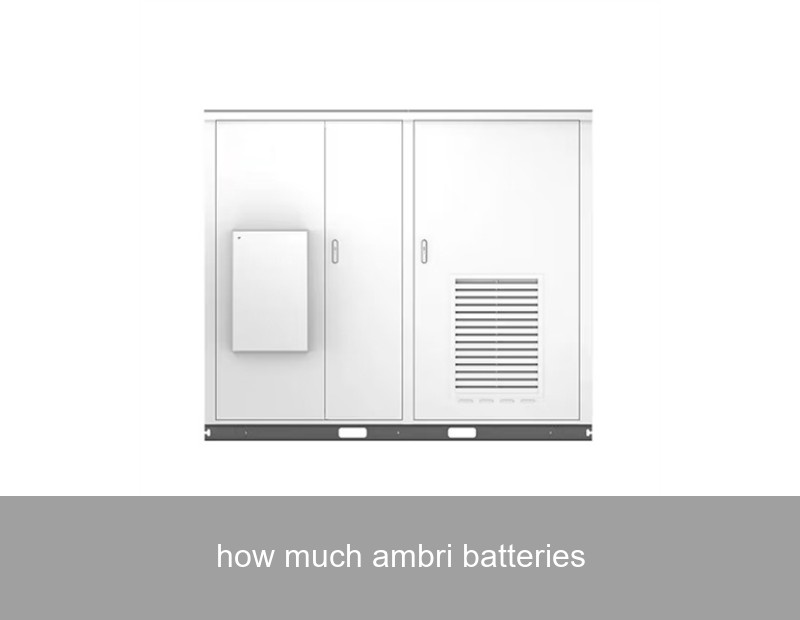
If you're exploring long-duration energy storage (LDES) solutions, you've likely come across the innovative technology from Ambri. Their liquid metal battery promises durability, safety, and a unique approach to storing energy for hours or even days. But the burning question for any project developer, utility manager, or sustainability leader is: how much do Ambri batteries actually cost? The answer, as with most complex energy technologies, isn't a simple sticker price. It's about the total cost of ownership over decades. Let's unpack the economics, compare the value, and see how emerging solutions like Ambri fit into a market where providers like Highjoule are delivering bankable storage today.
Table of Contents
- The Phenomenon: The Urgent Need for Long-Duration Storage
- The Data: Decoding "Cost" in Energy Storage
- The Case Study: A Real-World Benchmark
- The Insight: Total Value Over Sticker Price
- The Highjoule Alternative: Proven Tech for Today's Grid
- Your Next Step: Evaluating Your Project

Understanding the total system cost goes beyond any single component. (Image: Unsplash)
The Phenomenon: The Urgent Need for Long-Duration Storage
Our energy grid is undergoing its most radical transformation in a century. The rapid integration of renewable sources like wind and solar is fantastic for decarbonization, but it introduces a fundamental challenge: intermittency. The sun sets, the wind calms, but our factories, data centers, and cities need constant power. This mismatch creates a pressing demand for energy storage that can bridge gaps not just for minutes or hours, but potentially for entire days or across seasons. This is the domain of long-duration energy storage (LDES), where technologies like Ambri's liquid metal battery aim to play a crucial role.
The Data: Decoding "Cost" in Energy Storage
Asking "how much does an Ambri battery cost?" is like asking "how much does a house cost?" It depends massively on scale, configuration, and what's included. In energy storage, we talk about two primary cost metrics:
- Capital Expenditure (CAPEX): The upfront cost per kilowatt-hour (kWh) of energy capacity. This is the closest to a "sticker price."
- Levelized Cost of Storage (LCOS): The more comprehensive metric. It accounts for the total cost over the system's lifetime—including CAPEX, installation, operation, maintenance, efficiency losses, and degradation—divided by the total energy discharged.
For a novel technology like Ambri's, precise public LCOS figures are scarce as commercial deployments are still scaling. However, analyses from authorities like the U.S. Department of Energy provide context. The DOE's Long Duration Storage Shot aims to reduce the cost of grid-scale storage lasting 10+ hours by 90% by 2030, targeting less than $0.05 per kWh. This highlights the current premium for very long-duration tech.
A critical factor is duration. A 1-hour lithium-ion battery system might have a certain $/kWh CAPEX, but a 10-hour system isn't simply 10x the price. The "power" components (inverters, transformers) are similar, but the "energy" components (the battery cells themselves) scale up. This is where the chemistry and design of a battery like Ambri's, which uses calcium and antimony electrodes separated by a molten salt electrolyte, aims for cost advantages at longer durations due to its potentially simpler manufacturing and use of abundant materials.
| Cost Factor | Typical Lithium-Ion (4-hour system) | Liquid Metal / LDES (10+ hour target) |
|---|---|---|
| Key Cost Driver | Electrode materials (Li, Co, Ni), complex manufacturing | Abundant materials, thermal management system |
| Degradation | Cycle-life dependent; degrades with use & time | Claims of minimal degradation over 20+ years |
| Efficiency | High (85-95% round-trip) | Projected to be lower (due to thermal maintenance) |
| Value Proposition | Peak shaving, frequency regulation, short-duration shifting | Multi-day/seasonal shifting, grid resilience |
The Case Study: A Real-World Benchmark
Let's ground this in reality. While large-scale Ambri deployments are forthcoming, we can look at a comparable pioneering LDES project. In 2022, the Vistra Moss Landing Energy Storage Facility in California (using lithium-ion) expanded to 400 MW / 1,600 MWh. Reported costs for such large-scale Li-ion projects are in the range of $250-$350 per kWh of energy capacity installed. For a hypothetical 10-hour LDES system of similar power, the energy component cost would be a much larger portion of the total.
Now, consider a microgrid for a remote industrial site in Northern Europe that needs 72 hours of backup power from its solar array. A lithium-ion battery bank for this would be astronomically expensive due to the massive energy capacity needed. This is the niche where technologies like liquid metal batteries could eventually shine, if their per-kWh cell cost drops low enough to offset their potentially lower efficiency and the balance-of-system costs for thermal management.

Real-world project economics depend on precise control and management. (Image: Unsplash)
The Insight: Total Value Over Sticker Price
The key insight for any decision-maker is this: Focus on the problem you need to solve, not just the technology. Are you:
- Shaving peak demand charges for a factory? (Requires high power, 2-4 hours).
- Stabilizing a weak grid with fast frequency response? (Requires sub-second response).
- Enabling a renewable-powered mine off-grid? (Requires high energy, 10+ hours).
Each application has a different optimal technology and economic model. The "cost" is only relevant relative to the value stream it creates: avoided demand charges, arbitrage revenue, grid service payments, or ensuring business continuity.
The Highjoule Alternative: Proven Tech for Today's Grid
While the LDES landscape evolves with promising entrants like Ambri, the commercial and industrial sectors need reliable, bankable, and high-performance storage solutions today. This is where Highjoule excels.
Since 2005, Highjoule has been a global leader in deploying advanced lithium-ion Battery Energy Storage Systems (BESS) for commercial, industrial, and microgrid applications. Our systems are designed for the 95% of use cases that require between 1 and 8 hours of storage duration. We offer a complete, integrated solution:
- Highjoule Core BESS: Our containerized, plug-and-play systems feature industry-leading cell technology, sophisticated thermal management, and a design life exceeding 15 years.
- Athena AI GridOS: This is where the real value is unlocked. Our proprietary AI-driven operating system doesn't just store energy; it optimizes it. Athena constantly analyzes weather, grid conditions, and your energy tariffs to autonomously dispatch your storage for maximum financial return or carbon reduction.
- Full Lifecycle Support: From feasibility studies and financing partnerships to installation, maintenance, and end-of-life recycling, Highjoule provides a single point of accountability.
For a manufacturing plant in Germany or a data center in Texas, the question isn't just "how much does the battery cost?" It's "what is my net present value and payback period?" By integrating Highjoule's smart BESS, businesses typically see payback in 4-7 years through a combination of demand charge reduction, energy arbitrage, and participation in grid-balancing markets—all managed seamlessly by Athena.
Where Does Highjoule See Ambri's Technology?
We view innovations like liquid metal batteries as complementary future solutions for the most demanding long-duration applications. Our focus is on delivering unparalleled reliability and intelligence for the critical storage needs that define today's energy transition. As LDES technologies mature and their LCOS becomes competitive for specific niches, Highjoule's platform approach is designed to integrate the best storage media for the job, always managed by our intelligent Athena software.
Your Next Step: Evaluating Your Project
So, how much could an Ambri battery cost for your project? The honest answer today is that it depends on the scale and timeline of your deployment, and it requires direct engagement with their team for a quote. The more pertinent question for your 2024 or 2025 planning is: What is the most cost-effective and reliable way to achieve my energy resilience and financial goals right now?
We invite you to leverage our expertise. Share your project's key parameters—your average load, peak demand, solar/wind generation profile, and primary objectives (savings, backup, sustainability). Our team will provide a detailed feasibility study and a transparent proposal for a Highjoule system, showing you the projected costs, savings, and ROI. This will give you a concrete, real-world benchmark against which to evaluate any future technology.
What specific energy challenge keeps you up at night, and what duration of storage do you believe would solve it?
 Inquiry
 Online Chat