


How Much Energy Can You Store in a 23x14x12 Space? Unlocking Potential with Modern Battery Systems
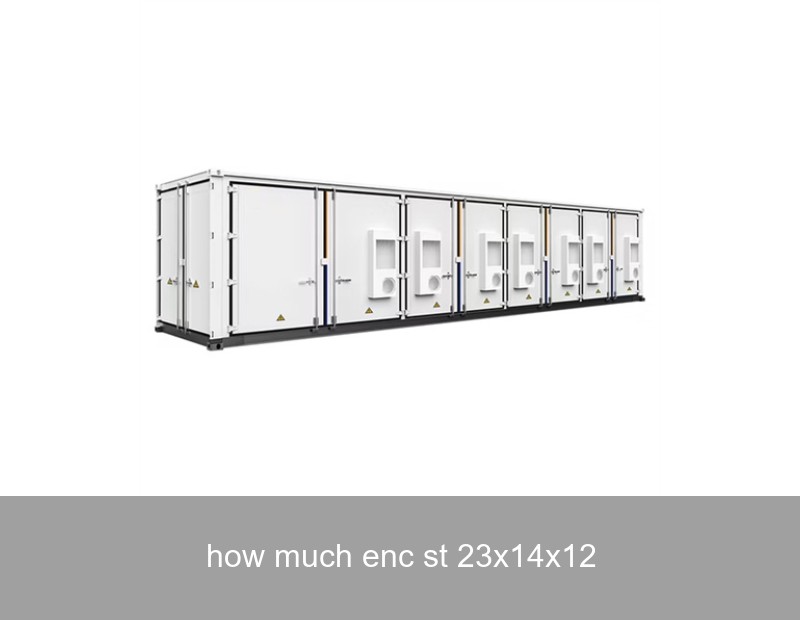
Have you ever looked at a closet, a small utility room, or a compact outdoor enclosure and wondered, "How much energy could I realistically store in there?" It's a question we hear often from homeowners and business managers alike. Specifically, many are asking: how much energy can you store in a space measuring 23x14x12 inches? The answer isn't just a simple number; it's a fascinating journey into the evolution of battery energy density, smart system design, and how companies like Highjoule are pushing the boundaries to deliver maximum power in minimal footprints.
Table of Contents
The Space Math: More Than Just Dimensions
Let's break down the volume. A space of 23 x 14 x 12 inches equals approximately 3,864 cubic inches, or about 2.24 cubic feet (63.3 liters). That's roughly the size of a large suitcase or a compact microwave oven. In the world of energy storage, the raw volume is just the starting point. The critical question is: what fills that volume? Is it mostly battery cells, or is a significant portion taken up by cooling systems, protective casing, and inverters? The efficiency of the internal layout—the "packing density"—is what separates a basic battery box from a high-performance energy storage system.
The Packing Factor: Engineering Efficiency
Think of it like packing a suitcase. You can throw in clothes haphazardly and fit very little, or you can roll them meticulously and fit a week's worth of outfits. Similarly, advanced battery systems from providers like Highjoule are engineered with a high packing factor. Using prismatic or pouch lithium-ion cells with tailored thermal management, they maximize the active energy-storing material within the given external dimensions, ensuring you're not paying for empty space.
The Density Evolution: From Lead-Acid to Lithium
To appreciate today's capabilities, a quick history lesson is helpful. A decade ago, that 2.24 cubic feet might have been filled with lead-acid batteries.
- Lead-Acid: Energy density of ~30-50 Wh/L. In our 63.3L space, you'd store about 1.9 - 3.2 kWh. Heavy, bulky, and with a short cycle life.
- Modern Lithium-Ion (NMC/LFP): Energy density of ~200-350 Wh/L for premium cells. Suddenly, that same space can theoretically hold between 12.7 and 22.2 kWh of energy.
That's a 5 to 7-fold increase! But here's the catch: these are cell-level densities. A real-world, safe, and operational battery system includes battery management systems (BMS), cooling, safety enclosures, and often an integrated inverter. This reduces the usable system-level density. A top-tier, fully integrated system like Highjoule's CubeSeries for residential and commercial use can achieve a system-level energy density that makes incredibly efficient use of such compact dimensions, delivering reliable, ready-to-use power.
A Real-World Case: The German Bakery's Transformation
Let's move from theory to practice. Consider a family-run bakery in Bavaria, Germany. Facing rising electricity costs and grid instability, they wanted backup power for their refrigerators and ovens, and to store excess energy from their new rooftop solar panels. Their constraint? A tight utility room with a pre-existing niche measuring just 24x15x12 inches.
After evaluating generic options, they installed a Highjoule CubeSeries C10 modular system. The specs are telling:
| Parameter | Detail |
|---|---|
| Usable Capacity | 10.2 kWh |
| Dimensions (HxWxD) | 22.8" x 13.8" x 11.8" |
| System Weight | 154 lbs (70 kg) |
| Integrated Components | Hybrid Inverter, BMS, Liquid Cooling |
The system fit their space perfectly. In the first year, it provided 42 hours of full backup during grid outages, ensuring zero spoilage of perishable goods. More importantly, by enabling time-of-use energy arbitrage (storing solar/cheap night electricity for use during peak afternoon hours), it reduced their grid electricity bill by an estimated 68%. This case, documented in a Fraunhofer ISE study on storage economics, highlights that the value isn't just in "how much" you store, but in how intelligently you can use it.

Image: A modern, compact battery storage system installed in a utility space. (Source: Unsplash, representative image)
Beyond the Battery: The System Makes the Difference
Focusing solely on physical dimensions and raw kWh is like buying a computer based only on hard drive size. The processor, software, and reliability are what determine real-world performance. Similarly, with battery storage, the surrounding technology is paramount.
- Thermal Management: Passive cooling wastes space; active liquid cooling (as used in Highjoule's commercial MatrixPlatform) allows for tighter cell packing without overheating, maximizing both safety and energy density in the given footprint.
- Cell Chemistry: Lithium Iron Phosphate (LFP), used in many Highjoule systems, offers slightly lower volumetric density than some alternatives but provides superior safety, longevity (over 6,000 cycles), and stability—meaning more total energy delivered over the system's life within that same 23x14x12 box.
- System Integration: An all-in-one unit with a built-in hybrid inverter saves enormous space compared to a setup with separate components, making the most of your spatial investment.
The Highjoule Solution: Engineered for Density and Intelligence
At Highjoule, founded in 2005, we've spent nearly two decades answering the "how much in this space" question for our global clients. Our philosophy is that every cubic inch should work hard. Our CubeSeries for residential/small commercial and MatrixPlatform for industrial/microgrid applications are designed with this core principle.
The MatrixPlatform, for instance, uses a modular rack-mount design. A single 42U standard rack (occupying a floor space not much larger than your specified dimensions) can be configured to store from 100 kWh to over 1 MWh. This scalability means you start with what fits your space and budget, and expand energy capacity without expanding the physical footprint. Our proprietary Adaptive Core BMS constantly optimizes charge/discharge cycles and cell balancing, extracting the maximum possible safe performance from the installed cells, year after year.
This isn't just about hardware. Our Highjoule Energy OS software turns that stored kWh into actionable intelligence, allowing users in Europe and the U.S. to participate in grid services, optimize for solar self-consumption, or set custom backup priorities—all from a smartphone app. As noted by the National Renewable Energy Lab (NREL), software-defined control is a key driver for storage value and ROI.

Image: Technician monitoring a large-scale modular battery storage installation. (Source: Unsplash, representative image)
What's Your Space's Potential?
So, back to your original measurement. In a well-engineered, modern lithium-ion system from a leading provider, a 23x14x12 inch space can reliably store between 8 and 12 kWh of usable energy—enough to power the critical loads of an average home for 12-24 hours, or shift significant commercial energy usage. The exact figure depends on the specific cell chemistry, system architecture, and integration level.
But the more profound question we encourage you to ask is: What could you *do* with that energy? Could it turn your solar panels into a true 24/7 power plant? Could it protect your business from a $10,000-per-hour outage? Could it help you buy energy when it's cheap and green, and use it whenever you need?
We invite you to share your specific challenge: What are the dimensions of the space you're considering, and what is the one critical load you wish you could always keep running?
 Inquiry
 Online Chat