


How Much Hengyang Energy Really Powers Your Future? Decoding Capacity, Stability, and Smart Storage
You've likely seen the headlines: "Hengyang Announces New 500MW Solar Farm" or "Major Investment in Hengyang Energy Infrastructure." It's an exciting time for renewable energy globally. But as a business owner, facility manager, or even a community leader in Europe or the US, you might be reading this with a pressing, practical question: How much Hengyang energy—or energy from any major renewable project—can reliably power my operations, my home, or my grid? The raw megawatt (MW) figure is only the beginning of the story. The true measure of modern energy lies not just in capacity, but in consistency, control, and intelligent integration. Let's unpack what this really means for a sustainable energy future.
Beyond the Megawatt: A Deeper Look at "How Much"
When we ask "how much energy," we're often given a capacity number in megawatts (MW). A 100MW solar plant, for instance, suggests significant power. However, this is its maximum potential output under ideal conditions—bright, sunny midday. The real, delivered energy over time (measured in megawatt-hours, MWh) is a different tale. It's influenced by the simple fact that the sun doesn't always shine, and the wind doesn't always blow. This intermittency is the core challenge of renewable energy integration.
Consider this: The International Renewable Energy Agency (IRENA) reports massive global growth in renewable capacity. Yet, grid operators balance this with a critical metric: capacity factor. This is the ratio of actual energy output over time versus its maximum possible output. For solar PV, this typically ranges from 10-25% depending on location; for onshore wind, it might be 20-45%. So, a 100MW solar farm might deliver an average equivalent of only 15-25MW of constant power over a year. This gap between "nameplate capacity" and "dependable output" is where the real energy planning begins.

Image Source: Unsplash - A visual representation of large-scale renewable generation, highlighting its weather-dependent nature.
The Stability Imperative & The Case for Storage
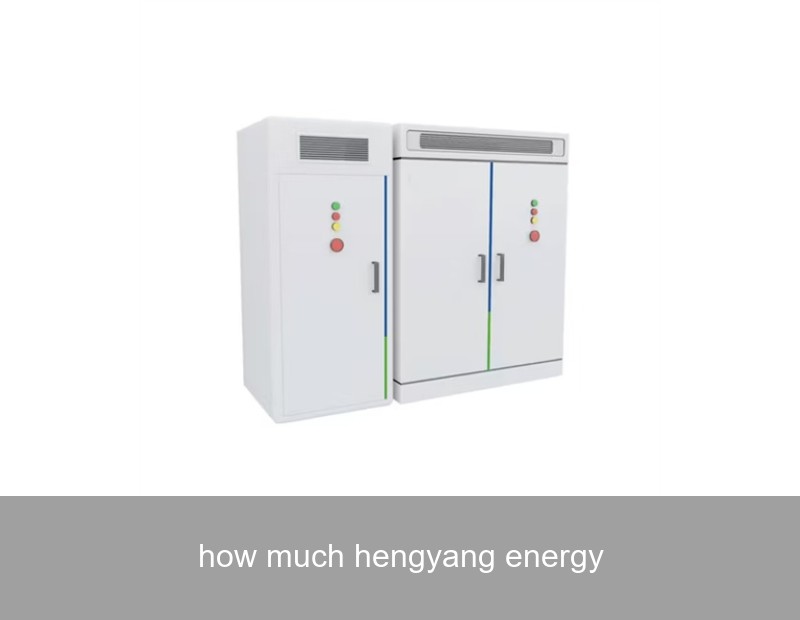
For commercial and industrial entities, consistent power isn't a luxury; it's a requirement for production lines, data centers, and critical infrastructure. Voltage fluctuations or outages can cost thousands per minute. This is why the conversation is shifting from simply "how much generation" to "how much stable, dispatchable power." The answer increasingly involves Battery Energy Storage Systems (BESS). Think of BESS not as a source of energy, but as a productivity tool for your energy assets. It takes the abundant but irregular energy from sources like Hengyang's projects and time-shifts it, releasing power precisely when and where it's needed most.
Highjoule Solutions: Bridging the Generation-Consumption Gap
This is precisely where Highjoule, as a global leader in advanced energy storage since 2005, provides the critical link. We don't just ask "how much energy is produced"; we engineer solutions that answer "how much value can that energy deliver." Our intelligent storage systems are designed to maximize the utility of every megawatt-hour from renewable sources, whether from a utility-scale solar farm or a rooftop PV array on a factory.
For our commercial and industrial clients across Europe and North America, Highjoule's IntelliBESS Platform offers:
- Peak Shaving: Automatically discharge stored energy during high-cost utility rate periods, dramatically reducing demand charges.
- Renewable Firming: Smooth out the natural fluctuations from solar or wind, creating a stable, grid-friendly power output.
- Backup Power: Provide seamless, instantaneous power during grid outages, ensuring operational continuity.
- Energy Arbitrage: Store energy when prices (or renewable generation) are low, and use it when they are high.
Our systems, like the Highjoule C&I Stack, are built with industry-leading safety standards, lithium-iron-phosphate (LFP) chemistry, and an AI-driven energy management system that learns and adapts to your load patterns and tariff structures. This transforms a simple question of quantity into a sophisticated strategy for energy resilience and cost optimization.
A European Case Study: Lessons for All
Let's ground this in reality with a project from Southern Europe. A major food processing plant in Spain with a 2MW rooftop solar installation faced a dual challenge: their solar production peaked midday, but their highest energy consumption and utility costs came in the early evening during production shifts. They were exporting excess solar at low feed-in tariffs while paying premium rates to the grid later.
The Solution & The Data: Highjoule deployed a 1.5MWh / 750kW battery storage system integrated with their existing solar. Our IntelliBESS platform was programmed for optimal self-consumption and peak shaving.
| Metric | Before Highjoule BESS | After Highjoule BESS (12-month avg.) |
|---|---|---|
| Renewable Self-Consumption | 35% | 89% |
| Peak Demand from Grid | 1.8 MW | 1.2 MW |
| Annual Energy Cost Savings | Baseline | €114,000 |
| Grid Dependency During Peak | 100% | 40% |
The result? They weren't just asking "how much solar energy do we produce?" (2MW peak). They now manage "how much of our solar energy do we use on our terms, and how much grid cost do we avoid?" The project achieved a return on investment in under 5 years and significantly boosted their sustainability credentials. This model is directly applicable to any region, including areas integrating large-scale renewable inputs, where stabilizing the grid and maximizing local value is key.

Image Source: Unsplash - Example of a commercial facility utilizing rooftop solar, a prime candidate for storage integration.
Rethinking Energy Capacity for Homes and Microgrids
The paradigm shift extends to the residential and microgrid sector. Homeowners with solar panels are familiar with the frustration of sending excess daytime energy back to the grid for minimal credit, only to buy it back at night at a higher rate. A Highjoule Home Energy Hub solves this by storing that excess daytime production for use in the evening, effectively increasing the home's usable renewable capacity by 70% or more. For remote communities or critical facilities operating as microgrids, our containerized Megapack Solutions provide the backbone, allowing them to integrate high levels of renewable generation while maintaining grid stability and security 24/7.
The Role of Policy and Market Structures
It's important to note that the economics of storage are also shaped by policy. Markets in California (CAISO), the UK, and Germany are increasingly creating value streams for storage through frequency regulation services and capacity markets. Highjoule's systems are designed to be market-ready, capable of stacking multiple revenue streams where available, from providing grid services to reducing local demand charges. You can explore how different grid operators view this integration through the U.S. Department of Energy's Grid Modernization initiative.
So, when you next read about a significant renewable energy development, whether it's in Hengyang or your local region, consider the complete picture. The future isn't powered by generation alone. It's powered by intelligent storage that unlocks reliability, resilience, and real economic value. Highjoule is at the forefront of building that intelligent layer, turning raw megawatts into dependable, sustainable power for businesses, homes, and communities.
Is your organization currently evaluating how to increase the real, usable capacity of your renewable energy investments or mitigate rising demand charges? What's the biggest hurdle you face in achieving true energy independence?
 Inquiry
 Online Chat