


Industrial Battery Systems (IBS): The Powerhouse for Modern Manufacturing and Beyond
a major manufacturing plant in Germany. The assembly lines are humming, robots are welding with precision, and overhead cranes are gliding silently. Suddenly, the grid voltage dips—a common occurrence in industrial areas. A decade ago, this might have caused costly production halts, damaged sensitive equipment, and ruined a batch of products. Today, that same plant barely notices. The secret? A robust Industrial Battery System (IBS) seamlessly kicks in, providing ride-through power and ensuring uninterrupted operations. This isn't science fiction; it's today's industrial reality. For facility managers, energy directors, and CEOs across Europe and the U.S., understanding and deploying the right industrial battery systems IBS is no longer a luxury—it's a strategic imperative for resilience, cost control, and sustainability.
Table of Contents
- The Phenomenon: Why Industry is Turning to On-Site Power
- The Data: Quantifying the IBS Advantage
- The IBS Breakdown: More Than Just a Big Battery
- The Highjoule Approach: Intelligent, Integrated Industrial Power
- Case Study: Peak Shaving at a Belgian Steel Processor
- Future-Proofing Your Operations: Key Insights for Decision-Makers
The Phenomenon: Why Industry is Turning to On-Site Power
The industrial energy landscape is undergoing a seismic shift. We're moving from a simple model of "draw from the grid, pay the bill" to a complex, dynamic interplay of generation, storage, and consumption. Three powerful forces are driving this change:
- Grid Instability & Power Quality Issues: Aging infrastructure and the variable nature of renewable energy feeding into the grid can lead to more frequent sags, surges, and interruptions. For a data center, pharmaceutical clean room, or automated factory, even a milliseconds-long disturbance can be catastrophic.
- Soaring Energy Costs & Demand Charges: In many regions, a significant portion of a commercial electricity bill isn't just for total energy used (kWh), but for the highest rate of power drawn (kW) in a billing period—the "demand charge." A single spike in usage can inflate costs for the entire month.
- The Decarbonization Mandate: Corporate sustainability goals and regulatory pressures are pushing industries to reduce their carbon footprint. Simply put, relying solely on fossil-fuel-based grid power is no longer viable for a forward-thinking brand.
This is where the modern industrial battery system enters as a game-changer. It's the keystone technology that addresses all three challenges simultaneously.
The Data: Quantifying the IBS Advantage
Let's talk numbers, because the business case for IBS is compelling. According to a U.S. Department of Energy analysis, behind-the-meter storage can provide significant value streams. Consider this typical breakdown for a 1 MW / 2 MWh IBS installation at a medium-sized factory:
| Value Stream | Potential Annual Savings/Revenue | How It Works |
|---|---|---|
| Demand Charge Reduction | $80,000 - $150,000 | The IBS discharges during short periods of peak facility demand, "shaving" the peak draw from the grid. |
| Backup Power & Resilience | Avoided $250,000+ in downtime losses (event-based) | Provides seamless bridging power during outages, preventing production stoppages. |
| Frequency Regulation (Grid Services) | $15,000 - $30,000 | In some markets, the IBS can sell fast-response services to the grid operator to stabilize frequency. |
| Arbitrage & Time-of-Use Optimization | $10,000 - $25,000 | Store energy when grid prices are low, use it when prices are high. |
When you add these up, the payback period for a well-designed IBS can often fall within 4-7 years, after which it delivers nearly pure cost savings and risk mitigation for the remainder of its 15+ year lifespan.

Image: A modern industrial battery system installation requires precision engineering and monitoring. (Source: Unsplash)
The IBS Breakdown: More Than Just a Big Battery
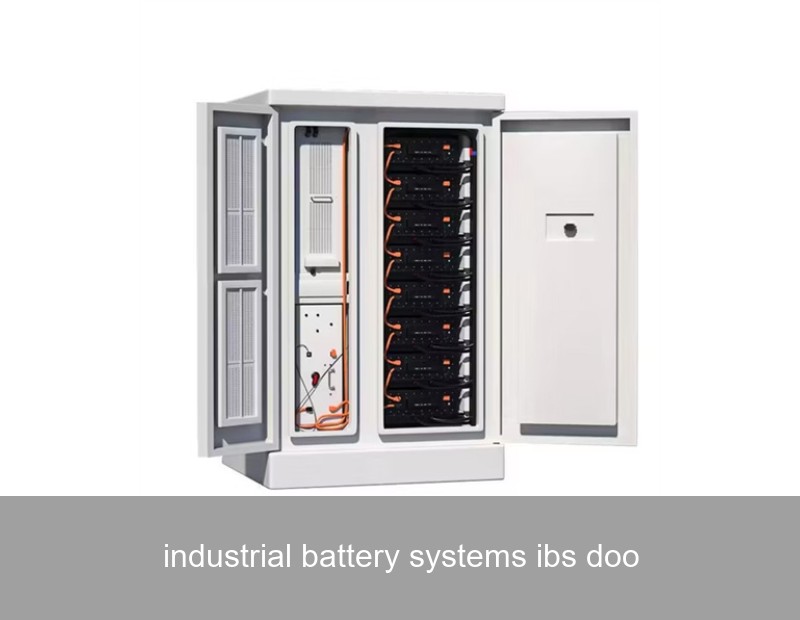
An industrial battery system is a sophisticated ecosystem. It's far more than just racks of battery cells. A complete, functional IBS comprises several critical components:
- Battery Modules & Racks: The core energy storage units, typically using Lithium-Iron Phosphate (LFP) chemistry for its superior safety, long cycle life, and thermal stability—a non-negotiable for industrial settings.
- Battery Management System (BMS): The "brain" of the battery. It monitors cell voltage, temperature, and state of charge for safety, performance, and longevity.
- Power Conversion System (PCS): The "muscle and interpreter." This bi-directional inverter converts DC battery power to AC for the facility and vice-versa, while managing the flow and quality of power.
- Energy Management System (EMS): The "strategic commander." This software platform is where the magic happens. It uses algorithms and sometimes AI to decide when to charge or discharge based on electricity rates, production schedules, and grid conditions.
- Thermal Management & Safety Systems: Dedicated cooling/heating and comprehensive fire suppression systems tailored for battery hazards.
Integrating these components seamlessly into your facility's electrical infrastructure is where expertise matters most.
The Highjoule Approach: Intelligent, Integrated Industrial Power
Since 2005, Highjoule has been at the forefront of this evolution. We understand that an off-the-shelf battery pack won't solve the unique challenges of a chemical plant, a frozen food warehouse, or a semiconductor fab. Our industrial battery systems are engineered as holistic solutions.
Our flagship product line, the Highjoule H-Series IBS, is built from the ground up for industrial duty. It features:
- Modular & Scalable Design: Start with a 500kWh system and scale to multiple MWhs as your needs grow, minimizing upfront capital outlay.
- Proprietary Adaptive EMS: Our system doesn't just react; it learns. It integrates with your building management and production systems to optimize around your actual operational rhythms, not just theoretical price signals.
- Unmatched Safety Protocol: With multi-layer protection—from cell-level fusing to gas and heat detection to isolated thermal runaway containment—safety is embedded in every layer.
- Grid-Interactive Functionality: Ready to participate in demand response programs or provide grid services, turning your energy asset into a potential revenue stream.
Our service doesn't end at delivery. Highjoule provides full lifecycle support, from initial feasibility and financial modeling to commissioning, remote monitoring, and performance guarantees.
Case Study: Peak Shaving at a Belgian Steel Processing Plant
Let's look at a real-world application. A major steel processing and coating plant in Flanders, Belgium, faced crippling demand charges. Their processes—involving large induction heaters, rollers, and pumps—created short, intense spikes in power demand several times a day.
The Challenge: Reduce monthly peak demand by at least 15% to achieve significant cost savings, without interfering with critical 24/7 production cycles.
The Highjoule Solution: We deployed a 1.2 MW / 2.4 MWh H-Series IBS, integrated directly at their medium-voltage substation. Our EMS was programmed with a primary goal of aggressive peak shaving, while maintaining a minimum state of charge for emergency backup.
The Data-Driven Result: Within the first full year of operation:
- Peak Demand Reduction: 18.7% average reduction, with some monthly peaks shaved by over 25%.
- Annual Cost Savings: €92,000 saved on demand charges alone.
- Additional Benefit: The system automatically provided seamless backup during two brief grid disturbances, preventing estimated downtime losses of €40,000.
Image: A modern industrial battery system installation requires precision engineering and monitoring. (Source: Unsplash)
Future-Proofing Your Operations: Key Insights for Decision-Makers
As you evaluate industrial battery systems IBS for your organization, here are critical insights to guide your journey:
- Look Beyond Chemistry: While LFP is the current frontrunner, the real differentiator is system-level intelligence and integration. The EMS software is where 50% of the value is created.
- Demand Detailed Modeling: A reputable provider will conduct a granular analysis of your historic load profile (at least 15-minute interval data) to accurately model savings and size the system correctly. Avoid vendors who offer generic, rules-of-thumb sizing.
- Plan for Evolution: Your IBS should be a platform. Can it easily integrate with future solar PV? Can it adapt to new grid service markets? Choose a system with open-architecture communication protocols.
- Understand the Total Cost of Ownership (TCO): Focus on the levelized cost of storage (LCOS) over 15 years, not just the upfront capital cost. A cheaper, less efficient system with a shorter lifespan often costs more in the long run.
The transition to a resilient, low-carbon industrial sector is undeniable. As noted by the International Energy Agency, energy storage is a critical enabler of this transition, with front-of-the-meter and behind-the-meter applications growing rapidly.
Ready to See Your Load Profile Transformed?
What would a 15-20% reduction in your facility's peak demand do for your bottom line this year? Highjoule's team of experts can provide a complimentary, data-driven feasibility assessment using your utility bills. Could your largest energy cost center become a strategic asset?
 Inquiry
 Online Chat