


How Much Solar Energy Can Your Home or Business Really Generate?
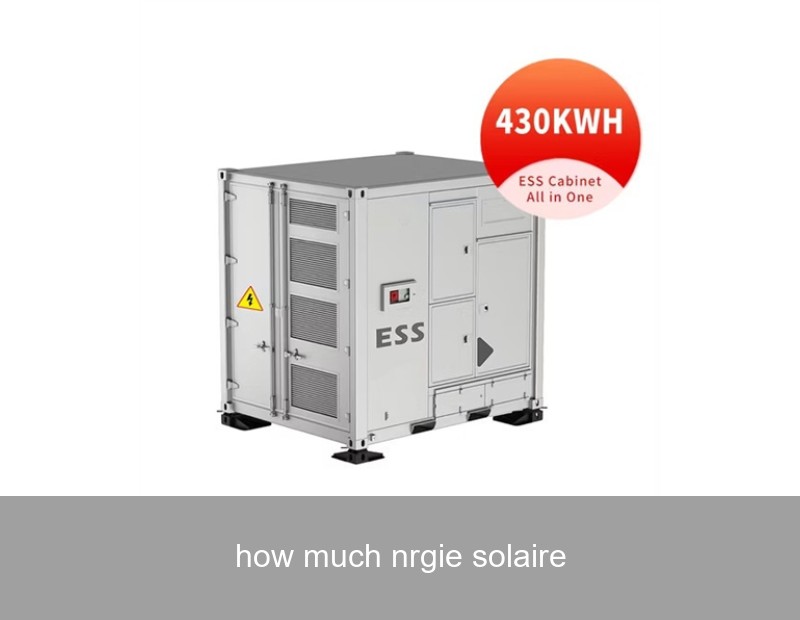
You've seen the solar panels on rooftops and heard the promises of clean, free energy from the sun. But when considering the switch, the most practical question arises: how much solar energy can I actually produce? The answer isn't a simple number. It's a fascinating equation involving your location, roof, technology, and a critical, often overlooked component: the storage system. This article will demystify the factors that determine your solar yield and explain how modern storage solutions, like those from Highjoule, transform every kilowatt-hour into reliable, usable power.
Table of Contents
- The Core Question: It's About More Than Just Panels
- Key Factors Determining Your Solar Energy Harvest
- The Storage Multiplier: Why Your Solar System's Value Isn't Just in Generation
- A Real-World Case: The Barcelona Bakery
- Highjoule's Role: Maximizing Your Solar Investment
- Your Next Step Towards Energy Independence
The Core Question: It's About More Than Just Panels
Ask most people about solar energy potential, and they'll point to the panels. While photovoltaic (PV) modules are the workhorses, thinking only in terms of "panel wattage" is like buying a car based solely on engine size. The real metric you care about is how much usable electricity you get over time—measured in kilowatt-hours (kWh). This is your solar energy harvest, and it depends on a symphony of factors.

Image Source: Unsplash (Photographer: Vivint Solar)
Key Factors Determining Your Solar Energy Harvest
Let's break down the key variables in the solar energy equation. Understanding these will help you set realistic expectations and design a system that truly meets your needs.
1. Solar Irradiance: Your Location's Solar Budget
This is the amount of sunlight that hits your roof. A home in sunny Arizona has a much higher "solar budget" than one in cloudy Seattle. In Europe, a system in Malaga, Spain will outperform one in Hamburg, Germany. Tools like the PVGIS calculator from the European Commission provide incredibly precise local data.
2. System Size and Panel Efficiency
System size, measured in kilowatts-peak (kWp), is the combined power rating of all panels. A 6 kWp system is larger than a 4 kWp system. But efficiency matters too. High-efficiency panels (21%+) convert more sunlight into electricity in the same space, crucial for roofs with limited area.
3. Orientation and Tilt
In the Northern Hemisphere, south-facing roofs are ideal. East or west-facing roofs can still capture 80-90% of the potential. The tilt angle should roughly match your latitude for optimal year-round production.
4. Shading and Local Environment
Even small shadows from chimneys, trees, or neighboring buildings can drastically reduce a panel string's output. A professional site assessment is non-negotiable here.
5. System Losses and Degradation
Inverters, wiring, and heat all cause small losses. Panels also degrade slowly, typically around 0.5% per year. High-quality components minimize these losses.
| Region (City Example) | Estimated Annual Production (kWh) | Equivalent to... |
|---|---|---|
| Sunny (Phoenix, USA / Malaga, Spain) | 9,500 - 10,500 | ~85% of a typical US home's annual use |
| Moderate (Stuttgart, Germany / Boston, USA) | 6,200 - 7,000 | ~60% of a typical EU home's annual use |
| Less Sunny (Seattle, USA / Glasgow, UK) | 5,000 - 5,800 | ~45% of a typical home's annual use |
*Estimates based on south-facing, unshowed roofs using standard efficiency panels. Actual production varies. Data synthesized from NREL and PVGIS tools.
The Storage Multiplier: Why Your Solar System's Value Isn't Just in Generation
Here's the pivotal insight: how much solar energy you generate is less important than how much of it you can actually use. Without storage, a typical home might only directly consume 30-50% of its solar production, sending the rest back to the grid for minimal compensation. The sun peaks at midday; your highest energy demand is often in the morning and evening. This is the solar "dilemma."
This is where battery energy storage systems (BESS) become the game-changer. They don't generate more sunlight, but they ensure you utilize a far greater percentage of your harvest. A high-performance storage system acts as a "time machine" for your solar energy, shifting it to when you need it most.
A Real-World Case: The Barcelona Bakery
Let's look at a concrete example from our work at Highjoule. A family-run bakery in Barcelona, Spain, installed a 25 kWp solar array. Their initial data showed impressive generation: an average of 110 kWh on a sunny day. Yet, their monthly electricity bills remained stubbornly high. Why? Their baking ovens fired up at 4 AM, and their shop's peak was 6-9 AM and 5-8 PM—all times outside the solar peak.
The Solution & Result: We integrated a Highjoule HI Series Commercial Battery System (50 kWh capacity) with advanced energy management software. The system was programmed to store excess midday solar energy and dispatch it during the morning and evening peaks. The outcome? Within one year:
- Solar Self-Consumption Rate increased from 35% to over 85%.
- Grid Energy Draw during expensive peak hours was reduced by 90%.
- Annual Electricity Costs were slashed by 72%, achieving a return on investment in under 5 years.
This case perfectly illustrates that the question isn't just "how much solar energy?" but "how much solar energy can I use on my terms?"

Image Source: Unsplash (Photographer: American Public Power Association)
Highjoule's Role: Maximizing Your Solar Investment
Since 2005, Highjoule has been at the forefront of solving this exact challenge. We don't just sell batteries; we provide intelligent, integrated systems that maximize the value of every kilowatt-hour your solar panels produce.
Our Technology Makes the Difference
- Adaptive AI Energy Management: Our systems don't just store and release. They learn your consumption patterns, forecast weather, and even consider variable electricity tariffs (like time-of-use rates common in Europe and the US) to optimize energy flow automatically.
- Scalable & Robust Hardware: From the Highjoule HI Series for Commercial & Industrial applications to the sleek Residential HX Series, our battery systems are built with longevity, safety (UL 9540A / IEC certified), and scalability in mind. You can start with what you need and expand later.
- Grid Services & Backup Power: For businesses and microgrids, our systems can provide revenue streams through grid services or ensure critical operations continue during an outage, a feature increasingly valued in both California and Central Europe.
By integrating a Highjoule system, you're not simply adding a battery. You're installing the brain and heart of your personal energy ecosystem, ensuring that the answer to "how much solar energy" is always: "More than enough, exactly when I need it."
For more on the science behind solar potential, the National Renewable Energy Laboratory (NREL) is an invaluable resource.
Your Next Step Towards Energy Independence
The journey to understanding your true solar potential starts with a detailed analysis of your specific site and energy profile. Generic calculators give a ballpark, but the precision needed for a sound investment comes from a tailored assessment. So, the most important question we can leave you with is this: What does your unique energy consumption pattern look like throughout the day and year, and how can we design a solar-plus-storage system that flattens your grid dependency curve?
 Inquiry
 Online Chat