


How Much Solar Inventory Do You Really Need? A Guide to Sizing Your System
So, you're thinking about going solar. It's a fantastic decision for your wallet and the planet. But one of the very first and most crucial questions that pops up is: how much solar inventory—panels, inverters, and especially battery storage—do I actually need to power my home or business? It's not a one-size-fits-all answer. The right "inventory" isn't just about covering your roof with panels; it's about creating a resilient, efficient, and cost-effective energy ecosystem. Let's break down this complex question into a clear, actionable plan.
Key Factors Determining Your "Solar Inventory"
Think of your energy system like a personal energy bank. You need to know your daily "spending" (consumption), your daily "income" (solar production), and how much you want to "save" (store) for a rainy day—or more accurately, for nighttime and power outages.
1. Your Energy Consumption Profile
This is your starting point. How much electricity do you use, and when do you use it? A family running air conditioning in Arizona has a different profile than a German household with an electric heat pump.
- Annual Usage: Check your utility bills for total kilowatt-hours (kWh) used per year.
- Daily & Hourly Patterns: Do you consume more in the morning and evening? High evening usage, after the sun sets, dramatically increases the value of battery storage.
Image: Understanding your consumption pattern is the first step. Source: Unsplash

2. Your Solar Production Potential
Not all roofs are created equal. Your actual solar "income" depends on:
- Location & Climate: Peak sun hours vary greatly between Southern California and Northern Germany. The European Commission's PVGIS tool is an excellent resource for accurate solar potential data across Europe and the US.
- Roof Orientation & Shading: South-facing (in the Northern Hemisphere), unshaded roofs yield the highest production.
- System Size (kWp): This is the "nameplate" capacity of your panel array. A larger system in a sunny area generates more kWh, increasing your daily energy "paycheck."
3. Your Storage Strategy: The Game Changer
This is where the concept of "inventory" becomes most tangible. Batteries allow you to store excess solar energy produced during the day for use at night. Determining how much solar inventory you need in storage hinges on your goals:
| Primary Goal | Storage Sizing Implication | Typical Battery Capacity Needed* |
|---|---|---|
| Maximize Self-Consumption Use more of your own solar power, reduce grid purchases. |
Size to cover evening/night load until sun returns. | 5 - 15 kWh |
| Backup Power & Resilience Keep critical loads running during grid outages. |
Size based on outage duration and essential load list (fridge, lights, internet, etc.). | 10 - 30+ kWh |
| Energy Independence & Time-of-Use Optimization Minimize grid interaction or avoid peak electricity rates. |
Larger systems designed to cover multiple days of consumption or significant load shifting. | 20 - 50+ kWh |
*Capacity varies widely based on individual consumption.
Case Study: A Real-World Example from Bavaria
Let's look at a real scenario to make this concrete. The Müller family in Bavaria, Germany, has an annual electricity consumption of 6,500 kWh. Their roof allows for a 9 kWp solar system. Without storage, they were self-consuming only about 30% of their solar energy, sending the rest to the grid for a modest feed-in tariff.
Their goal was to increase energy independence and have backup power. They partnered with a local installer who, using Highjoule's design tools, recommended integrating a Highjoule HES-G2 10.2 kWh battery system with their solar array. The results after one year:
- Self-Consumption Rate: Increased from 30% to over 85%.
- Grid Independence: Achieved 70% annual energy autonomy.
- Backup Power: The system seamlessly powers essential circuits during the region's occasional winter grid outages for up to 24 hours.
This case shows that the right "inventory" of storage transformed their solar system from a partial solution into a resilient home energy asset.
Highjoule's Intelligent Solutions for Optimal Inventory Management
At Highjoule, we understand that answering "how much solar inventory" you need goes beyond simple calculations. It's about intelligent integration. Our H-Stack series of modular battery energy storage systems (BESS) is designed for this precise challenge.
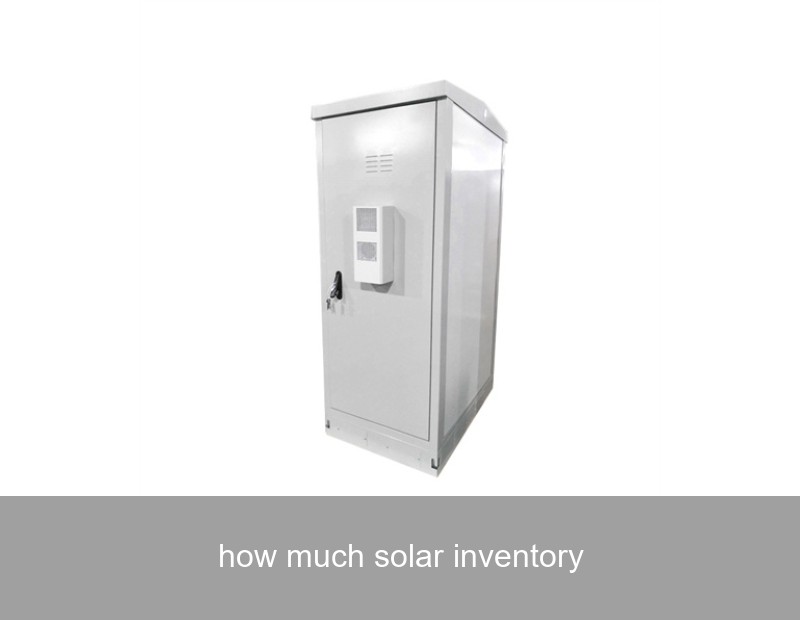
Unlike rigid, one-size-fits-all solutions, the H-Stack's modular architecture allows you to start with a core system—say, 10 kWh—and easily expand capacity by adding more battery modules as your needs evolve. This "grow-as-you-go" approach ensures you don't over-invest upfront but have a clear path to increase your energy inventory later.
Image: Modular battery systems like Highjoule's H-Stack allow for flexible capacity. Source: Unsplash

Furthermore, our systems are powered by Highjoule's EnergyOS™, an advanced energy management platform. EnergyOS™ doesn't just store energy; it intelligently manages it. It learns your consumption patterns, considers weather forecasts, and can be programmed to optimize for time-of-use rates or maximize self-consumption automatically. This software intelligence ensures every kilowatt-hour in your inventory is used in the most efficient and economical way possible.
Beyond the Basics: Advanced Inventory Considerations
For commercial and industrial applications, or for those planning to add electric vehicles (EVs) and heat pumps, the inventory question scales up.
- EV Charging: An EV can add 3,000-4,000 kWh annually to your consumption. Sizing your solar and storage system to accommodate future EV ownership is a wise move.
- Grid Services & Microgrids: For businesses or communities, larger Highjoule C&I BESS solutions can provide not just backup, but also services like peak shaving (reducing demand charges) and even participating in grid stability programs, turning your energy inventory into a revenue stream. The National Renewable Energy Lab (NREL) details the value of storage in grid services.
Taking Control of Your Energy Future
Determining how much solar inventory you need is a personalized journey. It starts with understanding your own energy footprint and defining your goals—be it savings, resilience, or full energy independence. With intelligent, modular solutions like those from Highjoule, you have the flexibility to build a system that fits your life today and adapts to your needs tomorrow.
What's the first step you'll take to audit your current energy "spending" and start planning your optimal solar and storage inventory?
 Inquiry
 Online Chat