


How Much Sunectric Solar Do You Really Need? A Practical Guide
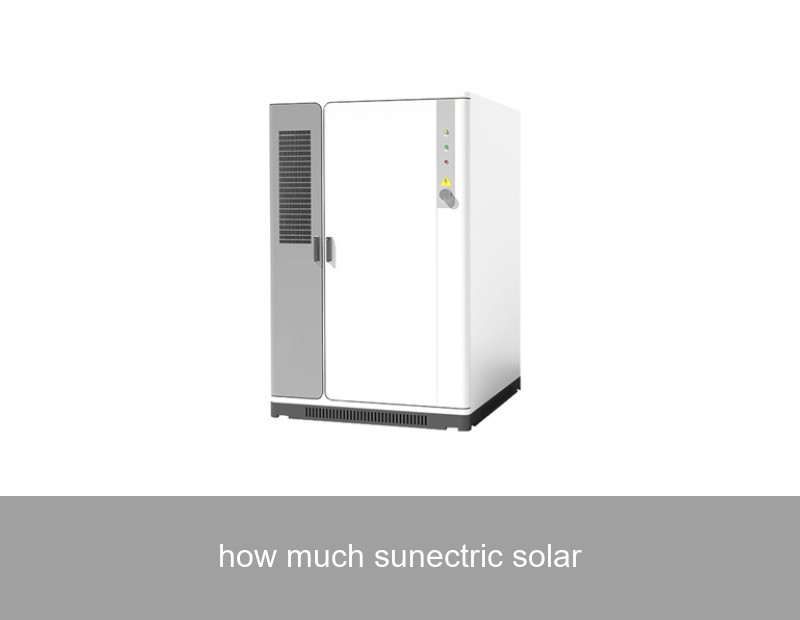
You're considering solar power. It's a smart move. But one question likely looms larger than all others: how much Sunectric solar capacity is right for my home or business? It's not just about the number of panels on your roof. It's about understanding your energy DNA—your consumption patterns, your goals, and how a system integrates into your daily life. Let's demystify the process and calculate what "enough" truly means for you.
Table of Contents
- The Phenomenon: From Bill Shock to Energy Independence
- The Data: Breaking Down the "How Much" Equation
- The Case Study: A Real-World Example from California
- The Critical Piece: Why Solar Alone Isn't the Full Answer
- The Highjoule Solution: Intelligent Storage for a Complete Energy System
- Your Next Step Towards Energy Confidence
The Phenomenon: From Bill Shock to Energy Independence
Across homes in Europe and the US, a common pattern unfolds. Homeowners receive escalating electricity bills, look at their sun-drenched roofs, and think, "There must be a better way." The initial instinct is to cover the roof with as many panels as possible. However, this "max-out" approach often leads to oversized, inefficient systems that produce excess energy at the wrong times—energy that is sold back to the grid for pennies while you buy it back at night for dollars. The real goal isn't just generation; it's intelligent consumption and storage.

Credit: Photo by Andreas Gücklhorn on Unsplash. A solar-equipped home, but is it optimized?
The Data: Breaking Down the "How Much" Equation
So, how do we calculate your ideal solar capacity? We move beyond rules-of-thumb and focus on your specific data. Here's the foundational formula:
Key Factors in Your Solar Calculation:
- Annual Energy Usage (kWh): Found on your utility bills. A typical US home uses 10,400 kWh/year (U.S. Energy Information Administration).
- Peak Sun Hours: Daily average of full-power sunlight your location receives. This varies dramatically (e.g., 3.5 in London, 5.5 in Arizona).
- System Efficiency & Losses: Accounting for inverter efficiency, shading, panel orientation, and soiling (typically 75-85% of rated output).
- Your Primary Goal: Offset 100% of your bill? Achieve backup power? Reduce carbon footprint? Each goal changes the system design.
| Location | Peak Sun Hours | Required System Size (kW) | Approx. Number of Panels (400W each) |
|---|---|---|---|
| Southern California | 5.5 | 5.0 kW | 13 |
| Northern Germany | 2.8 | 9.8 kW | 25 |
See the dramatic difference? A German home needs a system nearly twice as large as one in California to produce the same energy. This is why generic online calculators can be dangerously misleading.
The Case Study: A Real-World Example from California
Let's look at the Johnson family in Sacramento. Their goal was to eliminate their $220 monthly electric bill and have backup power during Public Safety Power Shutoffs (PSPS).
- Data: Annual usage: 11,000 kWh. Peak sun hours: 5.2.
- Initial Design: A 8.2 kW solar-only system was proposed to cover 100% of their daytime usage and export surplus.
- The Flaw: This design ignored their evening peak (6 PM - 9 PM) when the sun was down. They would still draw expensive power from the grid.
- Optimized Solution: They installed a 6.5 kW solar array paired with a Highjoule HES-10 home energy storage system (10 kWh usable capacity).
- Result: The solar system covers daytime loads and charges the battery. The battery powers the home through the evening and during outages. Their grid dependence dropped by 94%, and they achieved true bill protection and resilience. The smaller, smarter solar system was more cost-effective and functional than the initially proposed oversized one.
The Critical Piece: Why Solar Alone Isn't the Full Answer
The Johnsons' case highlights the modern truth: solar generation and energy storage are two halves of a complete solution. Asking "how much solar?" is now intrinsically linked to "how much storage?"
Think of it this way: your solar panels are a prolific water spring that only flows during the day. A battery is your personal reservoir, letting you store that water for use at night or during a drought. Without it, you're reliant on the communal (and costly) grid pipeline when your spring stops flowing.

Credit: Photo by Kindel Media on Pexels. A home battery system, the essential partner to solar.
The Highjoule Solution: Intelligent Storage for a Complete Energy System
This is where Highjoule's expertise transforms your solar investment. For nearly two decades, we've moved beyond simply providing batteries to delivering intelligent energy platforms. Our systems ensure the Sunectric solar energy you produce works hardest for you.
Highjoule's Product Ecosystem for Homeowners:
- HES Series (Home Energy Storage): Scalable, modular battery systems from 10 kWh to 30+ kWh. They feature advanced lithium iron phosphate (LFP) chemistry for safety and longevity, seamlessly integrating with any new or existing solar array.
- Energy Management System (EMS): The true brain of the operation. Our AI-driven EMS doesn't just store energy; it learns your habits, weather patterns, and utility rate schedules. It automatically decides when to charge from solar, when to discharge to power your home, and when to participate in grid services programs (where available), optimizing for both savings and resilience.
- Integrated Inverter Systems: We provide fully integrated AC or DC-coupled solutions, ensuring high conversion efficiency and a single point of control for your entire solar + storage system.
For commercial and industrial clients, Highjoule's GridMax series provides large-scale storage for peak shaving, demand charge reduction, and microgrid formation, turning energy from a cost center into a strategic asset.
Designing with Highjoule: A New Approach to "How Much Solar"
When you partner with a Highjoule Certified Installer, the conversation shifts. Instead of just sizing panels, we model your 24/7 energy profile. We ask: What are your critical loads during an outage? What is your utility's time-of-use rate structure? Our design software simulates thousands of scenarios to recommend the optimal pairing of solar kW and storage kWh to meet your specific financial and reliability targets. Often, this leads to a more balanced, cost-effective system than a solar-only design.
Your Next Step Towards Energy Confidence
The journey to answering "how much Sunectric solar do I need" begins with a deeper inquiry into your relationship with energy. It's no longer a simple square footage calculation. It's about designing a personalized energy ecosystem that generates, stores, and manages power intelligently.
Are you ready to move beyond the simplistic panel count and explore how a holistic solar and storage solution, powered by intelligent technology like Highjoule's, can deliver not just savings, but true energy independence and peace of mind? What would you power first when the grid goes down?
 Inquiry
 Online Chat