


How Much Do Renewables Veer? Understanding and Taming the Intermittency Challenge
a bright, sunny afternoon powers a region with abundant solar energy. Suddenly, a large cloud bank rolls in. What happens to the power supply? This isn't a hypothetical—it's the daily reality of integrating renewable energy into our grids. As we ambitiously transition from fossil fuels, a critical question emerges for grid operators, energy managers, and homeowners alike: how much do renewables veer, and how can we ensure the lights stay on when they do?
The variability, or "veering," of sources like solar and wind is the most significant technical challenge in the clean energy transition. It's not that they are unreliable in the long term; it's that their output is inherently non-dispatchable and weather-dependent. This article will delve into the data behind renewable intermittency, explore a real-world case study, and illuminate the technological key to a stable, sustainable grid: advanced energy storage.
Quantifying the Challenge: How Much Do Renewables Veer?
Let's move beyond anecdotes and look at the numbers. The degree of veering depends on the technology, location, and time scale.
- Solar Photovoltaic (PV): Output follows a predictable daily curve (the "duck curve"), but can plummet by 70-80% in minutes due to passing clouds, a phenomenon known as "solar ramping." Seasonally, output in temperate zones can vary by a factor of 5 between summer and winter.
- Wind Power: Variability is more pronounced. A single wind farm's output can swing from 0% to 100% of its capacity within 12 hours. Regional aggregation smooths this somewhat, but large-scale, multi-day calm periods ("wind droughts") are a real grid planning concern.
According to a comprehensive study by the National Renewable Energy Laboratory (NREL), high penetrations of solar and wind require significant grid flexibility. The study notes that in some scenarios, the net load (total demand minus renewable generation) can require conventional generators to ramp up at rates exceeding 40% of their capacity per hour to compensate for renewable dips.
| Renewable Source | Short-Term Variability (Minute-to-Minute) | Daily Variability | Seasonal Variability |
|---|---|---|---|
| Utility-Scale Solar PV | High (Cloud-induced ramps) | Predictable curve to zero at night | High (Sun angle, day length) |
| Distributed Rooftop Solar | Very High (Hyper-local weather) | Predictable curve to zero at night | High |
| Onshore Wind | Moderate to High | Often higher at night | Moderate (Site-dependent) |
| Offshore Wind | Lower (More consistent winds) | Often higher at night | Moderate |
Case Study: The Texas Grid and Solar's Sharp Drop
Let's examine a concrete event. The Electric Reliability Council of Texas (ERCOT), which operates a grid with one of the highest wind and solar penetrations in the world, provides public data on generation. On a spring day like April 19, 2023, solar power can reliably provide over 30% of midday demand. However, meteorologists forecast a fast-moving front with thick clouds.
As the front arrived, real-time data showed aggregate solar generation across the ERCOT region dropping from a peak of ~12,500 MW to below 4,000 MW in under two hours—a decrease of over 8,500 MW. That's the equivalent of suddenly turning off more than eight large nuclear power plants. The grid operator had to call upon natural gas "peaker" plants and, crucially, grid-scale battery storage systems to inject power instantly and follow the steep downward solar ramp. This event perfectly encapsulates the "how much" and highlights the urgent need for rapid-response solutions. (ERCOT Solar Dashboard).

Image Source: Unsplash (User: @americanpublicpower)
The Stabilizer: Energy Storage Systems (ESS)
So, how do we manage this veering? The answer lies in decoupling energy generation from its immediate use. Energy Storage Systems (ESS) act as a shock absorber and a buffer for the grid. They perform four critical functions to mitigate intermittency:
- Ramp Rate Control: Batteries can respond in milliseconds to smooth out sudden drops or spikes in renewable generation.
- Energy Time-Shifting (Arbitrage): Store excess solar energy at noon and discharge it during the evening peak (flattening the "duck curve").
- Frequency Regulation: Maintain the grid's precise 60 Hz (or 50 Hz) frequency by injecting or absorbing tiny amounts of power continuously.
- Backup Power: Provide resilience during outages, whether for a home, a factory, or a critical community facility.
Highjoule's Solutions for a Steadier Flow
At Highjoule, we've been engineering solutions for this exact challenge since 2005. Our intelligent storage systems are designed to directly address the question of "how much renewables veer" by providing precise, reliable, and scalable control.
For our commercial and industrial (C&I) clients across Europe and the U.S., our H-Series C&I ESS is a powerhouse. It integrates seamlessly with on-site solar arrays to maximize self-consumption, shave costly peak demand charges, and provide backup power. Its advanced forecasting algorithms, which integrate local weather data, predict solar veering and pre-charge or discharge the battery to ensure a facility's load is met smoothly, protecting both the bottom line and operational continuity.

Image Source: Unsplash (User: @possessedphotography)
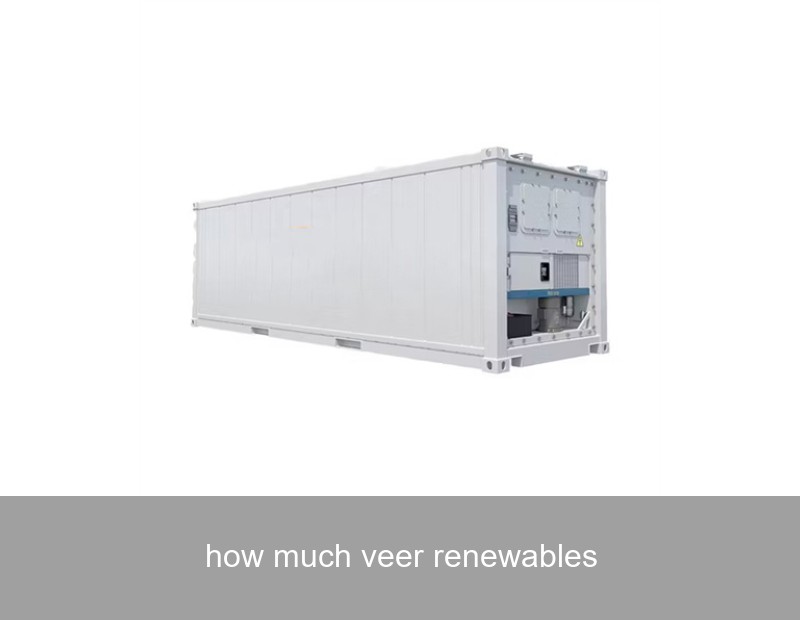
On a larger scale, our Grid-Scale Integrator GX platform is the tool of choice for utilities and independent power producers. These modular, containerized systems can be deployed in arrays to provide hundreds of megawatt-hours of storage. They are the frontline defense against the kind of variability seen in the Texas case study, providing synthetic inertia, black start capability, and bulk energy time-shifting to turn volatile renewable generation into a firm, dispatchable resource.
For residential customers looking to achieve energy independence, our Home Energy Vault pairs intelligently with rooftop solar. It doesn't just store energy; it manages it. On a day with intermittent clouds, the system ensures your home draws from the battery during solar dips, avoiding pulling from the grid during high-rate periods. It effectively makes your home's solar output predictable and reliable.
The Future Grid: Predictable, Resilient, and Renewable
The journey to a decarbonized grid isn't about waiting for perfectly steady renewables. It's about deploying the right technology to manage their natural variability. The data is clear: veering is significant but manageable. The case studies from Texas, California, and Europe prove that with strategic investment in storage, grids can handle high renewable penetration reliably.
As battery technology advances and costs continue to decline, the synergy between renewables and storage will only deepen. The future grid will be a networked web of generation, storage, and smart controls—a system where the question "how much do renewables veer?" is answered not with concern, but with the quiet hum of a battery system seamlessly compensating, stabilizing, and unlocking the full potential of clean energy.
Is your business or community evaluating how to integrate more renewables while maintaining reliability? What specific variability challenge are you looking to solve?
 Inquiry
 Online Chat