


Unlocking the Full Potential of Solar and Wind Power with BESS
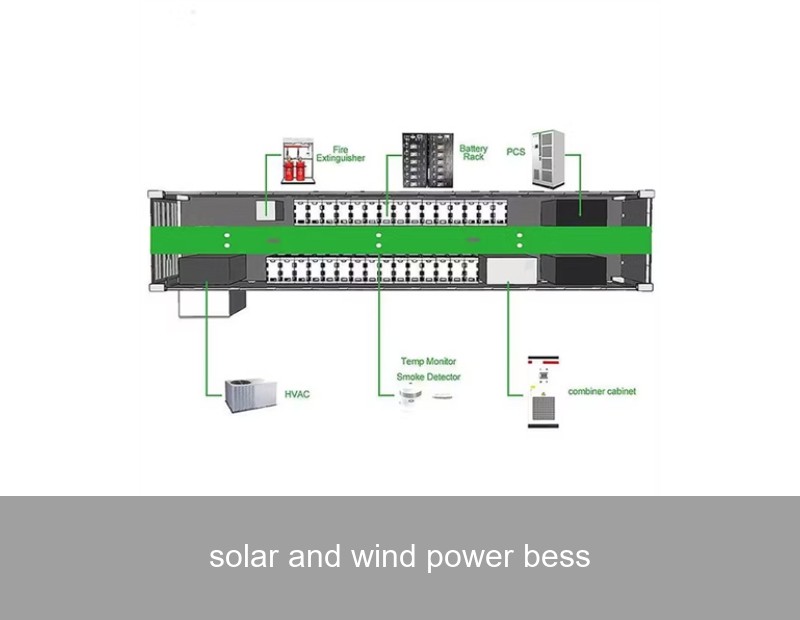
Have you ever wondered what happens to all the clean energy generated when the sun is blazing or the wind is howling, but our homes and factories don't need it at that exact moment? This is the central challenge of the renewable revolution. Solar and wind power are fantastic, but their intermittent nature—the fact that the sun sets and the wind calms—creates a mismatch between supply and demand. This is where Battery Energy Storage Systems (BESS) come in as the game-changing partner. Think of BESS as a giant, intelligent power bank for the grid, soaking up excess solar and wind power and releasing it precisely when it's needed most. For businesses, communities, and grid operators, integrating a BESS with solar and wind power isn't just an upgrade; it's the key to achieving true energy independence, resilience, and cost savings. Companies like Highjoule, a global leader in advanced energy storage since 2005, are at the forefront of designing these intelligent systems that make renewable energy reliable 24/7.
Table of Contents
- The Intermittency Challenge: More Than Just a Cloudy Day
- BESS: The Perfect Partner for Solar and Wind Power
- Beyond Backup: Key Benefits of Integrating BESS
- Real-World Case Study: A U.S. Industrial Plant's Success
- Choosing the Right BESS for Your Solar and Wind Project
- The Future is Integrated and Intelligent
The Intermittency Challenge: More Than Just a Cloudy Day
The phenomenon is clear: renewable energy generation is weather-dependent. A grid with a high penetration of solar and wind power can experience significant volatility. On a bright, windy afternoon, generation can exceed demand, potentially leading to grid congestion and even curtailment—where renewable assets are paid to switch off, wasting clean energy. Conversely, on a calm evening, generation plummets just as demand peaks, forcing reliance on fossil-fueled "peaker" plants.
Let's look at the data. In California's CAISO grid, curtailment of solar and wind energy has risen dramatically, exceeding 2.4 million megawatt-hours in a recent year—enough to power over 200,000 homes for a year. This isn't just a California problem; it's a pattern emerging in grids across Europe and the U.S. as renewable adoption grows. The financial and environmental cost of this mismatch is substantial.

Image Source: Unsplash - Highlighting the variability of solar and wind resources.
This volatility creates a real business challenge. For a factory running on solar power, production might need to slow down after sunset unless they buy expensive grid power. For a wind farm owner, curtailment means lost revenue. The core insight here is that solar and wind power generation assets alone are not a complete solution. To maximize their value, they need a stabilizing force.
BESS: The Perfect Partner for Solar and Wind Power
This is where the Battery Energy Storage System (BESS) enters the stage. A modern BESS is far more than a simple battery pack. It's an integrated system comprising lithium-ion battery racks, a sophisticated power conversion system (PCS), a thermal management system, and, most crucially, an advanced energy management system (EMS) that acts as the brain of the operation.
So, how does it work in harmony with solar and wind power?
- Energy Time-Shifting (Arbitrage): The BESS charges during periods of high solar/wind generation and low electricity prices, then discharges during peak demand periods when prices are high. This turns excess, low-value energy into high-value, dispatchable power.
- Frequency Regulation: The grid's frequency must remain stable. BESS can respond in milliseconds to inject or absorb power to correct tiny frequency fluctuations, a service far more efficiently provided by batteries than by traditional power plants.
- Ramp Rate Control: When a cloud passes over a large solar farm, output can drop sharply. A BESS can instantly fill that gap, smoothing the "ramp" and preventing grid instability.
Highjoule's approach epitomizes this partnership. Our H-IQ Energy Management Platform doesn't just see the battery; it sees the entire energy ecosystem. It continuously forecasts solar and wind generation (using weather data), analyzes real-time electricity market prices, and understands your facility's load profile. It then makes autonomous, millisecond decisions to optimize the charge/discharge cycles of the BESS, ensuring every kilowatt-hour of your solar and wind power is used in the most economically and operationally beneficial way.
Beyond Backup: Key Benefits of Integrating BESS
Pairing solar and wind power with a BESS transforms the value proposition. The benefits cascade across financial, operational, and environmental dimensions.
| Benefit Category | How it Manifests | Impact |
|---|---|---|
| Economic | Reduced peak demand charges, energy arbitrage, participation in grid service markets (like frequency response). | Significant reduction in electricity bills and creation of new revenue streams. ROI periods are shrinking rapidly. |
| Reliability | Provides seamless backup power during grid outages, smooths renewable intermittency. | Enhanced energy security for critical operations, from data centers to manufacturing lines. |
| Sustainability | Maximizes self-consumption of on-site renewables, reduces reliance on fossil-fuel peaker plants. | Dramatically lowers carbon footprint and accelerates net-zero goals. |
| Grid Support | Deferral of costly grid infrastructure upgrades, provision of stability services. | Becomes an asset for the wider community and utility, enabling higher renewable penetration. |
For commercial and industrial clients, the economic argument is particularly compelling. In many regions, a large portion of the electricity bill is based on the highest 15-30 minutes of power draw (peak demand) in a month. A strategically dispatched BESS can "shave" these peaks by discharging during those short windows, leading to massive savings. Highjoule's IntelliPeak Shaving algorithm within the H-IQ platform is specifically engineered for this, learning your load patterns to predict and mitigate demand charges proactively.
Real-World Case Study: A U.S. Industrial Plant's Success
Let's move from theory to practice. Consider a mid-sized automotive parts manufacturing plant in Ohio, USA. The facility had a 2 MW rooftop solar array, which covered about 30% of its daytime energy needs. However, it faced two major problems: high demand charges from afternoon production peaks and an inability to use solar energy for its critical night shifts. Furthermore, grid power outages threatened costly production stoppages.
In 2022, the plant partnered with Highjoule to integrate a 1.5 MW / 3 MWh Highjoule CubeStack BESS with their existing solar infrastructure. The CubeStack's containerized, plug-and-play design allowed for swift deployment with minimal site disruption. The system was commissioned with Highjoule's H-IQ platform at the helm.
The Results (12-month post-installation):
- Demand Charge Reduction: By discharging the BESS during daily and monthly peak periods, the plant reduced its peak demand by 22%, saving over $120,000 annually on this portion of the bill alone.
- Increased Solar Self-Consumption: Solar energy that was previously being exported to the grid at low rates is now stored and used in the evening, increasing the solar array's effective utilization by 40%.
- Backup Power: The system provided seamless backup power during two brief grid outages, preventing an estimated $80,000 in production losses.
- Grid Services Revenue: The plant enrolled its BESS in a local frequency regulation program, generating approximately $15,000 in ancillary service revenue in the first year.
This case, mirrored by similar successes across Europe in countries like Germany and Spain, illustrates the multi-faceted ROI of a solar and wind power BESS solution. It's not a single benefit but a synergy of savings, revenue, and resilience.

Image Source: Unsplash - Representative of a modern industrial BESS installation.
Choosing the Right BESS for Your Solar and Wind Project
Not all BESS are created equal, especially when tasked with the dynamic job of partnering with variable renewables. Here are key considerations for your project:
- Depth of Discharge & Cycle Life: Solar and wind power integration requires daily cycling. You need a battery chemistry and system design that supports deep, regular discharges without significant degradation. Highjoule systems use premium Li-ion NMC or LFP cells with robust cycle life warranties.
- Power vs. Energy Rating: Do you need high power for short bursts (demand shaving) or more energy for longer discharge (night-time shifting)? The ratio (e.g., 2-hour system: 1 MW power, 2 MWh energy) is critical.
- Intelligence of the EMS: This is the differentiator. A basic EMS might just charge and discharge on a timer. An advanced system like Highjoule's H-IQ uses AI and market signals to optimize for multiple, sometimes competing, value streams simultaneously.
- Safety & Compliance: Ensure the system has comprehensive safety certifications (UL, IEC, etc.), integrated fire suppression, and remote monitoring. Highjoule's systems are designed with multi-layered safety protocols as a core principle.
Highjoule offers a spectrum of solutions, from the modular HomePower for residential prosumers with solar, to the scalable CubeStack for C&I applications, up to the MegaGrid solutions for utility-scale solar and wind farms. Our process begins with a detailed energy assessment to model your solar/wind generation and consumption, precisely sizing the BESS for maximum economic return.
The Future is Integrated and Intelligent
The trajectory is undeniable. As noted by the International Energy Agency (IEA), the pairing of renewables with storage is becoming the new benchmark for cost-effective, decarbonized power systems. The next evolution is the rise of virtual power plants (VPPs), where thousands of distributed solar and wind power BESS assets—like those installed by Highjoule in homes and businesses—are aggregated to act as a single, flexible power plant for the grid.
This future isn't distant; it's being built today. The question is no longer if solar and wind power need storage, but how quickly and intelligently we can deploy it. The technology is proven, the economics are solid, and the environmental imperative is clear.
Is your business or community ready to stop wasting its clean energy and start controlling its power destiny? What would the ability to predict and manage your energy costs with precision do for your bottom line or your sustainability goals?
 Inquiry
 Online Chat