


Industrial Storage Cabinets: The Backbone of Modern Energy Resilience
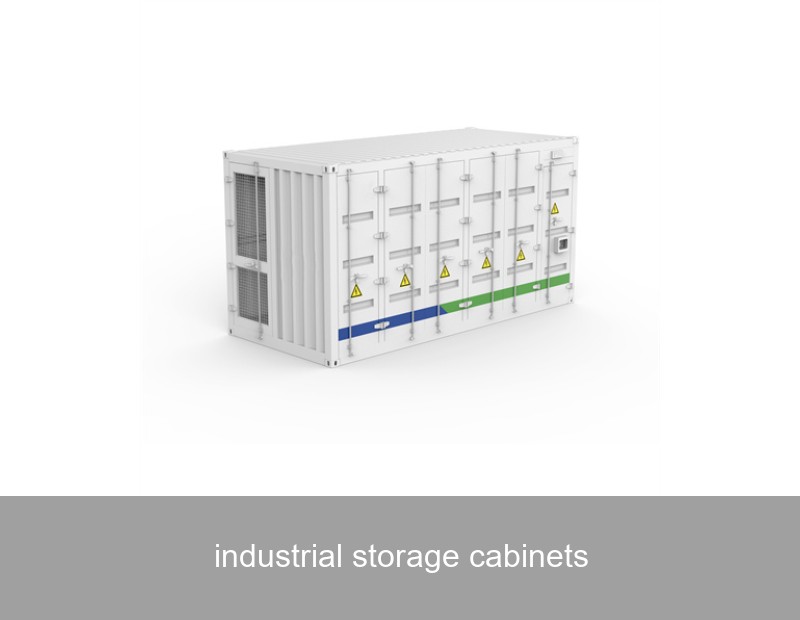
Let's talk about a silent revolution happening in factories, data centers, and industrial parks across Europe and the United States. It's not about robots or AI—though they play a part—but about power. Specifically, the growing reliance on industrial storage cabinets to ensure operations don't miss a beat. If you manage a facility, you've felt the pinch: volatile energy prices, grid instability warnings, and the pressing need to decarbonize. The solution isn't just generating more power; it's about storing it intelligently. This is where advanced Battery Energy Storage Systems (BESS), neatly packaged into robust, scalable industrial storage cabinets, are becoming the indispensable foundation for energy security and cost management.
Table of Contents
- The Phenomenon: From Cost Center to Strategic Asset
- The Data: Why Industry is Investing Heavily
- The Case Study: A German Manufacturing Plant's Transformation
- The Insight: More Than Just a Battery in a Box
- The Future: Integration and Intelligence
The Phenomenon: From Cost Center to Strategic Asset
Gone are the days when energy was simply a monthly bill to pay. For industrial operators, it's now a dynamic variable that directly impacts profitability and continuity. The phenomenon is clear: unreliable grids and price volatility are tangible business risks. A momentary dip in voltage (a "sag") can halt sensitive manufacturing processes, costing tens of thousands per hour. Peak demand charges—fees for the highest 15-minute power draw in a month—can constitute up to 50% of an electricity bill. Industrial storage cabinets address this head-on. They are not passive containers; they are active power assets. By deploying a bank of these cabinets, a facility can shift its energy consumption, drawing from stored power during expensive peak periods and charging during low-cost, off-peak hours. This simple arbitrage turns a cost center into a revenue-protecting machine.

Image Source: Unsplash - Representative image of industrial energy storage systems.
The Data: Why Industry is Investing Heavily
The numbers speak louder than words. According to the U.S. Department of Energy, the global market for grid-scale storage (which includes large industrial applications) is projected to grow exponentially. In Europe, driven by the REPowerEU plan and soaring natural gas prices, investment in behind-the-meter storage for industry is accelerating. Let's break down a typical ROI scenario:
| Challenge | Without Storage Cabinet | With Highjoule Storage Cabinet System |
|---|---|---|
| Peak Demand Charges | $100,000 per month | $60,000 per month (40% reduction) |
| Grid Outage Impact | Production halt: $50k/hour loss | Seamless backup: $0 loss (for critical loads) |
| Renewable Utilization | 30% of solar PV used on-site | 85%+ of solar PV used on-site |
This isn't hypothetical. It's the daily reality for facilities that have made the strategic decision to invest in robust industrial storage cabinets. The key is choosing a system designed for the rigors of industrial use—not a scaled-up residential unit.
The Case Study: A German Manufacturing Plant's Transformation
Consider "Stahlwerk GmbH" (a pseudonym for a real customer), a mid-sized automotive parts manufacturer in Bavaria. Facing grid constraints and aiming to power their factory with a new rooftop solar array, they hit a wall. Their solar production peaked at midday, but their energy-intensive presses and furnaces ran around the clock. Without storage, they were exporting excess solar power at low feed-in tariffs only to import expensive grid power at night.
Their solution was a turnkey installation from Highjoule: a modular system comprising twelve of our HI-Cube Industrial Storage Cabinet units, with a total capacity of 1.2 MWh, integrated with their existing solar PV and managed by our AI-driven Highjoule Energy Management System (HEMS). The results after one year were compelling:
- Energy Cost Reduction: Achieved 68% reduction in peak demand charges, saving €145,000 annually.
- Self-Consumption: Increased on-site consumption of solar generation from 35% to 92%.
- Backup Power: Provided 4 hours of full backup for critical quality control and assembly lines, preventing an estimated €280,000 in potential downtime during two grid disturbances.
- Sustainability: Boosted their renewable energy fraction from 25% to over 80%.
The HI-Cube cabinets were chosen for their UL 9540 and IEC 62619 certifications, built-in fire suppression, and passive cooling system—ensuring safety and reliability in an industrial environment. This case exemplifies the multi-faceted value proposition of modern industrial storage cabinets.
The Insight: More Than Just a Battery in a Box
As a technology expert at Highjoule, I often emphasize that the battery cells are just one component. The true intelligence lies in the system integration. An industrial-grade cabinet must be:
- Thermally Managed: Industrial environments are tough. Our cabinets use advanced liquid cooling for optimal cell temperature, extending lifespan beyond standard air-cooled units.
- Safety-Certified: Compliance with the latest international safety standards (like UL 9540A for fire hazard) is non-negotiable for insurability and peace of mind.
- Grid-Interactive: In regions like California or parts of the EU, cabinets can participate in grid services programs, creating an additional revenue stream by providing frequency regulation.
This is the core of Highjoule's design philosophy. Since 2005, we've focused on creating industrial storage cabinets that are not just products but integrated solutions. Our HEMS software is the brain, allowing operators to set strategies—maximize self-consumption, cap peak demand, or ensure backup—with a simple interface, while the system executes complex optimizations automatically.

Image Source: Unsplash - Representative image of energy system monitoring.
The Future: Integration and Intelligence
The next frontier for industrial storage cabinets is deeper integration with the Industrial Internet of Things (IIoT) and microgrids. Imagine a system where your storage cabinets communicate directly with your production scheduling software. If a batch of high-margin orders comes in, the system automatically ensures energy is reserved for that production line, even if it means drawing from storage earlier. Furthermore, as highlighted by research from the National Renewable Energy Laboratory (NREL), the role of storage in providing grid resilience is becoming critical for national infrastructure.
For businesses in the US and Europe, the question is evolving from "Why should we get storage?" to "How do we implement it most effectively?" The answer lies in partnering with a provider that understands the full lifecycle—from site assessment and financial modeling to installation, commissioning, and long-term performance management.
Your Energy Resilience Blueprint
Highjoule's services are designed to guide you through this journey. We offer comprehensive energy audits to size your system correctly, flexible financing options, and 24/7 remote monitoring. Our industrial storage cabinets, like the HI-Cube and the high-power HI-Rack series, are the physical manifestation of our promise: intelligent, efficient, and sustainable power solutions built to last.
So, I leave you with this: When you look at your facility's energy profile, what is the single largest vulnerability or cost that, if addressed, would fundamentally change your operational resilience and bottom line? Is it the predictable yet staggering peak demand charge, the unpredictable grid outage, or the untapped potential of your renewable assets?
 Inquiry
 Online Chat