


Understanding INR vs. ICR Batteries: How Much Does the Right Chemistry Matter for Your Energy Storage?
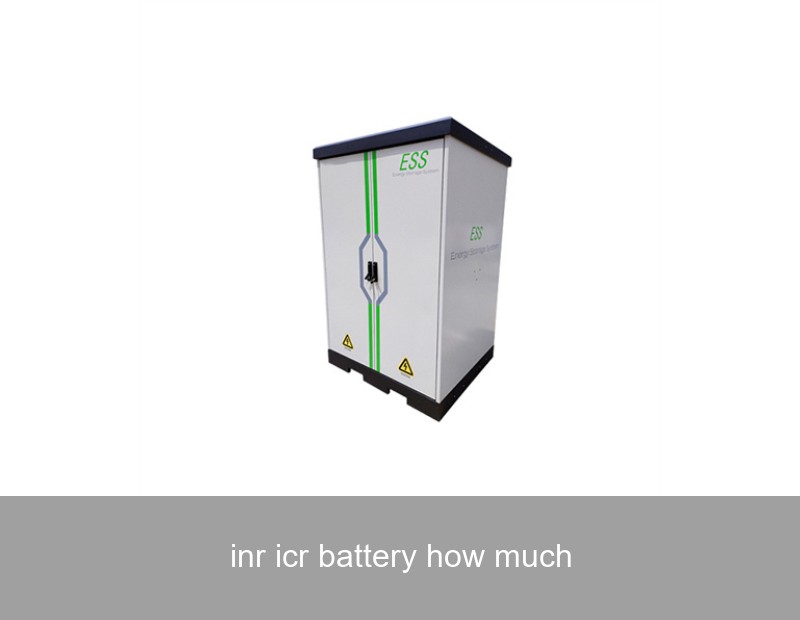
If you're researching batteries for a solar storage system, home backup, or an industrial application, you've likely encountered a confusing alphabet soup of acronyms: NMC, LFP, INR, ICR. The question "INR ICR battery how much?" isn't just about price; it's about understanding the true cost of performance, safety, and longevity. At its core, this question highlights a critical choice between two prevalent lithium-ion cell types that power our modern energy storage solutions. As a leader in advanced energy storage, Highjoule is here to demystify these terms and help you calculate the real value behind the price tag.
Table of Contents
Chemistry Decoded: What Are INR and ICR Cells?
Let's break down the jargon. "INR" and "ICR" are part of a standardized cell naming system used by manufacturers like Samsung and LG. The letters indicate the cathode chemistry and shape.
- I stands for Lithium-Ion.
- N stands for Nickel-based cathode (specifically, Nickel Manganese Cobalt or NMC).
- C stands for Cobalt-based cathode (a classic Lithium Cobalt Oxide or LCO chemistry).
- R stands for Cylindrical cell (like a large AA battery).
So, an INR battery is a cylindrical Lithium-Ion cell with an NMC cathode. An ICR battery is a cylindrical Lithium-Ion cell with an LCO cathode. While both are lithium-ion, their internal chemistry leads to vastly different performance profiles, which directly answers the deeper question behind "how much?"—how much power, how much cycle life, how much safety risk?

Image Source: BatteryIndustry.tech - Illustrating the internal difference between cell types.
Performance vs. Cost: The Critical Trade-Offs
Choosing between INR and ICR isn't about finding the "best" battery, but the right battery for your specific needs. The initial cost per cell is only one piece of the financial puzzle.
| Feature | ICR (LCO) Battery | INR (NMC) Battery | Impact on "How Much?" |
|---|---|---|---|
| Energy Density | Very High | High | ICR packs more energy into a small space, but at a trade-off. |
| Power Output (Discharge Rate) | Moderate | High | INR handles high-power bursts (like starting motors) better. |
| Cycle Life | Lower (500-1000 cycles) | Higher (1500-3000+ cycles) | INR often offers a lower cost-per-cycle over its lifespan. |
| Thermal & Safety Stability | Lower | Higher | INR's NMC chemistry is more robust, reducing safety system costs. | Typical Cost (Cell Level) | Generally Lower | Generally Higher | ICR may have a lower upfront "sticker price." |
As you can see, an ICR cell might seem cheaper initially. However, for an application like daily solar cycling, its shorter lifespan could mean replacing the entire battery bank much sooner. The total cost of ownership for an INR-based system often proves more economical. This is precisely why at Highjoule, our H-series commercial storage systems predominantly utilize high-grade, automotive-tested INR-type NMC cells. We prioritize long-term value and safety, designing our systems with advanced thermal management to fully leverage the chemistry's potential for thousands of reliable cycles.
A Real-World Case Study: The German Dairy Farm Transition
Let's make this tangible. Consider a mid-sized dairy farm in Bavaria, Germany. They installed a 120 kWp solar array in 2018 with a 40 kWh storage system based on generic ICR/LCO cells. The goal was to maximize self-consumption and provide backup for cooling systems.
The Phenomenon: By 2022, the farm owners noticed their battery backup runtime during outages was decreasing faster than expected.
The Data: A performance audit revealed the battery had degraded to 70% of its original capacity after approximately 1,200 cycles. The system's management was struggling with the cells' sensitivity to high discharge rates during equipment startup.
The Case: In 2023, the farm upgraded to a Highjoule H-Stack Modular system with a 50 kWh capacity using next-generation INR chemistry. The new system was specifically chosen for its higher permissible discharge rate (2C continuous) and superior cycle life rating.
The Insight: After one year of operation, data shows less than 2% degradation. The farm manager noted, "The new system doesn't flinch when the chillers kick on. We're projecting this battery to last the lifetime of our solar panels. The higher initial investment was justified." This case underscores that the answer to "INR ICR battery how much?" is found in long-term performance data, not just a purchase receipt. You can explore more on battery degradation from real-world field studies at the National Renewable Energy Laboratory (NREL).
Looking Beyond the Cell: The System Makes the Difference
Focusing solely on cell chemistry is like choosing an engine without considering the rest of the car. The Battery Management System (BMS) and thermal design are paramount. A premium INR cell in a poorly designed system will underperform and may be unsafe.
Highjoule's engineering philosophy is system-first. Our proprietary Adaptive BMS doesn't just monitor voltage; it intelligently balances each cell cluster, manages state-of-charge within the healthiest range, and predicts maintenance needs. For our residential EcoHome ESS, this means whether we're using advanced LFP or NMC/INR cells, the system is optimized to extract maximum safe life and value. The BMS ensures the chemistry operates in its "sweet spot," directly answering the "how much" question with "more than you expected."

Image Source: U.S. Department of Energy - A commercial-scale energy storage system installation.
Making Your Choice: Key Questions to Ask
So, when evaluating storage solutions and pondering "INR ICR battery how much?", shift the conversation. Ask your provider these questions:
- What is the projected cycle life at my specific depth of discharge (DoD)? (e.g., 80% DoD for solar).
- What is the system's warranted capacity after 5 or 10 years? This is more telling than the initial capacity.
- How does the BMS handle high-power events and thermal extremes? Request details on cooling and safety protocols.
- Can you provide a total cost of ownership (TCO) model, not just an upfront quote?
Understanding the broader context of battery technology is crucial. For a deeper dive into evolving lithium-ion chemistries, resources like the Journal of Power Sources offer authoritative insights.
Where Highjoule Fits In
With nearly two decades of experience since 2005, Highjoule acts as your expert guide through these complex decisions. We don't just sell battery cells; we engineer integrated, intelligent storage solutions. For a microgrid project requiring robust power delivery, we might recommend our Industrial Containerized ESS built with high-power INR cells. For a family home prioritizing ultimate safety and longevity, our LFP-based solution might be ideal. We provide the analysis, transparency, and technology so you understand exactly what you're paying for—and the value you're gaining over decades.
Given the rapid evolution of battery technology, what specific energy challenge in your home or business is driving you to ask "how much" today, and how can redefining that question to "how much value over time" change your approach to finding a solution?
 Inquiry
 Online Chat