


Demystifying Inverter Battery for Home Specifications: Your Guide to Smarter Energy
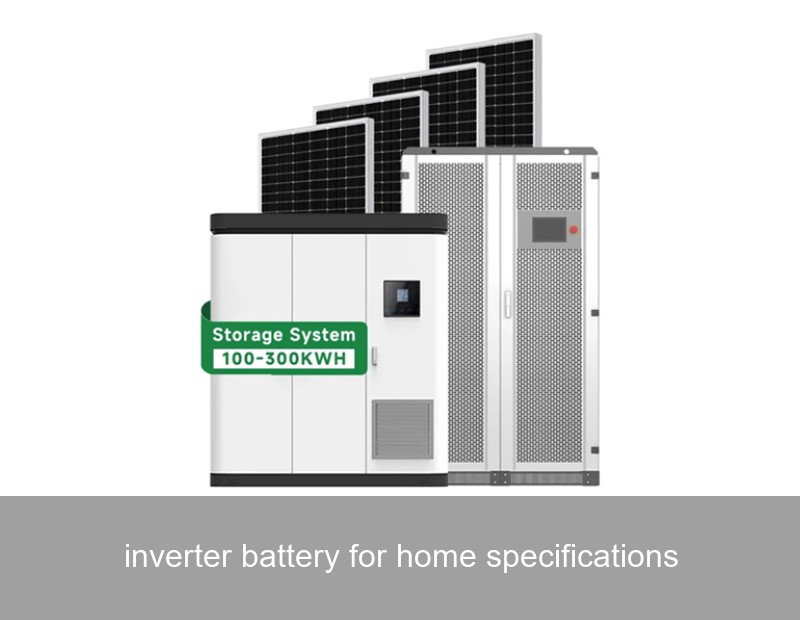
So, you're thinking about taking control of your home's energy? That's fantastic. Whether you're looking to back up essential appliances during a blackout, maximize your solar panels' output, or simply reduce your reliance on the grid, a home battery system is a game-changer. But let's be honest, when you start researching, you're immediately hit with a wall of technical jargon: kilowatt-hours, depth of discharge, LFP chemistry, peak power... It can feel like learning a new language. Don't worry, you're not alone. Understanding inverter battery for home specifications is the crucial first step from a vague idea to a powerful, tangible solution for your household. This guide will translate those specs into plain English, helping you make an informed decision for a more resilient and sustainable home.
Key Specifications for Your Home System Explained
Think of your home battery system like a car. You wouldn't buy one just knowing it's "red" – you'd want to know the engine size (power), fuel tank capacity (energy storage), and its reliability. Your battery system is the same. Let's break down the key specs you'll encounter.
Capacity & Power: kWh vs. kW – The Storage Tank and the Faucet
This is the most common point of confusion, but it's simple once you get the analogy. Capacity (kWh) is the size of your energy "storage tank." A 10 kWh battery can, in theory, deliver 1 kilowatt of power for 10 hours, or 2 kilowatts for 5 hours. It tells you how much energy you have stored.
Power (kW) is the size of the "faucet." It's the maximum rate at which the battery can discharge energy at any one moment. A system with 5 kW of power can run more high-demand appliances simultaneously (like an AC unit, fridge, and washing machine) than a system with only 2 kW of power.
Why does this matter? A battery with high capacity but low power might keep your lights on for days but struggle to start your heat pump. Conversely, high power with low capacity could run everything for just a short while.
Battery Chemistry: The Heart of the System
The chemical makeup of your battery cells determines its safety, lifespan, performance, and cost. Here are the two main contenders for modern homes:
- Lithium Iron Phosphate (LFP or LiFePO4): This has become the gold standard for residential storage. LFP batteries are exceptionally safe (more stable chemistry), have a long cycle life (often over 6,000 cycles), and perform well across a wide temperature range. They are also cobalt-free, which is a significant ethical and supply chain advantage. While slightly less energy-dense than some alternatives, their safety and longevity make them the top choice for most homeowners.
- Nickel Manganese Cobalt (NMC): Previously very common, NMC offers high energy density (more capacity in a smaller space). However, they typically have a shorter lifespan and greater sensitivity to high temperatures and deep discharging, which can affect long-term durability.

For a deeper dive into the science and safety profiles of these chemistries, the U.S. Department of Energy provides an excellent, unbiased resource.
Depth of Discharge (DoD) & Cycle Life: Planning for the Long Haul
You wouldn't drive your car until it runs completely out of fuel every day, right? The same principle applies to batteries. Depth of Discharge (DoD) indicates how much of the battery's total capacity you can safely use. If a 10 kWh battery has a recommended 90% DoD, you should only use 9 kWh of its stored energy before recharging. Regularly discharging beyond this point stresses the battery and shortens its life.
This leads directly to Cycle Life. One cycle is one full charge and discharge (not necessarily from 100% to 0%). Manufacturers rate their batteries for a certain number of cycles before capacity degrades to a specified percentage (often 80% of original capacity). A battery rated for 6,000 cycles at 90% DoD will last significantly longer than one rated for 3,000 cycles at 80% DoD.
| Chemistry | Typical Cycle Life (to 80% capacity) | Recommended DoD | Effective Usable Energy per Cycle* |
|---|---|---|---|
| LFP (LiFePO4) | 6,000+ cycles | 90-100% | 9-10 kWh |
| NMC | 3,000 - 5,000 cycles | 80-90% | 8-9 kWh |
*Based on a nominal 10 kWh battery.
Efficiency & Scalability
Round-Trip Efficiency is a critical but often overlooked spec. It tells you how much energy you get back out for the energy you put in. If you feed 10 kWh from your solar panels into a battery with 95% round-trip efficiency, you'll get 9.5 kWh back out. Higher efficiency (mid-90% is excellent) means less energy is lost as heat, putting more of your self-generated power to work.
Scalability is about future-proofing. Can you easily add more battery modules later if your needs change (e.g., buying an EV)? A modular system designed for expansion saves you from a costly complete replacement down the line.
Inverter Compatibility & Integration: The Brain of the Operation
The inverter is the brain. It converts DC electricity from the battery (or solar panels) into AC electricity for your home. Compatibility is non-negotiable. You have two main paths:
- AC-Coupled Systems: The battery has its own, separate inverter. This is often easier to retrofit to existing solar systems and offers great flexibility.
- DC-Coupled Systems: The battery shares a hybrid inverter with the solar panels. This can be slightly more efficient for new installations but may be less flexible for retrofits.
Modern systems like those from Highjoule often feature hybrid inverters or seamlessly integrated AC-coupled units. Our HomePower Hub series, for instance, is an all-in-one unit that combines a high-efficiency inverter, charger, and system controller. It's designed to work perfectly with our EcoCell LFP battery modules, but its intelligent software also allows it to communicate with and manage a wide range of third-party solar inverters. This focus on open, intelligent integration ensures you get a cohesive system, not just a collection of parts.
A Real-World Case Study: The Johnson Family, Arizona, USA
Let's move from theory to practice. The Johnson family in Phoenix, Arizona, had a 7 kW solar array but found themselves still drawing significant power from the grid during peak evening hours (when electricity rates are highest) and were vulnerable to frequent summer grid outages.
Their Goal: Achieve near-total energy self-consumption and ensure essential cooling and backup for 8-10 hours during outages.
Solution & Specs Analyzed: They installed a Highjoule HomePower Hub 10 with two EcoCell 10 battery modules.
- Total Usable Capacity: 20.0 kWh (2 x 10.4 kWh modules, with 96% DoD).
- Continuous Power Output: 10 kW (enough to start and run their central A/C unit alongside other loads).
- Chemistry: LFP for safety in their hot garage and long lifespan.
- Integration: AC-coupled to their existing solar inverter, managed by Highjoule's EnergyOS software.
The Data-Driven Result: In the first six months, their grid import during peak hours dropped by 98%. During a planned 6-hour grid outage in 110°F (43°C) weather, the system powered their entire home, including A/C, maintaining an indoor temperature of 76°F (24°C). Their calculated payback period, factoring in federal tax credits (IRS Residential Clean Energy Credit) and local utility incentives, is projected at under 7 years. For them, the right inverter battery for home specifications translated directly into comfort, savings, and peace of mind.
Highjoule's Tailored Solutions for Modern Homes
At Highjoule, we believe the perfect home energy system isn't a one-size-fits-all product; it's a tailored solution built on the right specifications for your unique home and goals. Founded in 2005, we've spent nearly two decades refining our technology for global markets, including the diverse climates and grid profiles of Europe and North America.
Our EcoCell battery series is built on proprietary LFP cell technology, engineered for daily deep cycling and a lifespan that matches your solar panels. The modular design allows you to start with a system that fits your current budget (e.g., 10 kWh) and expand later in 5 kWh increments simply by adding more stacks.

But hardware is only half the story. Our EnergyOS platform is the intelligent layer that makes it all work seamlessly. It learns your energy habits, automatically optimizes charging from solar or off-peak grid power (where available), and provides you with intuitive monitoring and control via a smartphone app. Whether your priority is maximizing self-consumption, participating in a virtual power plant program (like those gaining traction in California and parts of Europe), or simply having reliable backup, EnergyOS ensures your system is working optimally for you. You can explore how grid services are evolving in places like the UK via National Grid ESO.
Making the Right Choice for Your Home
Now that you're armed with knowledge, the path forward is clearer. Start by auditing your home's energy use. What are your essential loads during an outage? What is your average daily electricity consumption? Use this to ballpark the capacity (kWh) you need. Then, consider your simultaneous appliance demands to gauge the necessary power (kW).
Look for a system built with safe, long-life LFP chemistry, high round-trip efficiency, and a proven track record. Most importantly, partner with a certified installer who can assess your home's specific electrical setup and design a system that is safe, compliant, and perfectly matched to your needs.
We at Highjoule are committed to providing not just premium hardware, but the expertise and support to make your energy independence journey a success. Our network of certified installers across the US and Europe is ready to provide a detailed consultation.
So, what's the first energy goal you want to tackle for your home – is it eliminating those frustrating peak-time charges, ensuring your family's comfort during the next storm, or finally making the most of every sunbeam that hits your roof?
 Inquiry
 Online Chat