


Understanding the "Kit Panel Solar 1000 Watts Precio": Your Guide to Value and Performance
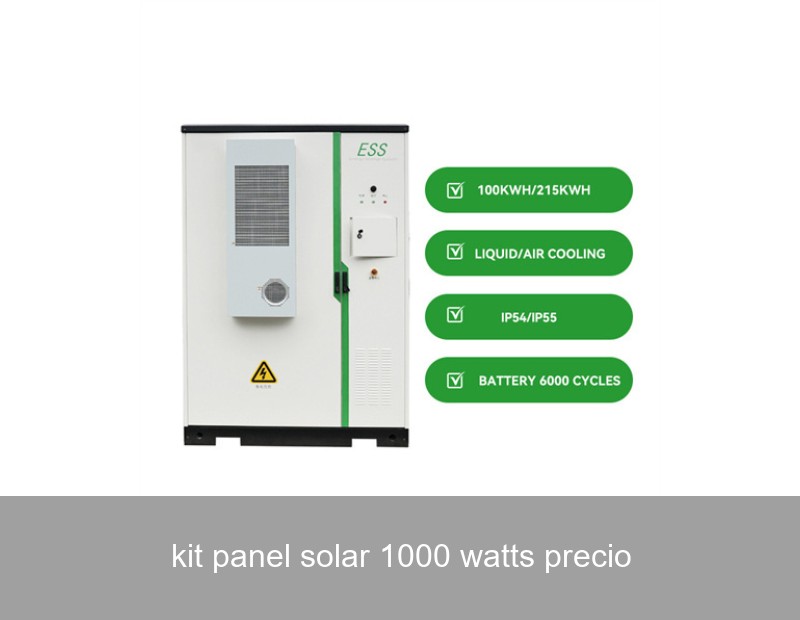
So, you're searching for a "kit panel solar 1000 watts precio" – a 1000-watt solar kit price. It's a smart move, but if you've ever felt overwhelmed by the sheer number of options and fluctuating price tags, you're not alone. The quoted price is just the entry point; the real value lies in what that system delivers over its 25+ year lifespan. This article will demystify the factors behind the cost and performance of a 1kW solar kit, helping you make an informed investment that powers your home efficiently for decades, with insights from global energy storage leader Highjoule.
Table of Contents
- The Real Price Breakdown: More Than Just Panels
- The 1kW Power Phenomenon: What Can It Really Do?
- The Data Reality: System Efficiency is King
- Case Study: A German Household's Journey to Energy Independence
- Expert Insight: The Missing Link – Intelligent Storage
- The Highjoule Solution: Beyond the Basic Kit
- Making Your Choice: Key Questions Before You Buy
The Real Price Breakdown: More Than Just Panels
When you see a "kit panel solar 1000 watts precio," it typically includes the solar panels, a mounting structure, cables, and an inverter. However, the component quality creates massive price and performance disparities. A budget kit might use polycrystalline panels with 17% efficiency and a basic string inverter, while a premium kit features monocrystalline PERC panels with 22%+ efficiency and a microinverter system. The latter generates more power in the same space and handles shading better, directly impacting your long-term return on investment.

Image Source: Unsplash (Photographer: American Public Power Association)
Installation costs, permits, and ongoing maintenance are also critical. In the U.S., the average installed cost for residential solar is around $2.50 to $3.50 per watt, meaning a 1kW system could range from $2,500 to $3,500 before incentives. Europe shows similar variability. The final "precio" must account for this full project scope.
The 1kW Power Phenomenon: What Can It Really Do?
A 1-kilowatt (kW) system is a popular entry point. But let's be clear: it produces about 1,000 watts of power under ideal, peak sunlight conditions. Its actual energy output, measured in kilowatt-hours (kWh), depends on your location. In sun-drenched Arizona, 1kW of panels might yield 1,600 kWh annually. In Germany, with fewer sun hours, it may produce around 900 kWh/year. That energy can power your refrigerator, run efficient lighting, and charge devices, but it's unlikely to cover a home's total load alone.
The Data Reality: System Efficiency is King
Here’s where data changes the game. Two 1kW kits with different panel and inverter efficiencies will have wildly different outputs. Losses from heat, dirt, wiring, and inverter conversion can clip your system's effective output by 15-25%. A high-quality, well-designed kit minimizes these losses. For example, pairing high-efficiency panels with module-level power electronics (like microinverters) can boost harvest by up to 25% in shaded conditions compared to a standard string inverter setup. This isn't just about the sticker price; it's about the cost per harvested kWh over the system's lifetime.
Case Study: A German Household's Journey to Energy Independence
Consider the Müller family near Frankfurt. In 2022, they installed a 6kWp solar system. Initially, they faced a common issue: exporting over 50% of their daytime production to the grid at low feed-in tariffs, while buying expensive power in the evening. Their system's self-consumption rate was only 35%, limiting their savings.
In 2023, they decided to retrofit a Highjoule HES-10 battery storage system. The results were transformative:
| Metric | Before Storage | After Adding Highjoule HES-10 |
|---|---|---|
| Self-Consumption Rate | 35% | 85% |
| Grid Electricity Purchased | 3,200 kWh/year | 800 kWh/year |
| Energy Bill Savings | €650/year | €1,700/year |
The battery allowed them to store their excess 1kW+ solar production from midday for use at night. This case underscores that maximizing the value of your solar "precio" often requires thinking beyond the panels to include storage.
Expert Insight: The Missing Link – Intelligent Storage
This leads to a crucial insight: the modern solar investment is incomplete without storage. A battery transforms your solar kit from a daytime power source into a 24/7 energy asset. It provides backup during outages, increases self-consumption, and in many markets, allows participation in grid services. The question evolves from "What is the price of a 1kW solar kit?" to "What is the value of a resilient, self-sufficient home energy system?"
The Highjoule Solution: Beyond the Basic Kit
This is where Highjoule's expertise becomes pivotal. We don't just sell components; we provide integrated, intelligent energy solutions. For homeowners considering a solar kit, our Highjoule Home Energy System (HES) series is the perfect complement.
Our systems, like the HES-10 (10 kWh usable capacity), are built with lithium iron phosphate (LFP) battery chemistry, renowned for its safety, longevity (over 6,000 cycles), and stable performance. What truly sets us apart is our Adaptive Power Management (APM) software. This brain of the system learns your energy habits, weather patterns, and utility rate structures to autonomously optimize when to store solar energy, when to power your home, and when to export strategically for maximum financial return.

Image Source: Unsplash (Photographer: Andres Garcia)
For larger commercial or microgrid applications, our Industrial Energy Platform (IEP) offers scalable, containerized storage that turns energy cost centers into profit centers through peak shaving and demand charge management. By integrating with any solar kit, Highjoule technology ensures you extract the maximum possible value from every watt your panels produce, fundamentally redefining the return on your initial solar investment.
Making Your Choice: Key Questions Before You Buy
Before finalizing your decision on a "kit panel solar 1000 watts precio," ask yourself and your provider these questions:
- What is the annual kWh production estimate for my specific location and roof orientation?
- Does the quoted price include a high-efficiency inverter with smart capabilities?
- What is the system's potential for future expansion, particularly adding battery storage?
- How will this kit integrate with an energy management system to optimize consumption?
The most sustainable and economical choice is a system designed not just for today's needs, but for tomorrow's energy landscape. With volatile energy prices across Europe and the U.S., isn't it time to view your solar kit as the first step toward true energy autonomy, rather than just a standalone product?
What energy goal is driving your search today – reducing your next bill, achieving backup security, or taking a definitive step off the grid dependency rollercoaster?
 Inquiry
 Online Chat