


Understanding the Levelized Cost of Energy Storage (LCOS): The True Metric for Your Energy Future
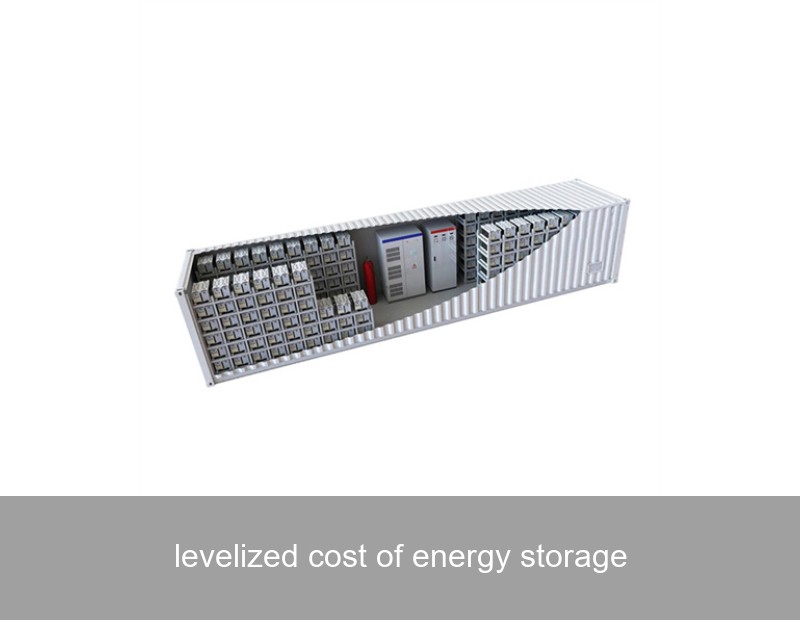
If you're evaluating battery storage for your business, factory, or community, you've likely heard about upfront costs and kilowatt-hours. But there's a more powerful, comprehensive metric that savvy energy managers are using to make truly informed decisions: the Levelized Cost of Energy Storage (LCOS). Unlike simple purchase price, LCOS reveals the real, long-term economics of storing a unit of energy over the system's entire lifetime. It's the key to unlocking not just savings, but true energy independence and resilience. As grid volatility rises and renewable integration becomes critical, understanding LCOS is no longer optional—it's essential for a sustainable and profitable energy strategy.
Table of Contents
- What Exactly is the Levelized Cost of Energy Storage?
- The Key Factors That Drive Your LCOS Up or Down
- LCOS vs. LCOE: Why the Distinction Matters for Your Project
- Real-World Impact: A California Microgrid Case Study
- How to Actively Lower Your Project's Levelized Cost
- Highjoule's Approach: Engineering Systems for Optimal Lifetime Value
What Exactly is the Levelized Cost of Energy Storage?
Think of LCOS as the "cost-per-mile" for your energy storage system. You wouldn't buy a car based on sticker price alone; you'd consider fuel efficiency, maintenance, and how long it lasts. LCOS does the same for batteries. It calculates the net present value of all costs over the system's life—including capital investment, operation and maintenance, charging electricity, degradation, and eventual replacement—and divides it by the total useful energy output expected over that lifetime. The result is a clear dollar-per-megawatt-hour (or cent-per-kilowatt-hour) figure that allows for direct comparison between different technologies and project designs. A lower LCOS means a more cost-effective and valuable storage asset for you.
The Key Factors That Drive Your LCOS Up or Down
Several interconnected elements directly impact your final LCOS number. Optimizing these is the heart of smart system design:
- Capital Expenditure (CapEx): The initial purchase and installation cost of the battery, inverters, and balance of system.
- Cycle Life and Degradation: How many full charge-discharge cycles the battery can perform before its capacity significantly fades. A battery that lasts 10,000 cycles will have a far lower LCOS than one rated for 3,000, even if its upfront cost is higher.
- Operational Efficiency: Round-trip efficiency (RTE) is crucial. A 90% RTE system loses only 10% of the energy put into it, while an 80% efficient system loses 20%, increasing the effective cost of stored energy.
- Operation & Maintenance (O&M): Ongoing costs for servicing, thermal management, software updates, and insurance.
- Charging Cost: The price of the electricity used to charge the battery. This is where pairing with low-cost solar or wind power dramatically improves LCOS.
- Depth of Discharge (DoD) & Usage Pattern: How deeply you cycle the battery daily and the specific application (e.g., daily peak shaving vs. weekly backup) affects degradation rate and total lifetime output.

Credit: ThisisEngineering RAEng / Unsplash. Smart monitoring and management are key to optimizing factors like degradation and efficiency, directly influencing LCOS.
LCOS vs. LCOE: Why the Distinction Matters for Your Project
It's easy to confuse LCOS with its older sibling, LCOE (Levelized Cost of Energy). LCOE applies to generation assets like solar farms or wind turbines—it's the cost to produce a unit of energy. LCOS, however, applies to storage, which doesn't generate energy but shifts it in time. This is a critical distinction. The value of storage isn't in raw creation, but in its services: avoiding peak demand charges, providing backup power, stabilizing the grid, and enabling more use of cheap renewable generation. Therefore, while LCOE for solar has plummeted, the economic case for adding storage is judged by whether the value it provides exceeds its own LCOS. For a deeper dive into LCOE trends from an authoritative source, the Lazard's Levelized Cost of Energy Analysis is an excellent reference.
Real-World Impact: A California Microgrid Case Study
Let's move from theory to practice. Consider a commercial winery in Northern California facing frequent Public Safety Power Shutoffs (PSPS) and exorbitant time-of-use electricity rates. They installed a 500 kW / 2 MWh battery storage system coupled with an existing 800 kW solar array.
- Phenomenon: Grid outages threatened production and inventory (wine storage), while peak energy charges eroded profitability.
- Data & Analysis: The project's calculated LCOS came in at $128/MWh. This was compared against the value streams: avoiding demand charges often exceeding $200/MWh, arbitraging time-of-use rates (buying at $80/MWh off-peak, using during $340/MWh peak periods), and providing outage resilience valued at $50,000 per avoided incident.
- Case Outcome: In its first year, the system delivered over $180,000 in direct energy cost savings, provided 42 hours of full-facility backup during outages, and increased on-site solar consumption by 35%. The value significantly outstripped the LCOS, resulting in a payback period of under 5 years. The system's intelligent software, which optimized cycles for both cost and battery longevity, was pivotal in achieving this low LCOS.
How to Actively Lower Your Project's Levelized Cost
As the case shows, a low LCOS is achievable with the right strategy. Here are actionable steps:
| Strategy | Action | Impact on LCOS |
|---|---|---|
| Technology Selection | Choose chemistry (e.g., LFP lithium-ion) and products known for long cycle life and safety, even at a premium CapEx. | High cycle life spreads CapEx over more energy throughput, lowering cost. |
| Intelligent System Design | Right-size the system with accurate load/ generation profiling and integrate seamlessly with renewables. | Optimizes utilization, reduces unnecessary cycling, and lowers charging cost. |
| Advanced Software & Controls | Implement AI-driven energy management systems (EMS) that optimize for cost, not just basic operation. | Maximizes value streams and actively manages battery health to slow degradation. |
| Proactive Operations | Use predictive maintenance and remote monitoring to prevent downtime and extend asset life. | Reduces O&M costs and unexpected failures, ensuring full lifetime output. |
Highjoule's Approach: Engineering Systems for Optimal Lifetime Value
At Highjoule, we engineer every HPS (Highjoule PowerStack) commercial and industrial battery system with the goal of minimizing your total cost of ownership, which is the real-world manifestation of a low LCOS. Our philosophy is that the best upfront price is meaningless if the system degrades quickly or fails to adapt. That's why our systems are built on Lithium Iron Phosphate (LFP) chemistry, renowned for its exceptional safety and longevity—often exceeding 6,000 cycles at 80% depth of discharge. Coupled with our JouleMind AI energy management platform, the system doesn't just store energy; it makes continuously optimized economic decisions. JouleMind considers real-time electricity prices, weather forecasts, load patterns, and the battery's precise health state to schedule charge/discharge cycles that maximize your financial return while actively prolonging the battery's life. This holistic approach ensures that the levelized cost of energy storage for a Highjoule installation is competitive not just at commissioning, but for the entire 15-20 year lifespan of the asset. For industries and communities looking to build resilient microgrids, our solutions provide the core intelligence to balance multiple generation sources and loads efficiently. You can explore the latest technical advancements in storage valuation from the U.S. Department of Energy's Energy Storage Grand Challenge reports.

Credit: Andreas Gücklhorn / Unsplash. Integrated residential storage, like Highjoule's home solutions, also benefits from LCOS analysis for long-term homeowner savings.
Ready to Calculate Your Own Path to Value?
The journey to a resilient and cost-effective energy future starts with asking the right questions. Instead of "what's the price of this battery?", what if you asked, "What will be the lifetime value and effective cost per kilowatt-hour this system delivers for my specific needs?" How would a detailed LCOS analysis change the way you plan your next energy infrastructure project?
 Inquiry
 Online Chat