


Understanding LFP Battery Cost for Sale: A 2024 Market and Technology Deep Dive
If you're exploring energy storage solutions for your home, business, or community project, you've likely encountered the term "LFP battery." And the central question on everyone's mind is: what is the current LFP battery cost for sale, and what truly drives its value? Lithium Iron Phosphate (LFP) technology has moved from a niche alternative to the mainstream frontrunner, especially in residential and commercial energy storage. But the price tag you see is more than just cells in a box; it's a reflection of chemistry, safety, longevity, and a rapidly evolving global supply chain. Let's unpack the real story behind LFP battery pricing and how it translates into a smarter, more sustainable investment for your energy independence.
Table of Contents
- What is an LFP Battery and Why is it Dominating?
- The Real Cost Breakdown: Beyond the Sticker Price
- Market Trends: What's Driving LFP Battery Cost for Sale in 2024?
- Real-World Impact: A California Microgrid Case Study
- The Highjoule Approach: Engineering Value Beyond the Cell
- Making the Right Decision for Your Project
What is an LFP Battery and Why is it Dominating?
LFP stands for Lithium Iron Phosphate (LiFePO4). It's a type of lithium-ion battery chemistry that uses iron and phosphate as the cathode material, unlike the more traditional NMC (Nickel Manganese Cobalt) batteries. This fundamental difference in chemistry creates a cascade of practical benefits that explain its surging popularity:
- Superior Safety & Stability: The LFP chemistry is inherently more stable, with a much higher thermal runaway threshold. This dramatically reduces fire risk, a paramount concern for residential and enclosed commercial installations.
- Exceptional Cycle Life: A quality LFP battery can typically deliver 6,000 to 10,000 charge-discharge cycles while retaining 80% of its original capacity. That translates to 15-20 years of daily use, far outstripping many other chemistries.
- Cobalt & Nickel-Free: By avoiding these expensive and often ethically contentious materials, LFP batteries are not only more cost-stable but also align better with sustainable and responsible sourcing goals.
- High Tolerance: They perform well across a wide temperature range and can regularly be charged to 100% state-of-charge without significant degradation, simplifying system management.
In essence, when evaluating LFP battery cost for sale, you're investing in a product defined by its longevity and safety. It's the "workhorse" of the battery world, designed to last for decades with minimal fuss.
The Real Cost Breakdown: Beyond the Sticker Price
Quoting a simple dollar-per-kilowatt-hour ($/kWh) figure for an LFP battery system is often misleading. The true cost—and value—are found in the total system and its lifetime performance. Let's break it down:
| Cost Component | Description | Impact on LFP Value |
|---|---|---|
| Core Cell Costs | The price of the raw battery cells, driven by lithium, phosphate, and manufacturing scale. | LFP cells have seen dramatic cost reductions due to massive manufacturing scale, especially from gigafactories. Prices have fallen from over $200/kWh a decade ago to a range often cited between $80-$130/kWh at the cell level in 2024, according to industry analyses[1]. |
| Battery Management System (BMS) | The intelligent "brain" that monitors, balances, and protects the battery. | A high-quality BMS is non-negotiable for unlocking LFP's long life. It ensures safety and maximizes cycle count. Cheaper systems often cut corners here, risking premature failure. |
| System Integration & Power Electronics | Inverters, thermal management, housing, and software integration. | This is where leading providers like Highjoule add critical value. Our EnsembleTM series integrates industry-leading LFP cells with our proprietary adaptive thermal management and grid-forming inverter technology, ensuring peak efficiency and responsiveness in real-world conditions. |
| Installation & Balance of System | Labor, wiring, mounting, and grid interconnection. | LFP's lightweight and flexible modular design can reduce installation complexity and cost compared to bulkier alternatives. |
| Lifetime Levelized Cost of Storage (LCOS) | The total cost of ownership divided by total energy delivered over the system's life. | This is the most important metric. LFP's stellar cycle life means the upfront LFP battery cost for sale is amortized over far more years and kilowatt-hours, often resulting in the lowest LCOS available today. |

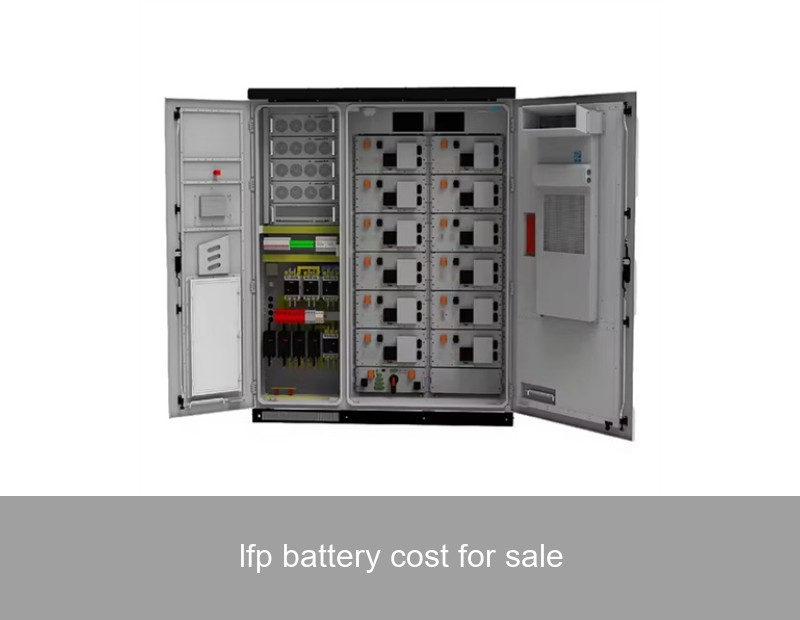
Image: Modular LFP battery systems, like Highjoule's Ensemble series, allow for scalable and serviceable installations. (Source: Unsplash, representative image)
Market Trends: What's Driving LFP Battery Cost for Sale in 2024?
The landscape is dynamic. After a period of supply chain-driven price volatility, we're entering a phase of stabilization and strategic growth. Key trends influencing LFP battery cost for sale include:
- Geopolitical Reshoring & Incentives: Policies like the U.S. Inflation Reduction Act (IRA) and European Net-Zero Industry Act are creating powerful incentives for local battery manufacturing and storage deployment. This can affect final project economics through tax credits, making high-quality systems even more accessible.
- Commodity Price Normalization: Lithium carbonate prices have corrected significantly from their 2022 peaks[2], easing pressure on cell costs. The LFP supply chain is also becoming more diversified and resilient.
- Technology Maturation: Innovations in cell-to-pack (CTP) designs are increasing energy density and reducing redundant parts, further optimizing system-level costs. Highjoule's R&D focuses on such pack-level innovations to deliver more compact and powerful units.
Real-World Impact: A California Microgrid Case Study
Let's move beyond theory to a concrete example. A medium-sized winery in Sonoma County, California, faced frequent public safety power shutoffs (PSPS) threatening its refrigeration and operations. Their goals were resilience, energy cost savings, and sustainability.
The Solution: A 250 kWh / 500 kW DC-coupled solar + storage microgrid centered on a Highjoule EnsembleTM C&I LFP battery system.
The Data & Outcomes (Over 24 Months):
- Upfront Investment: The total installed LFP battery cost for sale was competitive with NMC alternatives at the time, but the lifetime projection was superior.
- Resilience: The system provided over 15 uninterrupted backup events, including one 48-hour outage, keeping critical loads online with zero loss of product.
- Financial Return: Through solar self-consumption optimization and demand charge management, the system achieved a simple payback period of under 7 years. Given the system's 15+ year design life, the following years represent nearly pure savings.
- Cycle Performance: After 24 months and approximately 700 equivalent full cycles, the Highjoule system's capacity fade was measured at less than 2%, validating the long-life LCOS advantage.
This case illustrates that the true measure of cost is performance over time. The winery didn't just buy a battery; they invested in operational insurance and a predictable energy budget.
The Highjoule Approach: Engineering Value Beyond the Cell
At Highjoule, with nearly two decades of experience, we view the LFP battery cost for sale as the entry point to a long-term partnership. Our engineering philosophy ensures every system delivers on its promise:
- Intelligent System Design: Our products, like the EnsembleTM for Home and EnsembleTM for Business, are not just battery racks. They are integrated power platforms with built-in grid-forming capabilities, allowing them to form stable microgrids and provide backup power seamlessly.
- Proactive Health Management: Our cloud-based Highjoule NexusTM platform provides real-time analytics and predictive diagnostics, flagging potential issues before they impact performance, thereby protecting your investment.
- Application-Specific Tuning: Whether for peak shaving in a German factory, solar time-shift for a Spanish community, or full backup for a Texas data center, we optimize the battery's operational parameters to maximize financial return and cycle life for that specific use case.

Image: Residential energy storage systems are becoming a common sight, with LFP technology leading in safety for home integration. (Source: Unsplash, representative image)
Making the Right Decision for Your Project
So, when you're comparing quotes and evaluating LFP battery cost for sale, what questions should you ask?
- What is the warranted cycle life and throughput (total MWh delivered) over the guarantee period?
- How sophisticated is the Battery Management System? Does it offer cell-level monitoring and active balancing?
- Is the system designed for my specific use case (backup, arbitrage, demand charge reduction)?
- What is the expected round-trip efficiency and degradation rate after 10 years?
- How does the provider's software enable me to monitor, control, and optimize my system's value over time?
Choosing an LFP system is a decision for the next two decades. The lowest upfront cost may not represent the lowest lifetime cost or the highest reliability.
Ready to See the Numbers for Your Specific Scenario?
Understanding the nuanced LFP battery cost for sale is the first step. The next is translating that into a clear financial and operational model for your home or business. What specific energy challenge—be it rising utility bills, grid instability, or a sustainability target—is driving you to explore storage today, and how can we help you model the perfect solution?
 Inquiry
 Online Chat