


Understanding the Lithium Big Battery Price: Trends, Drivers, and Smart Investments
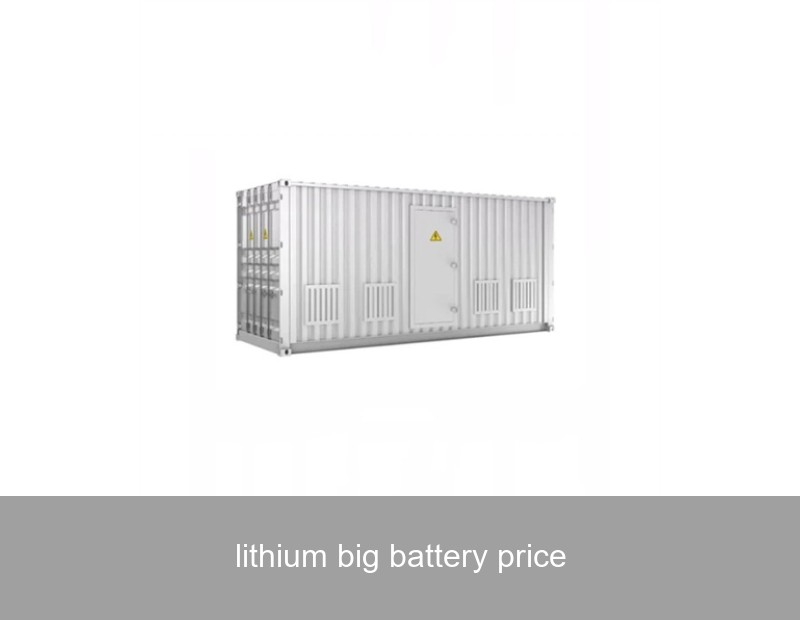
If you're looking into energy storage, you've likely encountered the term "lithium big battery" and the ever-present question about its price. It's not just a number on a quote; it's a dynamic figure shaped by global markets, technological leaps, and the urgent need for grid stability. For businesses and communities in Europe and the US, understanding the factors behind the lithium big battery price is key to making a sound, future-proof investment in energy independence. This article will demystify the cost, explore the real value beyond the sticker price, and show how leading providers like Highjoule deliver solutions where the long-term benefits truly outweigh the initial investment.
Table of Contents
The Price Plunge Phenomenon
Let's start with the good news. Over the past decade, the global average price of lithium-ion battery packs has fallen dramatically. According to BloombergNEF, prices dropped from over $1,200 per kilowatt-hour (kWh) in 2010 to around $139/kWh in 2023[1]. This decline, driven by economies of scale, improved manufacturing, and chemical innovations, has been a primary catalyst for the energy storage boom. But when we talk about a "lithium big battery"—meaning large-scale Battery Energy Storage Systems (BESS) for commercial, industrial, or grid use—the price conversation becomes more nuanced. The per-kWh cell cost is just one piece of the puzzle.

Image source: Unsplash. Large-scale battery storage systems involve more than just battery cells.
Breaking Down the Big Battery Cost
So, what are you actually paying for? A grid-scale or large commercial lithium battery system's total installed cost includes several critical components:
- Battery Cells & Modules (30-40%): The core lithium-ion cells. Prices fluctuate with raw material costs (lithium, cobalt, nickel).
- Battery Management System (BMS) & Power Conversion System (PCS) (20-25%): The "brain" and "heart" of the system. The BMS ensures safety and longevity, while the inverter (PCS) converts power between AC and DC. Quality here is non-negotiable.
- System Integration, Engineering, and Safety (20-30%): This includes enclosure, thermal management (cooling/heating), fire suppression, electrical integration, and comprehensive engineering. This is where expertise drastically impacts performance and safety.
- Software, Controls, and Grid Interconnection (10-20%): Intelligent software to optimize charging/discharging for revenue or savings, plus the cost of physical interconnection to the local grid.
Therefore, focusing solely on the per-kWh cell price can be misleading. A cheaper system with inferior integration or software may cost far more over its lifetime due to inefficiencies, shorter lifespan, or safety risks.
The True Metric: Levelized Cost of Storage (LCOS)
Forward-thinking buyers now evaluate the Levelized Cost of Storage (LCOS). LCOS accounts for the total cost over the system's life—including capital expenditure, operation & maintenance, efficiency losses, and degradation—divided by the total energy discharged. It's the ultimate measure of value. A system with a higher upfront lithium big battery price but superior efficiency, longer cycle life, and smarter software can have a significantly lower LCOS, offering a much better return on investment.
Case Study: Beyond the Sticker Price - A UK Industrial Plant
Consider a real-world scenario from the UK. A manufacturing plant with a 2 MW solar array was facing high peak demand charges and wanted to increase its self-consumption of solar power. They evaluated two storage proposals: a low-cost, basic BESS and a higher-priced, intelligent system from Highjoule.
| Factor | Basic BESS | Highjoule Intelligent BESS |
|---|---|---|
| Upfront Price | £580,000 | £650,000 |
| Guaranteed Cycle Life | 6,000 cycles | 10,000 cycles |
| Round-Trip Efficiency | 86% | 92% |
| AI-Powered Software | Basic scheduling | Dynamic optimization for demand charges, wholesale arbitrage, and frequency response |
| Projected Annual Savings/Revenue | ~£85,000 | ~£125,000 |
| Estimated LCOS (over 15 years) | £0.12/kWh | £0.08/kWh |
The plant chose Highjoule. Why? The higher initial lithium big battery price was offset within 3 years. Over the system's lifetime, the intelligent system is projected to deliver over £600,000 more in net value. The advanced battery chemistry and thermal management also ensure performance is maintained through cold British winters, a critical factor often overlooked in simple price comparisons.
Highjoule's Approach: Value Engineering for Optimal LCOS
Since 2005, Highjoule has focused on engineering systems that minimize the Levelized Cost of Storage for our clients. We don't just sell batteries; we deliver integrated, intelligent power solutions. Our Helios-IQ Commercial & Industrial (C&I) Series exemplifies this philosophy.
For a business concerned with the lithium big battery price, the Helios-IQ offers:
- Long-Duration, Degradation-Resistant Cells: We use lithium iron phosphate (LFP) chemistry for longer life, enhanced safety, and stability, reducing long-term replacement costs.
- Unified Power Conversion & Management: Our proprietary integration of the PCS and BMS reduces energy losses, boosting round-trip efficiency to over 92%.
- Athena GridOS Software Platform: This is where the real magic happens. Athena uses AI to constantly analyze energy prices, weather, consumption patterns, and grid signals. It automatically optimizes the battery's operation to maximize financial return—whether through demand charge reduction, solar self-consumption, or participating in grid service markets.

Image source: Unsplash. Intelligent software platforms are crucial for maximizing battery value.
For utility-scale and microgrid projects, our Titan Grid-Scale Platform takes this further with containerized, plug-and-play solutions that reduce balance-of-system costs and accelerate deployment, directly addressing the capital expenditure side of the price equation.
Future Trends: What's Next for Prices?
The trajectory is complex. Short-term volatility in lithium carbonate prices, as noted by the U.S. Geological Survey[2], can pressure cell costs. However, countervailing forces are strong:
- Innovation in Chemistries: Sodium-ion and other next-gen batteries may diversify supply and reduce pressure on lithium.
- Manufacturing Scale: Gigafactories in Europe and the US, spurred by policies like the U.S. Inflation Reduction Act, will increase local supply and potentially reduce logistics costs.
- System-Level Innovation: As seen with Highjoule's integrated designs, continued efficiency gains in power electronics and software will keep driving down the LCOS, even if cell prices plateau.
The future isn't just about the cheapest cell; it's about the most cost-effective, reliable, and intelligent system.
Making Your Investment Decision
Navigating the lithium big battery price landscape requires a shift in perspective. The critical question evolves from "What is the cost per kWh?" to "What is the value per kWh over the entire system lifetime?"
When you request a quote, demand transparency on the components that affect LCOS: guaranteed cycle life, round-trip efficiency, software capabilities, and the track record of the integrator. A partnership with an expert like Highjoule ensures you're not buying a commodity battery but a tailored financial and operational asset designed to meet your specific energy resilience and savings goals.
Ready to see how the true value of a lithium big battery stacks up for your facility?
What specific energy challenge—peak demand charges, renewable integration, backup power, or grid service revenue—would you like a custom LCOS analysis for? Contact our solutions team today for a detailed assessment that goes beyond the price tag.
 Inquiry
 Online Chat