


Power to Battery: How Much Does It Really Cost to Unlock Energy Independence?
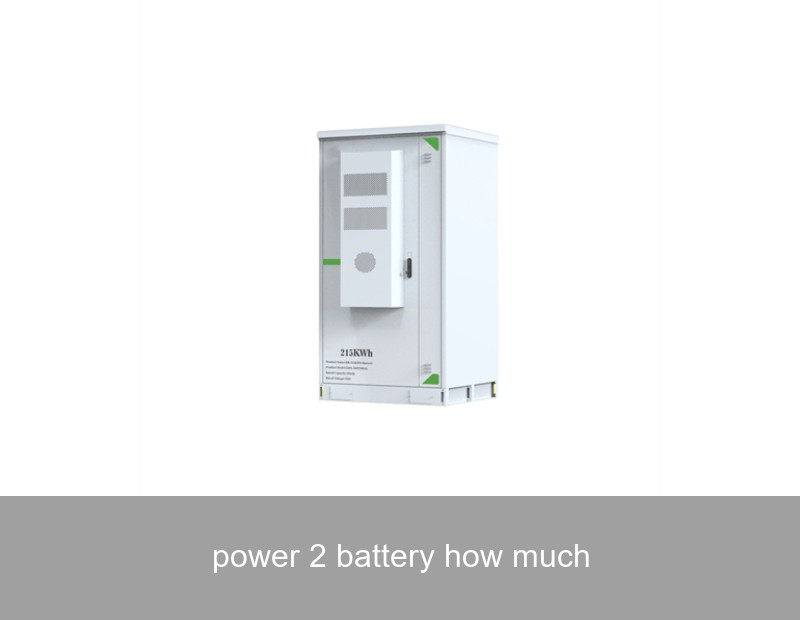
If you're a homeowner or business manager looking at your rising electricity bill or worrying about grid instability, you've likely heard the term "power to battery." It sounds like the future—capturing solar or grid power and storing it for when you need it most. But the immediate question that comes to mind is practical: "Power to battery, how much?" The answer isn't a single number, but rather an equation involving your energy goals, local incentives, and the smart technology you choose. At Highjoule, a global leader in advanced energy storage since 2005, we believe understanding this cost is the first step toward a smarter, more resilient, and sustainable energy setup for your home or business.
The "Power to Battery" Phenomenon: More Than Just a Backup
Let's break down the phenomenon. "Power to battery" (or P2B) refers to systems that convert electrical energy into stored chemical energy in a battery, for later use. This isn't just about emergency backup anymore. Driven by volatile energy prices and a global push for decarbonization, the market for battery energy storage systems (BESS) is exploding. In the U.S. alone, the Energy Information Administration (EIA) projects battery storage capacity to nearly double in 2024. This surge is a clear data point: the value is shifting from simply consuming power to actively managing it.

Image source: Unsplash. A modern home energy system integrating solar and storage.
How Much Does a Power-to-Battery System Cost? A Detailed Breakdown
So, let's tackle the core question. The total cost hinges on three main components: the battery itself, the critical balance of system (BOS), and installation.
1. The Battery: Capacity and Chemistry
Cost is typically quoted per kilowatt-hour (kWh) of storage capacity. As of 2024:
- Lithium-ion Phosphate (LFP): The dominant choice for residential and commercial storage due to safety, longevity, and performance. Prices range from $400 to $800 per kWh of installed capacity, depending on brand and specifications.
- System Size: A typical home might need a 10-20 kWh system for meaningful backup and self-consumption, putting the battery cost segment between $4,000 and $16,000.
2. Balance of System (BOS) & Installation
This is where many initial estimates fall short. BOS includes the inverter, battery management system, safety equipment, and wiring. Installation involves labor, permitting, and electrical work. Combined, BOS and installation can add $2,000 to $5,000 or more to the total system cost. An integrated, pre-engineered solution can streamline this significantly.
Total Installed Cost: A Realistic Range
| System Scale | Typical Capacity | Estimated Total Installed Cost Range (2024) | Primary Use Case |
|---|---|---|---|
| Residential | 10 - 20 kWh | $8,000 - $25,000 | Backup power, solar self-consumption, time-of-use bill management |
| Commercial & Industrial (C&I) | 50 - 500 kWh | $25,000 - $200,000+ | Demand charge reduction, backup for critical operations, renewable integration |
| Microgrid / Small Utility | 1 MWh+ | $400,000+ | Grid services, community resilience, renewable firming |
Crucial Insight: The sticker price is only half the story. The real metric is Levelized Cost of Storage (LCOS)—the total cost of owning and operating the system per kWh discharged over its lifetime. A higher-quality, longer-lasting battery with superior software (like Highjoule's) often has a lower LCOS, offering better value over 15+ years.
Real-World Impact: A Case Study from California
Let's move from theory to tangible results. Consider a mid-sized winery in Napa Valley, California. Their challenges were peak demand charges from refrigeration and irrigation, coupled with concerns over public safety power shutoffs (PSPS).
- Solution: They installed a 250 kWh Highjoule IntelliBESS C&I system, integrated with their existing solar PV.
- Financial Data: The system cost approximately $140,000. However, leveraging California's Self-Generation Incentive Program (SGIP), they received a rebate of ~$35,000, reducing the net capital outlay.
- Results (First Year):
- Demand Charge Reduction: 40% savings, translating to over $18,000 annually.
- Backup Power: Provided 12 hours of critical load coverage during a PSPS event, preventing spoilage.
- ROI Timeline: The net project cost is projected to be paid back in under 6 years through direct savings alone.
This case clearly shows that asking "power to battery how much?" must be followed by "how much can it save and protect?"
Highjoule's Tailored Solutions: Making Power-to-Battery Work for You
At Highjoule, we move beyond one-size-fits-all pricing. Our expertise across residential, commercial, industrial, and microgrid applications allows us to design systems that optimize both cost and value.

Image source: Unsplash. A large-scale containerized BESS for commercial/industrial use.
- For Homes (Highjoule HomePower Series): Our scalable LFP systems feature integrated energy management software. This isn't just a battery; it's a hub that intelligently decides when to store solar energy, charge from the grid during off-peak rates, and power your home during outages, maximizing your financial return.
- For Businesses & Industry (IntelliBESS Series): These modular, high-power systems are designed to tackle demand charges and provide seamless backup. Our AI-powered Energy Platform forecasts energy usage and automatically dispatches storage to shave peak loads, delivering a clear, fast ROI.
- Comprehensive Services: From initial site assessment and financial modeling to installation, grid interconnection support, and 24/7 monitoring, Highjoule provides a single point of responsibility. We help you navigate local incentives in Europe and the U.S., which can dramatically affect the final "how much."
Beyond Price: Key Considerations for Your Investment
When evaluating quotes, drill deeper into these specs that affect long-term value:
- Cycle Life & Warranty: A battery rated for 6,000 cycles at 90% depth-of-discharge will outlast one rated for 3,000 cycles, offering more usable energy over time.
- Round-Trip Efficiency (RTE): Highjoule systems achieve over 95% RTE. This means for every 100 kWh you put in, you get >95 kWh out. A lower RTE (e.g., 85%) silently erodes your savings.
- Software & Grid Services: Can the system participate in virtual power plants (VPPs) or grid response programs? This can create new revenue streams, further offsetting cost.
The Future of Power-to-Battery: An Intelligent Grid Partner
The conversation is evolving from pure cost to value creation. With advancements in solid-state batteries and AI-driven energy trading, future P2B systems will act as autonomous grid assets. Highjoule is at the forefront, developing solutions that don't just store power but actively participate in energy markets, turning a capital expense into a strategic, revenue-generating asset for our clients.
So, what's the next step for you? Is your primary goal to eliminate demand charges at your facility, ensure resilience against increasing grid outages, or finally maximize the return from your rooftop solar? Defining this will shape the optimal system size and technology, giving you a clear answer to "power to battery, how much for my specific needs?"
 Inquiry
 Online Chat