


What Can a 100 kWh Lithium Ion Battery Really Do for Your Business or Home?
You've likely heard the buzz about battery storage. But when we talk about a lithium ion battery 100 kWh system, we're moving beyond a simple backup. This is a powerful energy asset, a workhorse capable of transforming how you consume, manage, and even profit from electricity. Whether you're a business owner facing volatile energy prices or a homeowner with solar panels, understanding the real-world potential of a 100 kWh battery bank is the first step toward energy independence. Let's demystify this technology and explore its tangible impact.
Table of Contents
- The Energy Shift: More Than Just Backup Power
- By the Numbers: The Capacity of a 100 kWh Battery
- Key Applications: Where a 100 kWh Lithium Ion Battery Shines
- Case Study: A California Winery's Strategic Power Move
- Inside the Box: The Tech That Makes It Reliable
- Highjoule's Approach: Intelligent Storage Solutions
- What to Consider Before Investing
The Energy Shift: More Than Just Backup Power
Gone are the days when batteries were seen only as emergency fallbacks for a few lights. The modern lithium ion battery 100 kWh system represents a fundamental shift toward proactive energy management. The phenomenon is clear: electricity grids are under strain, renewable energy sources like solar are intermittent, and energy costs are increasingly unpredictable. A 100 kWh battery sits at the sweet spot—large enough to make a significant financial and operational dent for small-to-medium businesses, commercial properties, large residences, and microgrids, yet increasingly accessible and scalable.
By the Numbers: The Capacity of a 100 kWh Battery
Let's make "100 kilowatt-hours" tangible. It's a unit of energy, not power. Think of it as the fuel tank, not the engine. Here’s what that capacity can translate to in practical terms:
| Scenario | Approximate Runtime/Impact |
|---|---|
| Power a typical US home (excluding major heating/cooling) | 1-3 days |
| Run a small retail store (lights, registers, HVAC) | 6-12 hours |
| Offset peak demand charges for a medium workshop | Can shave 50-100 kW of peak demand |
| Store excess solar from a 50-80 kW rooftop array | Store 2-4 hours of full production |
| Power a critical server farm or refrigeration unit | Provides extended ride-through during outages |
The key is that this energy can be deployed strategically, not just consumed. It can be discharged rapidly to meet a short-term power spike (saving thousands in demand charges) or slowly over a long outage.

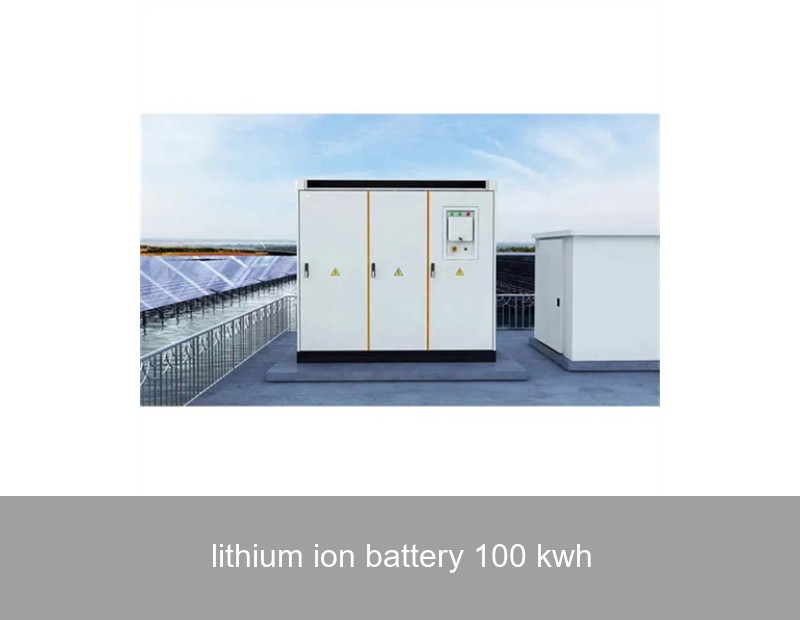
Image Source: Unsplash - A modern commercial battery energy storage system.
Key Applications: Where a 100 kWh Lithium Ion Battery Shines
So, what specific problems does it solve? Here are the primary use cases:
- Commercial & Industrial (C&I) Demand Charge Management: This is the #1 financial driver. Utility bills often have a "demand charge" based on your highest 15-minute power draw each month. A 100 kWh lithium ion battery can discharge during those short peak periods, flattening your demand curve and slashing that portion of your bill by 20-40%.
- Solar Self-Consumption & Time-of-Use Arbitrage: For sites with solar, the battery stores excess daytime generation for use at night. In regions with time-of-use rates, you can charge the battery when grid power is cheap (e.g., overnight) and use it when rates are high (e.g., evening peak), buying low and using high.
- Backup Power & Resilience: Provides a seamless, automatic transition to backup power during grid outages, keeping essential operations running. Far superior to noisy, polluting diesel generators for short-to-medium duration outages.
- Microgrid & Grid Services: Aggregated, these batteries can form virtual power plants, providing stability services to the local grid. This is an emerging revenue stream for asset owners.
Case Study: A California Winery's Strategic Power Move
Let's look at a real-world example. A mid-sized winery in Sonoma County, California, faced three challenges: high afternoon peak demand charges, unreliable grid power during fire-prevention shutoffs, and a desire to maximize their existing 200 kW solar array.
The Solution: They installed a 108 kWh lithium-ion battery system coupled with a sophisticated energy management system. The system was programmed with two primary goals: 1) Discharge aggressively during the 4-9 pm peak window to shave demand, and 2) Maintain a 40% reserve for critical backup power for fermentation tanks and cold storage.
The Data-Driven Results (First Year):
- Demand Charge Reduction: Peak demand reduced by an average of 65 kW, leading to annual savings of over $18,000 on the electricity bill.
- Solar Utilization: Increased on-site consumption of solar power from 55% to over 85%, reducing grid purchases.
- Reliability: Successfully rode through three planned public safety power shutoffs (PSPS), keeping critical operations online without interruption.
This case illustrates that a lithium ion battery 100 kWh system isn't an expense; it's a strategic investment with a clear, quantifiable return and risk mitigation benefits. For more on how C&I sectors are leveraging storage, see this report from the National Renewable Energy Laboratory (NREL).
Inside the Box: The Tech That Makes It Reliable
Not all 100 kWh systems are created equal. The core is the lithium-ion cell, but the surrounding technology—the Battery Management System (BMS), thermal management, and power conversion system (inverter)—is what defines safety, longevity, and performance.
- Battery Chemistry: Most commercial systems use Lithium Iron Phosphate (LFP). It's a chemistry we at Highjoule heavily favor for its superior safety profile (excellent thermal and chemical stability), long cycle life (often 6,000+ cycles), and lack of cobalt. It's ideal for daily cycling applications.
- Intelligent BMS: The brain of the system. A top-tier BMS monitors every cell for voltage, temperature, and state of charge, ensuring balanced operation and preventing conditions that lead to degradation or failure.
- Thermal Management: A liquid-cooled or advanced air-cooled system is crucial. It maintains the cells at their ideal temperature range, maximizing efficiency and lifespan whether it's a scorching summer day or a freezing winter night.

Image Source: Unsplash - Engineer inspecting battery modules.
Highjoule's Approach: Intelligent Storage Solutions
At Highjoule, with nearly two decades of experience since 2005, we've seen the storage market evolve. We don't just sell a 100 kWh lithium ion battery unit; we provide a tailored, intelligent power solution. Our H-Stack Commercial Series is designed around the principles of safety, longevity, and smart integration.
Our systems feature:
- LFP Cell Architecture: Built on inherently safe LFP chemistry for peace of mind.
- Modular Design: Start at 100 kWh and scale capacity as your needs grow, protecting your initial investment.
- Highjoule Energy OS: Our proprietary software platform is the true differentiator. It doesn't just monitor; it optimizes. By analyzing your load patterns, solar production, and utility rate structure, it automatically schedules charge/discharge cycles to maximize your financial return. You can track performance in real-time and participate in grid service programs where available.
- Full-Service Support: From initial site assessment and financial modeling to grid interconnection support and long-term maintenance, we partner with you for the lifecycle of the system.
We believe the hardware must be robust, but the intelligence that controls it is what unlocks its full value. Learn about battery safety standards from a trusted source like UL Solutions.
What to Consider Before Investing
Thinking about a 100 kWh system? Ask these questions:
- What is my primary goal? (Bill savings, backup, sustainability?) This dictates the system design.
- What is my utility rate structure? High demand charges or large time-of-use differentials create the best economics.
- Do I have solar, or plan to add it? The synergy between solar and storage amplifies benefits.
- What is my site's electrical infrastructure? An assessment is needed to ensure compatibility.
- What are the available incentives? In the US, the Investment Tax Credit (ITC) now applies to standalone storage, significantly improving ROI. Similar schemes exist in parts of Europe.
Ultimately, the most successful projects are those where the technology is matched with a clear strategy. Is your business or property ready to move from being a passive consumer to an active manager of its energy destiny? What would the ability to control and predict your largest operational cost之一 do for your bottom line and peace of mind?
 Inquiry
 Online Chat