


Lithium Ion Battery Storage Containers: The Plug-and-Play Powerhouse Revolutionizing Energy
Imagine having a power plant that you can deliver anywhere, activate in days, and scale on demand. That’s no longer a futuristic concept—it’s today’s reality thanks to lithium ion battery storage containers. These self-contained units are transforming how businesses, communities, and grid operators manage electricity, offering a blend of resilience, sustainability, and economic sense that was hard to achieve just a decade ago. At their core, these containers are more than just batteries in a box; they are sophisticated, pre-engineered energy systems designed for immediate impact. For over 18 years, Highjoule has been at the forefront of this evolution, pioneering intelligent and sustainable power solutions that empower our clients across commercial, industrial, residential, and microgrid applications.
The Growing Demand for Energy Resilience
Let's face it: our energy landscape is becoming more volatile. From extreme weather events causing prolonged outages in California and Europe to fluctuating energy prices impacting business bottom lines, the need for reliable, on-demand power has skyrocketed. The traditional response—building new power plants or transmission lines—is often too slow and capital-intensive. This is where the phenomenon of deployable energy storage steps in. Lithium ion battery storage containers offer a compelling alternative, acting as a "shock absorber" for the grid and a "lifeboat" for critical operations.
The data speaks volumes. According to the U.S. Energy Information Administration (EIA), the United States is projected to add a significant 14.3 GW of battery storage capacity in 2024, a large portion of which will be utility-scale systems often deployed in containerized formats. In Europe, driven by ambitious REPowerEU plans and a push for energy independence, the market for large-scale energy storage is experiencing similar explosive growth. This isn't just about backup power; it's about creating a more flexible, efficient, and renewable-powered grid.

Image Source: Unsplash - Representative image of containerized energy storage.
Key Benefits and Applications: Why Go Containerized?
So, what makes lithium ion battery storage containers so uniquely advantageous? Their value proposition lies in their integrated, turnkey design.
- Rapid Deployment & Scalability: These are pre-assembled and tested in a controlled factory environment. Once on-site, they can be connected and commissioned in weeks, not years. Need more capacity? Simply add another container.
- Enhanced Safety & Reliability: A high-quality container is a fortress. It houses not just the battery racks, but also integrated thermal management (cooling/heating), fire suppression, and sophisticated battery management systems (BMS) that continuously monitor cell health.
- Unmatched Flexibility: They can be stationed next to a factory, a solar farm, a remote community, or a temporary event. This mobility allows energy to be placed exactly where it's needed most.
- Economic Powerhouses: Beyond backup, they perform "energy arbitrage" (storing cheap energy to use/sell when prices are high), provide grid services for revenue, and maximize self-consumption of solar PV.
At Highjoule, we engineer these benefits into every system. Our EnerCore series of containerized BESS (Battery Energy Storage Systems) is a prime example. Built with our proprietary cell-optimizing technology, EnerCore units deliver superior cycle life, efficiency, and safety. Whether it's for a manufacturing plant looking to shave peak demand charges or a wind farm needing to smooth its output, our solutions are tailored to the application.
Common Use Cases for Containerized BESS
| Application | Primary Value Driver | Typical Scale |
|---|---|---|
| Commercial & Industrial (C&I) | Demand charge reduction, backup power, sustainability goals | 500 kW - 5 MW |
| Utility-Scale & Renewable Integration | Grid stabilization, frequency regulation, renewable firming | 10 MW - 100+ MW |
| Microgrids & Remote Power | Energy resilience, diesel displacement, main grid independence | 1 MW - 20 MW |
| Event & Construction Power | Silent, emission-free temporary power, reducing generator use | 250 kW - 2 MW |
Inside a Modern Energy Storage Container: More Than Just Batteries
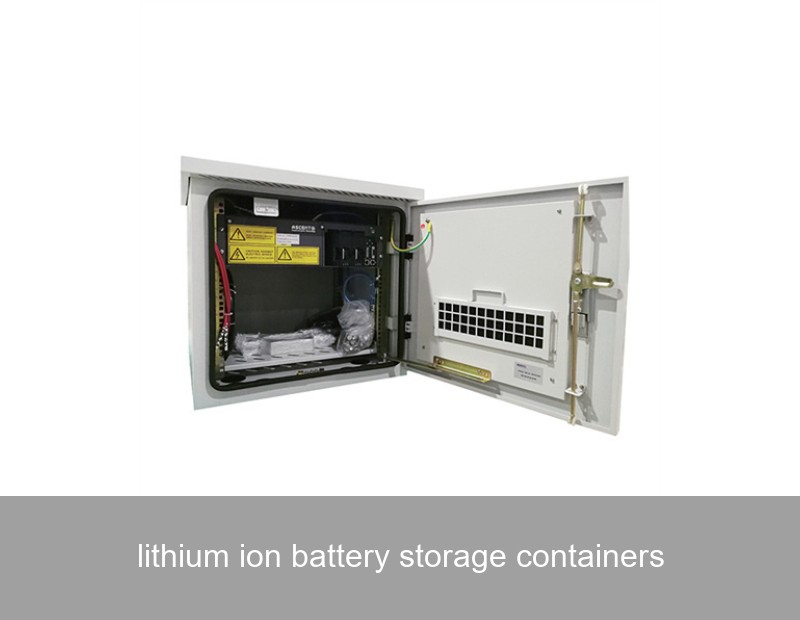
Opening the door to a modern lithium ion battery storage container reveals a marvel of engineering integration. Think of it as a data center for energy. Here’s what you’ll typically find inside a well-designed system like Highjoule's EnerCore:
- Battery Racks: The heart of the system, using premium lithium-ion cells (like LFP for enhanced safety and longevity), organized into modules and racks.
- Power Conversion System (PCS): The brain that converts DC battery power to AC grid power and vice versa. Its efficiency is crucial for overall system performance.
- Thermal Management System: A precision climate control system that maintains the batteries at their ideal operating temperature, ensuring performance and lifespan in all weather conditions.
- Fire Safety System: Multi-layered protection, including continuous gas detection, aerosol or early suppression fast response (ESFR) systems, and physical compartmentalization.
- Energy Management System (EMS): The strategic command center. This software platform controls when to charge, discharge, or hold, optimizing for economics, grid signals, or resilience.
Highjoule’s secret sauce is in the seamless communication between these components. Our integrated EMS and BMS are designed in-house, allowing for granular control and predictive analytics that prevent issues before they arise, a key factor in maximizing return on investment.
A Real-World Case Study: Utility-Scale Storage in Texas
Let’s move from theory to practice with a concrete example from one of the world's most dynamic energy markets: Texas, USA. The ERCOT grid is known for its price volatility and high penetration of wind energy, creating a perfect environment for lithium ion battery storage containers.
The Challenge: A renewable energy developer needed to firm up the output of a 200 MW wind farm and participate in ERCOT’s lucrative ancillary services market to generate additional revenue streams. They needed a solution that could be deployed rapidly to meet regulatory deadlines and capitalise on market opportunities.
The Solution: The developer partnered with Highjoule to deploy a 50 MW / 100 MWh battery storage facility. The project utilized 20 of our custom-configured EnerCore containers. Our team handled everything from system design and grid interconnection support to commissioning and ongoing performance monitoring.
- Deployment Time: The containerized solution cut construction time by approximately 40% compared to a traditional stick-built alternative.
- Financial Performance: In its first year of operation, the system generated revenue through multiple streams: energy arbitrage during price spikes (which, in ERCOT, can exceed $5,000 per MWh) and providing critical frequency regulation services to the grid.
- Grid Support: The facility helps absorb excess wind generation at night and discharges during peak evening hours, effectively "time-shifting" renewable energy and reducing curtailment.
This case exemplifies the triple win: a win for the developer (increased ROI), a win for the grid (enhanced stability), and a win for the environment (more utilized renewables).

Image Source: Unsplash - Representative image of technician servicing energy storage system.
Choosing the Right Solution for Your Needs
With the market expanding, how do you select the right lithium ion battery storage container provider? It goes beyond just comparing price per kWh. Here are critical factors to consider:
- Total System Efficiency: Look for AC-to-AC round-trip efficiency. A few percentage points difference significantly impacts energy yield and revenue over a 15+ year lifespan.
- Technology & Safety Credentials: Prioritize providers using lithium iron phosphate (LFP) chemistry for its thermal stability and long cycle life. Demand transparent safety certifications (UL, IEC).
- Software Intelligence: The EMS is what unlocks value. Can it adapt to changing market rules? Does it offer remote monitoring and predictive maintenance?
- Provider Experience & Support: Do they have a proven track record in your target market and application? What does their long-term service and warranty support look like?
This is where Highjoule’s end-to-end service model shines. We don’t just sell containers; we become your energy partner. From initial feasibility studies and financial modeling to installation, grid compliance, and 24/7 asset management, we ensure your storage project delivers on its promise for the long haul.
The Future of Mobile Energy
The evolution of lithium ion battery storage containers is far from over. We are moving towards even more intelligent, plug-and-play "energy appliances." Imagine containers with built-in, AI-driven EMS that autonomously optimizes for hundreds of market signals, or standardized interconnection interfaces that make adding storage as simple as adding a server rack. The convergence of electric vehicle charging infrastructure, green hydrogen production, and these modular storage blocks will redefine local energy ecosystems.
As you contemplate the resilience and sustainability of your operations, what single energy challenge—be it unpredictable costs, grid dependency, or carbon targets—could a scalable, containerized power solution start solving for you within the next 12 months?
 Inquiry
 Online Chat