


Lithium Solar Batteries in Lebanon: A Resilient Power Solution for a Challenging Grid
If you live or operate a business in Lebanon, you're intimately familiar with the daily reality of power cuts. The national grid's instability isn't just an inconvenience; it disrupts lives, hampers productivity, and increases reliance on expensive, polluting diesel generators. In this challenging landscape, a powerful and sustainable solution is gaining remarkable traction: lithium solar batteries. Combining high-efficiency solar panels with advanced lithium-ion battery storage creates a self-sufficient energy ecosystem, offering Lebanese households and businesses a reliable escape from the cycle of blackouts and fuel shortages.
Table of Contents
The Lebanese Energy Challenge: More Than Just Blackouts
The phenomenon is well-known. According to the World Bank, in 2021, state-provided electricity in Lebanon averaged only a few hours per day, pushing the country to have one of the highest shares of electricity provided by private, often diesel-fueled, generators in the world. This dependency creates a triple burden: exorbitant costs for families and businesses, severe noise and air pollution, and an unpredictable operating environment. For a country blessed with over 300 sunny days a year, the reliance on fossil fuels is particularly ironic. The data is stark—solar potential is abundant, but without storage, it vanishes when the sun sets, precisely when grid power is most likely to fail.
Why Lithium Batteries Are the Game-Changer for Solar in Lebanon
Earlier solar installations often used lead-acid batteries. While functional, they come with significant drawbacks: they are bulky, have a shorter lifespan (3-5 years), require regular maintenance, and offer a lower usable depth of discharge. Enter lithium solar batteries, specifically Lithium Iron Phosphate (LFP) chemistry, which has become the industry standard for renewable energy storage. Here’s why they are uniquely suited for Lebanon's needs:
- Longevity & Resilience: LFP batteries, like those in Highjoule's product line, can last 10-15 years and withstand thousands of charge cycles. They are a long-term investment in stability.
- High Efficiency & Capacity: They can be discharged up to 90% of their capacity without damage, providing more usable energy from a smaller physical footprint—a key advantage for space-constrained urban areas in Beirut or Tripoli.
- Low Maintenance & Smart Management: They are essentially maintenance-free and integrate with smart Battery Management Systems (BMS). This allows for remote monitoring and optimization, ensuring every kilowatt-hour of precious solar energy is used effectively.
- Safety: LFP chemistry is inherently more stable and less prone to thermal runaway than other lithium-ion types, a critical safety consideration for home and business installations.
For a Lebanese homeowner, this means solar power doesn't just work when the sun is shining. It means lights stay on at night, refrigerators keep running during prolonged grid outages, and children can study uninterrupted. For a business, it translates to operational continuity, protected inventory, and significant savings on generator fuel.
Technical Comparison: Battery Types for Solar Storage
| Feature | Lead-Acid | Lithium Iron Phosphate (LFP) |
|---|---|---|
| Typical Lifespan (Cycles) | 500-1,000 | 4,000-6,000+ |
| Usable Depth of Discharge | ~50% | ~90% |
| Maintenance | Regular (water topping) | Minimal to None |
| Efficiency (Round-trip) | 70-80% | 95-98% | Space Requirement | High | Low (Compact) |
A Case Study: Powering a Beirut Hospital Through Crisis
The real-world impact of lithium solar batteries in Lebanon is best illustrated through concrete examples. Consider a private hospital in the Ashrafieh district of Beirut. Facing up to 18 hours daily of grid outage and crippling diesel costs during the peak of the economic crisis, the hospital's administration turned to a hybrid solar-plus-storage solution in late 2022.
The system was designed with resilience as the core principle: a 350 kW rooftop solar array was paired with a 500 kWh lithium-ion battery storage system and intelligent controllers. The results, after one full year of operation, are compelling:
- Energy Independence: The hospital now covers 85% of its daytime load with solar and uses the battery bank to ensure 100% uptime for critical care units (ICUs, operating theaters) 24/7, regardless of grid status.
- Financial Savings: Diesel generator runtime was reduced by over 70%, leading to an annual fuel cost saving of approximately $180,000—a monumental figure given local currency depreciation.
- Emission Reduction: The project displaces an estimated 450 tons of CO2 annually, contributing to cleaner air in the city.
This case underscores a vital insight: in critical infrastructure, solar is only as good as the storage backing it up. The lithium batteries provided the instantaneous, reliable backup power that diesel generators promised but at a fraction of the long-term cost and environmental toll. You can explore more global data on energy storage trends from the U.S. Department of Energy's Energy Storage Hub.

Image Source: Unsplash (Representative image of commercial solar installation)
How Highjoule's Expertise Supports Lebanon's Energy Transition
As a global leader in advanced energy storage since 2005, Highjoule understands that deploying lithium solar batteries in complex environments like Lebanon requires more than just hardware. It demands robust, intelligent, and adaptable systems. Our solutions for the commercial and industrial (C&I) and microgrid sectors are particularly relevant.
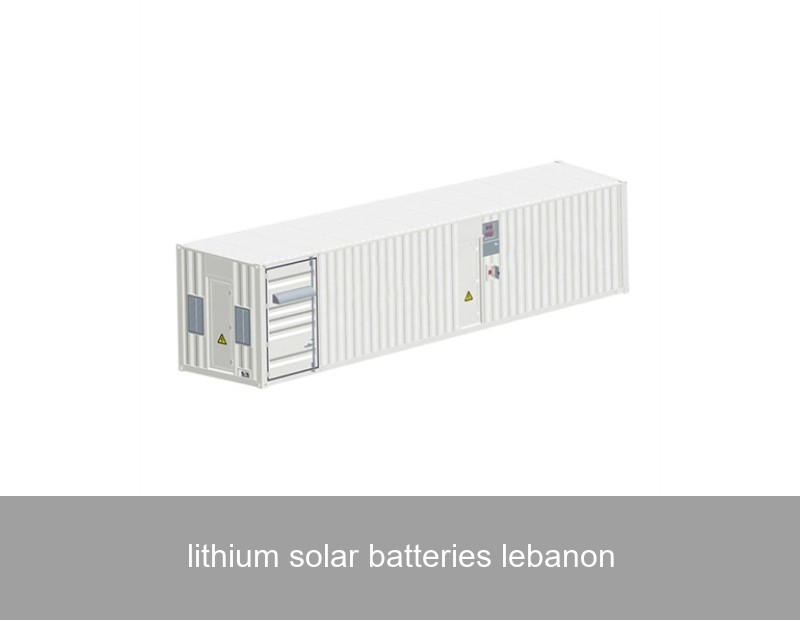
Highjoule's HPS Series containerized battery energy storage systems (BESS) offer a plug-and-play solution for large-scale needs, such as factories, agricultural facilities, or entire residential compounds. These systems integrate seamlessly with existing or new solar arrays and generator sets, creating an optimized hybrid microgrid. Our proprietary energy management software acts as the "brain," dynamically deciding the most economical and reliable power source at any moment—solar, battery, or grid/generator—ensuring maximum savings and uptime.
For residential and smaller commercial applications, our HRS Home Energy Stack provides a modular, scalable lithium battery solution. Lebanese homeowners can start with a base system and expand capacity as needed. All Highjoule systems are built with the highest safety standards and are designed for remote monitoring, a crucial feature for technical support in regions with logistical challenges. Learn more about battery safety standards from an independent source like the UL Solutions Energy Storage Fact Sheet.

Image Source: Unsplash (Representative image of a modern wall-mounted battery system)
The Future Outlook for Solar & Storage in Lebanon
The trajectory is clear. While the initial investment for a solar-plus-lithium-battery system is significant, the total cost of ownership, when measured against a decade of buying diesel at volatile prices, makes it an increasingly rational economic decision. International financing institutions and local green financing initiatives are beginning to recognize this, potentially improving access to capital for such projects.
The evolution is from viewing solar as a supplementary power source to embracing "solar-storage" as the primary, resilient energy backbone. This shift empowers communities, reduces the national burden of fuel imports, and builds climate resilience. For further reading on global solar storage growth, the IEA Renewables 2023 Report provides extensive analysis.
So, what does your energy independence look like?
Is your business calculating the true cost of next year's diesel fuel, or is it designing a system that locks in energy costs for the next 15 years? For a family, is it about enduring the next power cut, or is it about ensuring your home remains a safe, powered sanctuary regardless of what happens to the national grid? The technology for resilience, embodied by modern lithium solar batteries, is not a future dream—it is a present-day solution being deployed across Lebanon. The question is no longer if it works, but when you decide to make it work for you.
 Inquiry
 Online Chat