


Low Power Consumption ESS: The Smart Key to Sustainable Energy Independence
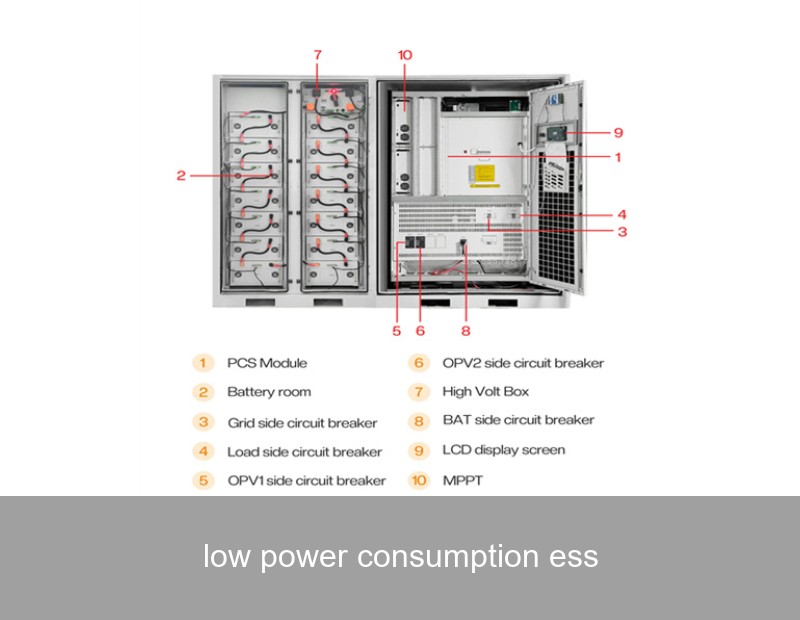
You've made the smart decision to invest in solar panels or a battery storage system. But have you ever stopped to consider how much energy the storage system itself uses? It might seem like a small detail, but in the world of energy efficiency, every watt counts. This is where the concept of a low power consumption ESS (Energy Storage System) becomes crucial. It's not just about storing energy; it's about doing so intelligently, ensuring that the system guarding your power doesn't become a silent drain on it. For homeowners and businesses across Europe and the U.S., understanding this is the next step in truly maximizing their renewable investment and achieving greater energy autonomy.
Table of Contents
- The Silent Drain: Why Your ESS's Own Appetite Matters
- Decoding the Numbers: What Does "Low Power Consumption" Really Mean?
- The Highjoule Advantage: Engineering Efficiency from the Ground Up
- A Real-World Case: The German Bakery's Recipe for Savings
- Beyond the Battery: System-Level Intelligence for Peak Performance
- Choosing Your Low Consumption ESS: Key Questions to Ask
The Silent Drain: Why Your ESS's Own Appetite Matters
Think of an ESS as the heart of your personal energy ecosystem. Even when it's not actively charging or discharging—say, at night when your solar panels are offline—it needs to stay "alive." Its brain (the battery management system, or BMS), its sensors, and its communication modules all require a constant trickle of power. This is known as standby or idle consumption.
Now, picture an older or poorly designed system that consumes 50-100 watts continuously. Over a 24-hour period, that's 1.2 to 2.4 kWh of energy gone—energy that could have powered your refrigerator, your lights, or been saved for a rainy day. Over a year, this adds up to a staggering 438 to 876 kWh of lost capacity. In regions with high electricity costs, like Germany or California, that's hundreds of dollars literally evaporating to keep your storage system on standby.

This phenomenon shifts the goalposts. The true efficiency of an ESS isn't just its round-trip efficiency (how much energy you get out vs. put in). It's the system efficiency, which accounts for this parasitic drain. A low power consumption ESS directly translates to higher usable capacity, lower operational costs, and a faster return on your investment.
Decoding the Numbers: What Does "Low Power Consumption" Really Mean?
So, what should you look for? Let's break down the benchmarks.
- High Standby Consumption (Outdated/Entry-Level): 50W - 100W+. These systems often use less efficient, always-on components and simpler thermal management.
- Moderate Standby Consumption (Standard Market): 20W - 50W. This is typical for many systems, representing a baseline but leaving room for improvement.
- True Low Power Consumption (Advanced Systems): Under 20W, and ideally below 10W. Achieving this requires sophisticated hardware design and smart software that puts non-critical functions into deep sleep modes.
To put this in perspective, the U.S. Department of Energy's research into next-generation storage emphasizes reducing "balance-of-system" losses, which include auxiliary power consumption. A system consuming 10W instead of 50W saves 40W continuously. Over 20 years, that's over 7,000 kWh of preserved energy—essentially giving you back months of your system's rated capacity over its lifetime.
The Highjoule Advantage: Engineering Efficiency from the Ground Up
At Highjoule, we've believed since our founding in 2005 that sustainability must be holistic. A greener battery chemistry is only part of the story. Our Helion Series residential and commercial ESS platforms are architected with a core principle: minimize waste at every level.
How do we achieve industry-leading low standby figures, often below 10W? It's a combination of factors:
- Proprietary BMS with Sleep Architecture: Our BMS isn't just monitoring; it's intelligently cycling. When full management isn't needed, non-essential circuits enter ultra-low-power states, waking periodically for health checks.
- High-Efficiency, On-Demand Cooling: Instead of constant fan operation, we use passive cooling designs coupled with software-triggered, variable-speed fans that only activate when strictly necessary.
- Integrated, Loss-Minimized Power Electronics: By designing our inverters and converters in-house alongside the battery, we optimize the entire power pathway, reducing conversion losses and heat generation that require more power to manage.
This isn't just a technical specification; it's a direct benefit to our customers. More of the solar energy you harvest goes towards powering your life or business, not sustaining the storage unit itself.
A Real-World Case: The German Bakery's Recipe for Savings
Let's move from theory to practice. Consider a mid-sized artisanal bakery in Bavaria, Germany. Facing rising energy costs and committed to a green brand image, they installed a 50 kWh solar array with a 40 kWh storage system in 2022. Their initial storage system had a documented idle consumption of around 45W.
The Data:
Annual Standby Loss: 45W * 24h * 365d = ~394 kWh
Cost at German Electricity Price (~€0.35/kWh): €138 per year lost.
Over a projected 15-year system life: ~5,910 kWh lost, costing over €2,000.
In 2023, the bakery upgraded to a Highjoule Helion Commercial ESS with a standby consumption of 9W. The difference was immediate.
The Result:
New Annual Standby Loss: 9W * 24h * 365d = ~79 kWh
Annual Savings on Standby Losses: ~315 kWh, or €110.
This translated to an extra 315 kWh of usable bakery power—enough to run their industrial dough mixer for dozens of hours. The low power consumption ESS directly improved their bottom line and increased their energy self-consumption rate by a measurable 1.5%. For them, efficiency became an ingredient as important as flour.

Beyond the Battery: System-Level Intelligence for Peak Performance
A truly efficient system looks beyond the battery cabinet. Highjoule's Orion AI Energy Manager software takes a whole-system approach. It doesn't just manage battery cycles; it learns your consumption patterns, weather forecasts, and utility rate schedules to make millisecond decisions that compound savings.
For example, on a cloudy day, the system might decide to draw a tiny amount from the grid to maintain its ultra-low standby state rather than deplete the battery for its own needs, preserving stored energy for critical evening loads. This level of predictive, system-wide coordination is what separates a simple battery box from an intelligent low power consumption ESS.
| Factor | Standard ESS | High-Efficiency ESS (e.g., Highjoule Helion) | Impact on User |
|---|---|---|---|
| Standby Power | 30W - 60W | < 10W - 20W | Higher usable capacity, lower operating cost |
| Thermal Management | Constant active cooling | Passive + on-demand active cooling | Reduced noise, less auxiliary energy use |
| System Integration | Multiple vendors, suboptimal interfaces | Unified, in-house design | Fewer conversion losses, enhanced reliability |
| Energy Management Software | Basic charge/discharge logic | AI-driven, whole-home optimization | Automated maximization of self-consumption and savings |
Choosing Your Low Consumption ESS: Key Questions to Ask
As you evaluate storage solutions, empower yourself with these questions for your installer or supplier:
- "What is the system's standby or idle power consumption in watts? Is this measured at the DC or AC side?" (AC-side is the real-world figure).
- "How does the system's design minimize thermal management energy use?"
- "Can the software intelligently schedule operations to further reduce auxiliary consumption based on my habits?"
- "What is the system-level annual efficiency, accounting for all losses, not just the battery's round-trip efficiency?"
For further independent research on storage efficiency metrics, reputable sources like the U.S. DOE Solar Energy Technologies Office or the International Energy Agency (IEA) provide valuable context.
The journey to energy independence is filled with important choices. Selecting a storage system with a keen focus on low operational consumption ensures that the guardian of your power isn't also its prisoner. It’s a choice for long-term value, true sustainability, and maximizing the potential of every sunbeam that hits your roof. What will your first question be when you speak to an energy specialist about your system's hidden appetite?
 Inquiry
 Online Chat